
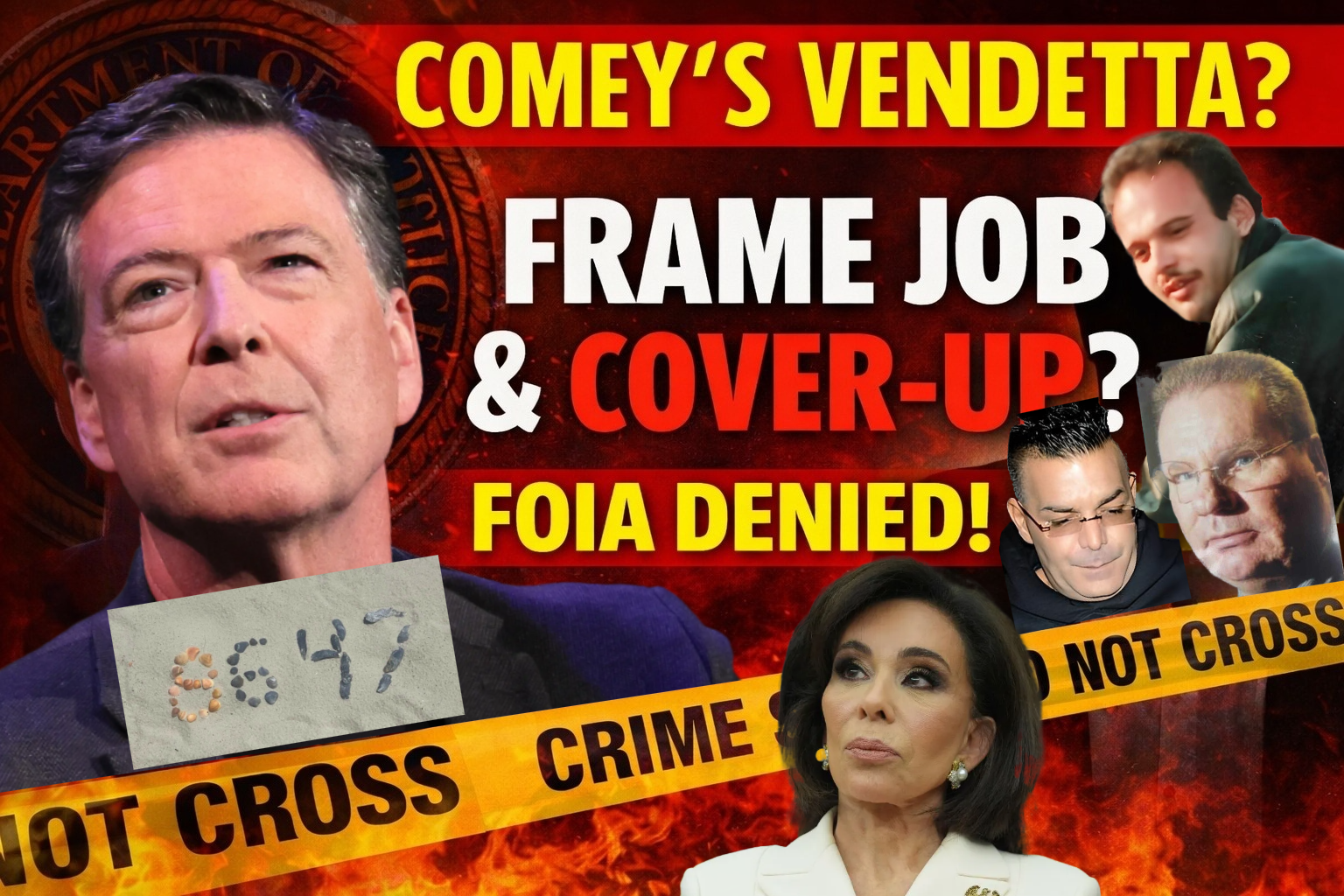
Florida FOIA Lawsuit Rips Former FBI Boss Over Richard Ortiz Murder and “Johnny T” Scandal
LUTHMANN NOTE: This case is about power. Raw, unchecked power. James Comey rose from Yonkers to the top of the FBI. Now the question is whether he carried old grudges with him — and used federal muscle to settle them. The DOJ’s FOIA dodge is the tell. When agencies hide behind process, they’re usually hiding substance. I filed this case to force disclosure. Not spin. Not narrative. Documents. If they exist, they will speak. If they don’t, that speaks louder. Either way, the American people deserve to know whether justice was done — or manufactured. This piece is “Comey Exposed in FOIA Case.”



By Frankie Pressman and Rick LaRivière with Richard Luthmann
(FORT MYERS, FLORIDA) – Did former FBI Director James Comey use federal law enforcement as a personal weapon to settle an old Yonkers, New York, score? That explosive question lies at the heart of a new lawsuit in Florida. Investigative journalist Richard Luthmann has filed a federal Freedom of Information Act (FOIA) suit – Luthmann v. DOJ, Case No. 2:26-cv-666-SPC-DNF – to pry loose records he says will expose Comey’s decades-long vendetta against John “Johnny T” Tortora, a beloved Yonkers pawn shop manager caught up in a dubious murder probe.
The complaint, filed this month in the Middle District of Florida, reads like a true-crime thriller and a legal broadside rolled into one. It paints Comey as the central player in a “wrongful prosecution” of Tortora, accusing the FBI under Comey of pushing a flimsy case “without evidence”, burying exculpatory material, and reviving a cold-case murder to settle personal scores.
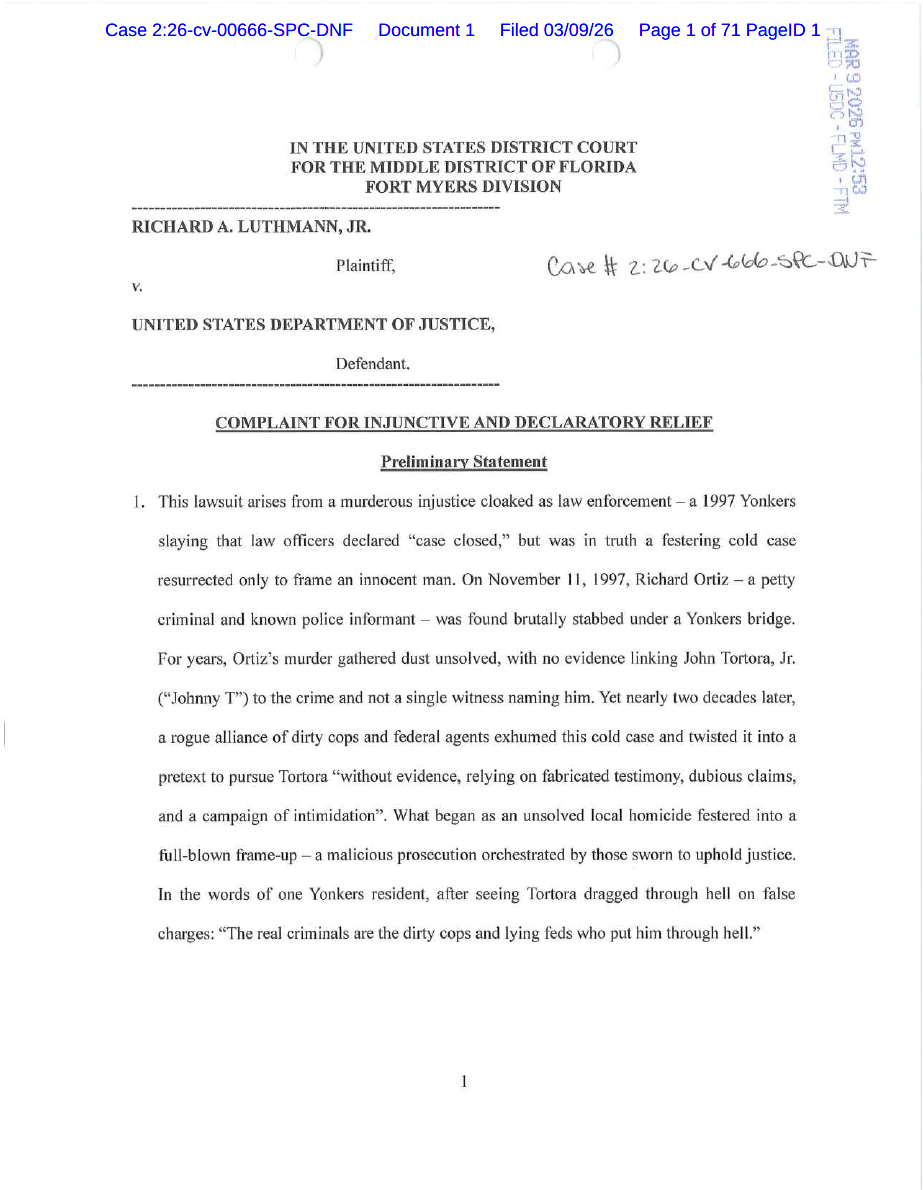
Now Luthmann wants the paper trail, and he’s taking the Department of Justice to court to get it.
A 1997 Yonkers Murder and a Long Shadow
On November 11, 1997, 29-year-old Richard Ortiz was found brutally stabbed to death under a bridge near the Mill Tavern in Yonkers, New York. Ortiz was a small-time criminal and, as it turned out, a police informant who had made enemies in the local underworld.
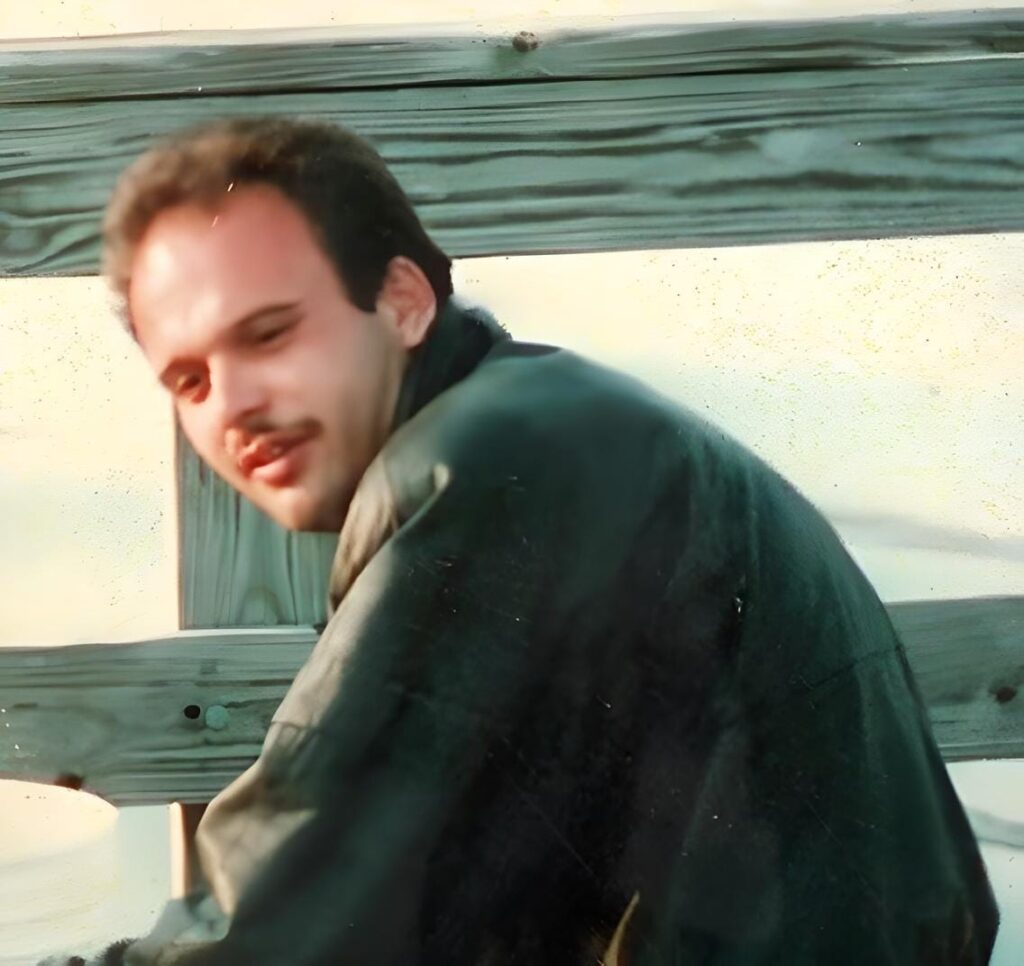
The Yonkers Police Department (YPD) investigated extensively, but no evidence linked John Tortora to the crime at the time. In fact, not a single police report from 1997 through 2015 even mentioned Tortora’s name in connection with Ortiz’s murder. The case went cold for nearly two decades.
One early suspect did emerge: Carmine Francomano Jr., a reputed Lucchese crime family associate who had been present at the tavern the night Ortiz was killed.
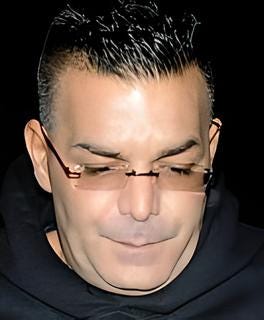
Francomano initially fingered another man, Abdill “Abbey” Saez, as Ortiz’s killer, and Saez was even arrested back in the late ’90s.
According to later court filings, then–Westchester County District Attorney Jeanine Pirro found the case against Saez (and by implication, against anyone else for Ortiz’s murder) “too weak to pursue” – likely because Francomano himself was a suspect and an unreliable one at that.
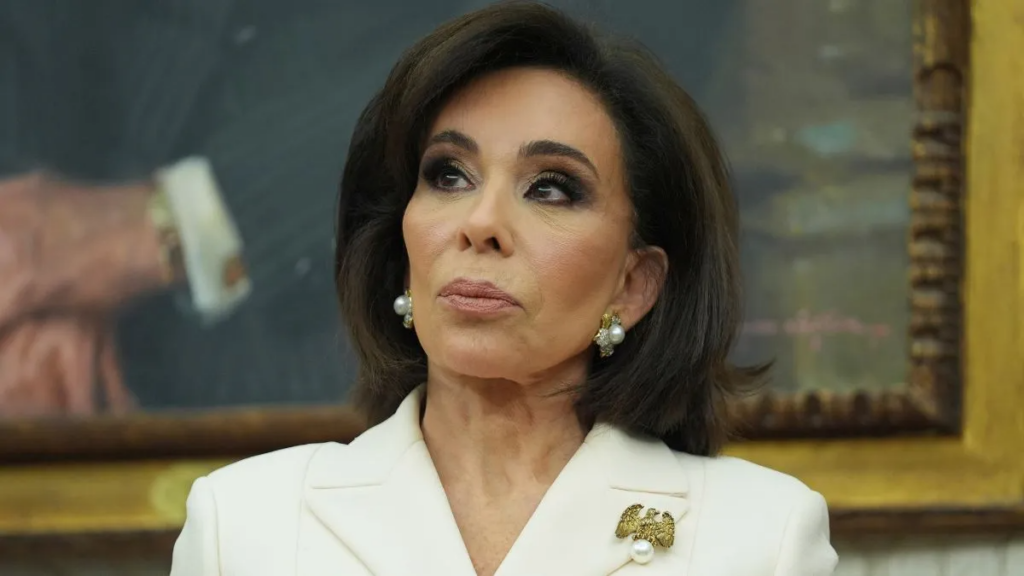
The local authorities had no solid case, and Ortiz’s murder remained unsolved.
That didn’t stop James Comey. Appointed as the U.S. Attorney for the Southern District of New York in 2001 under George W. Bush, Comey had Tortora picked up on a criminal information and jailed in the infamous Manhattan Correctional Center (where Jeffrey Epstein was found hanged).
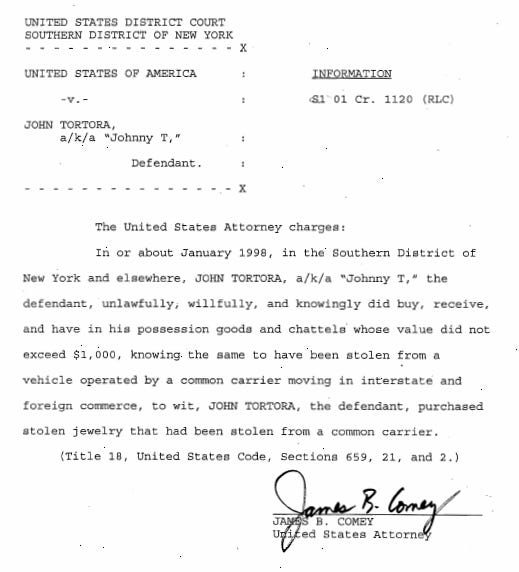
Tortora languished there for months, on a claim of possession of less than $1,000 in stolen goods. Comey was trying to build a vanity project case, pinning the murder of Ortiz on Tortora. The 9-11-01 terrorist attack got in the way, and Tortora was released because there was real work for the Feds to do.
Fast-forward to the mid-2010s. By this time, Comey – a Yonkers native born in 1960 (his father was the Yonkers Police Chief) – was the Director of the FBI. Comey’s tenure at the Bureau saw numerous cold cases and organized crime investigations get renewed attention.
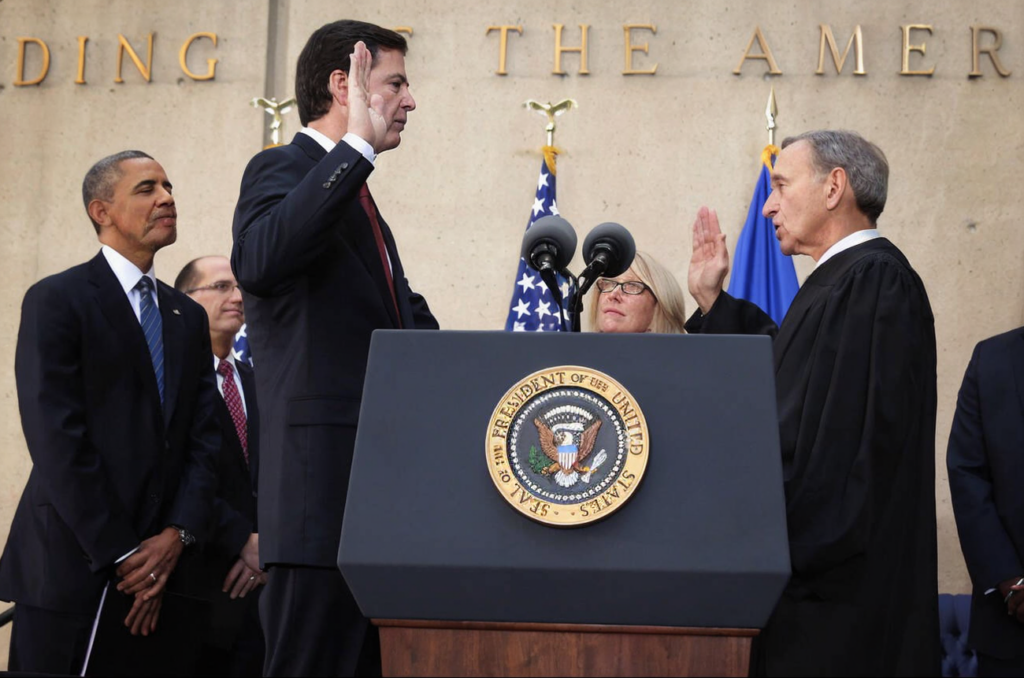
Luthmann’s lawsuit suggests that Comey’s interest in the Ortiz murder was intensely personal. Yonkers was Comey’s hometown, and Ortiz’s slaying had cast a long shadow. Comey, the suit implies, wanted this old murder solved – and may have wanted Tortora to be the fall guy.
Comey Exposed in FOIA Case: Francomano Flips the Script, Feds Pounce on “Johnny T”
The dormant case roared back to life after Carmine Francomano Jr.’s sudden change of tune. Arrested on unrelated charges in 2015, Francomano, for the first time, implicated John “Johnny T” Tortora as the man who ordered Ortiz’s murder. This claim was a 180-degree turn from his original story. Years earlier, Francomano had never once mentioned Tortora – not to Yonkers detectives, not to Westchester prosecutors.
Now, facing pressure, the career informant conveniently “remembered” Tortora’s involvement, in what Luthmann describes as a bid to please federal handlers and “save his own ass.” The Feds ramped up a full-fledged investigation on Tortora.
Francomano’s jailhouse revelation coincided with an eager federal push to finally crack the Ortiz case. Comey’s FBI and the U.S. Attorney’s Office for the Southern District of New York leapt at the opportunity to make headlines by charging Tortora. Geoffrey Berman, the U.S. Attorney in Manhattan, unveiled an indictment in August 2018 accusing John “Johnny T” Tortora of racketeering and murder-for-hire in the Ortiz killing.
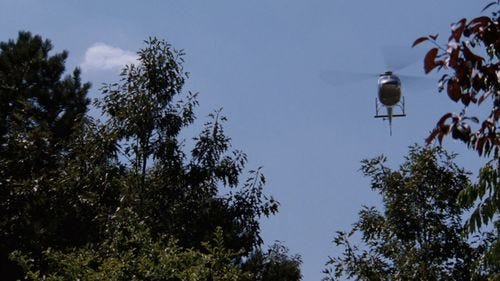
The arrest was treated as a major takedown: Yonkers police and FBI agents swarmed Tortora’s Yonkers business in a dramatic raid with helicopters and heavily armed teams.
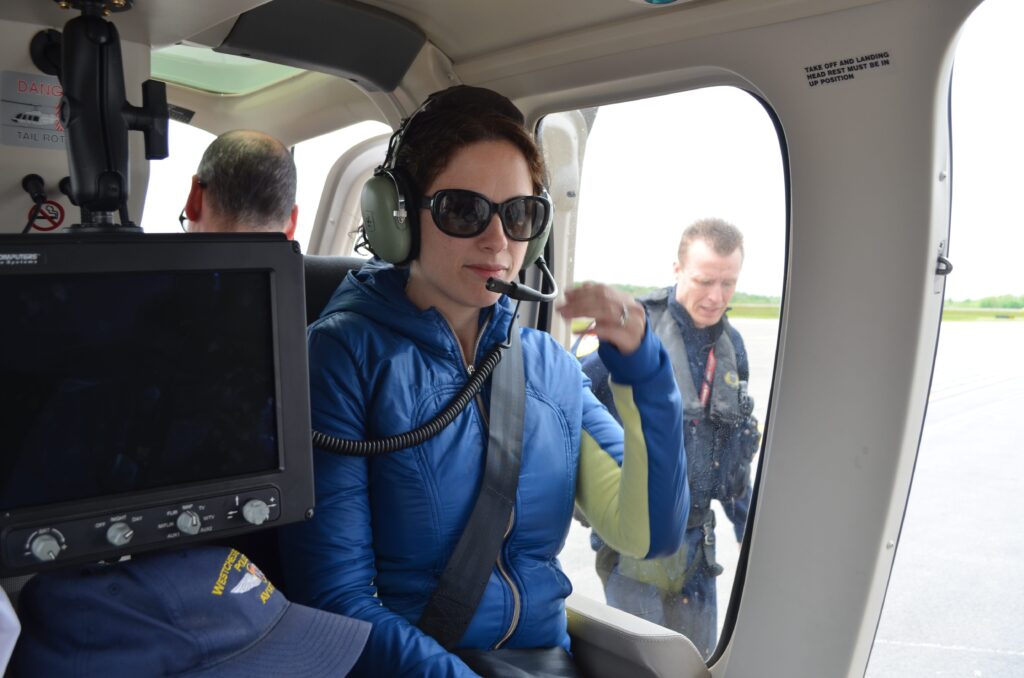





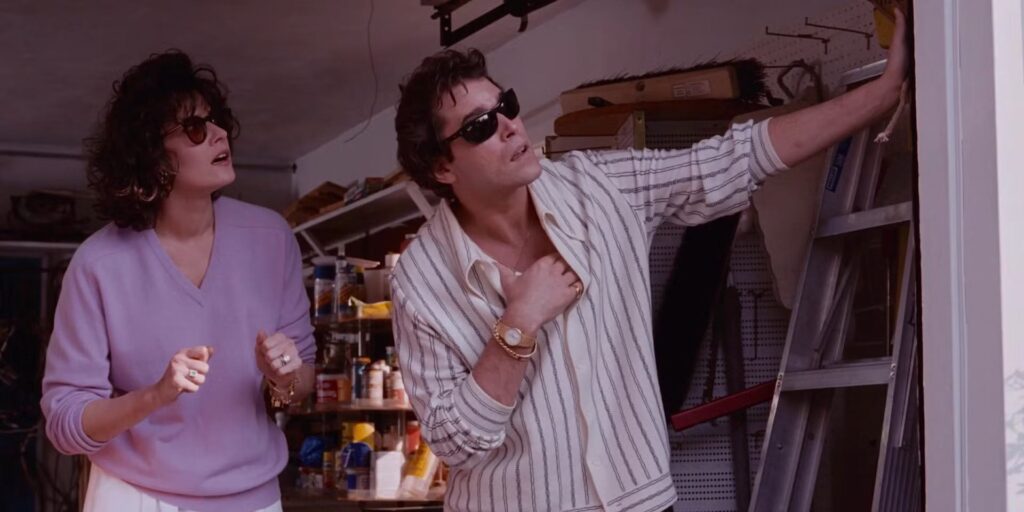
The New York FBI Field Office had effectively laundered the spurious claims of a known RAT into a full-fledged scene from Martin Scorsese’s 1990 film Goodfellas. It was the full “perp walk” treatment, over 20 years after the fact.

With straight faces, federal officials touted the case as a triumph of persistence. “Justice delayed is not justice denied,” proclaimed Comey-Era FBI Assistant Director William F. Sweeney, Jr., vowing that even decades-old crimes would be relentlessly pursued.
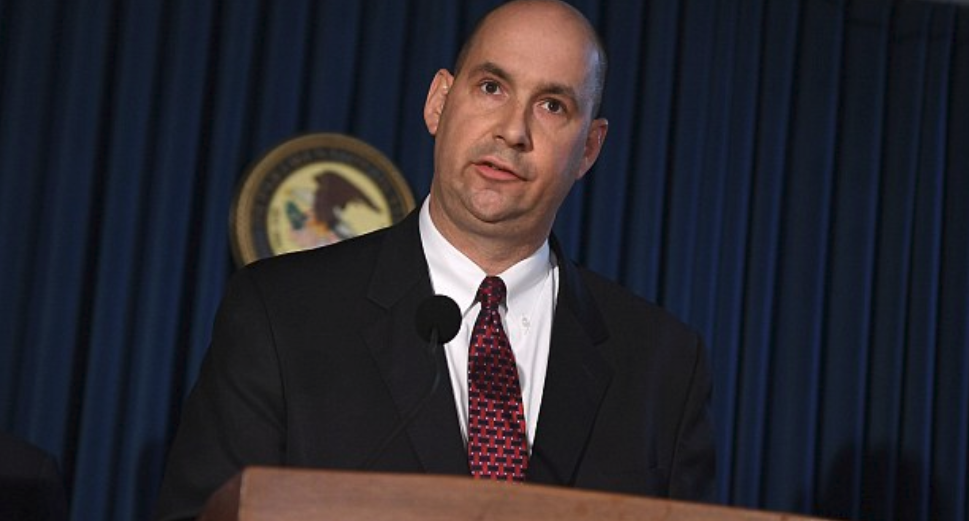
But behind the scenes, according to Luthmann’s investigation, this was no triumph of justice. It was, rather, a manufactured spectacle built on dubious witnesses and buried facts.
Defense attorneys soon exposed gaping holes in the government’s case. Francomano Jr. – the feds’ star witness – was a “known Government RAT and self-serving informant” whose tale was riddled with self-contradictions.
He had been present at the scene of the murder and, in fact, drove the actual stabber, Saez, from the scene that night. For nearly 18 years, Francomano never breathed Tortora’s name in connection with Ortiz’s death. Only when seeking a deal did he suddenly claim Johnny T was the mastermind.
Other witnesses painted a very different picture – one that federal agents and prosecutors apparently ignored. Multiple Yonkers sources have since attested that Francomano himself had the strongest motive to kill Ortiz. Ortiz, the victim, had allegedly informed police about an illegal after-hours gambling club run by Francomano’s family, causing it to get raided and shut down. In the underworld logic, Francomano wanted revenge.
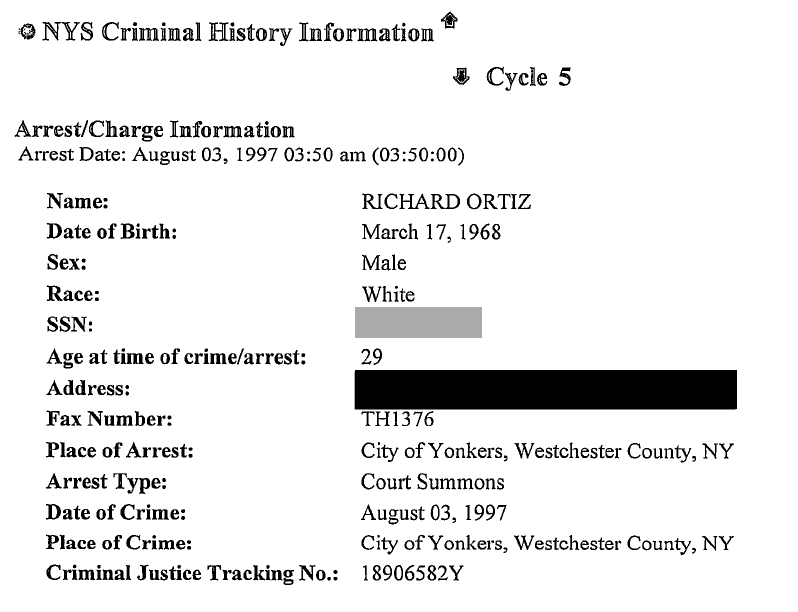
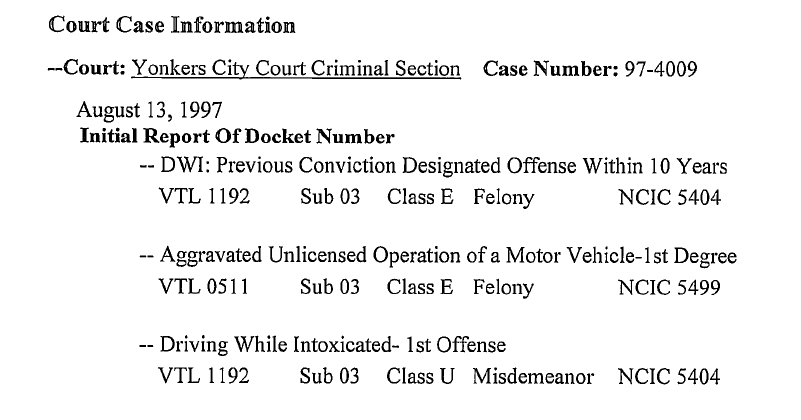
“Ortiz got pulled over on a drunk driving… He started singing about Francomano’s after-hours club… A few weeks later, Francomano got raided… He blamed Ortiz and was right to do so,” one Yonkers witness recounted.
Francomano even used to brag over the years about having Ortiz killed – and notably, “without ever implicating Tortora,” according to filed court documents and corroborating sources.
Yet none of this stopped the feds from barreling ahead at full throttle. Detective John T. Geiss, a YPD cold-case investigator who partnered with the FBI, became the linchpin in resurrecting the case. Geiss had a checkered reputation – known around Yonkers as a cop who coerced witnesses and played fast and loose with evidence, according to the complaint.
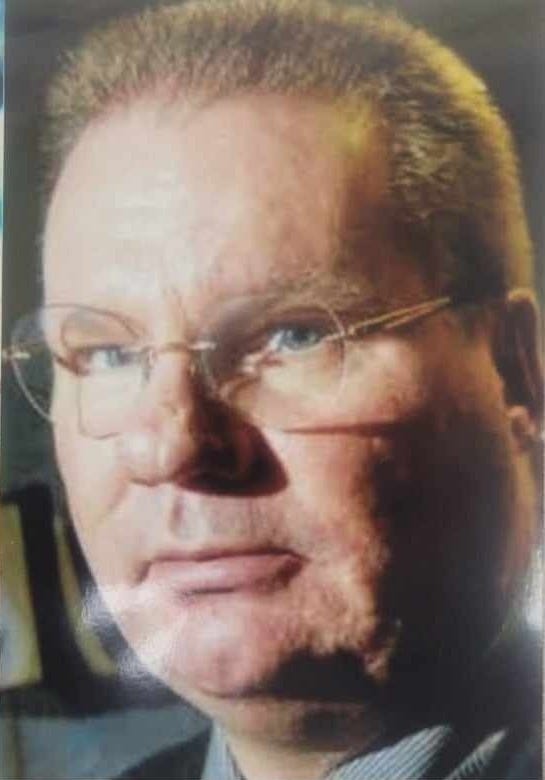
Locals described Geiss in unprintable terms. (One Yonkers source didn’t mince words, calling him “a lazy, fat, drunken Irish fraud and a dirty cop.”) Geiss “reconstructed” the Ortiz murder narrative from the ground up in the 2010s, this time plugging Tortora in as the villain despite the thin evidence.
“He was determined to pin this on Johnny, no matter the facts,” one Yonkers resident said of Geiss’s fixation on Tortora. “He’s a fat, jealous prick.”
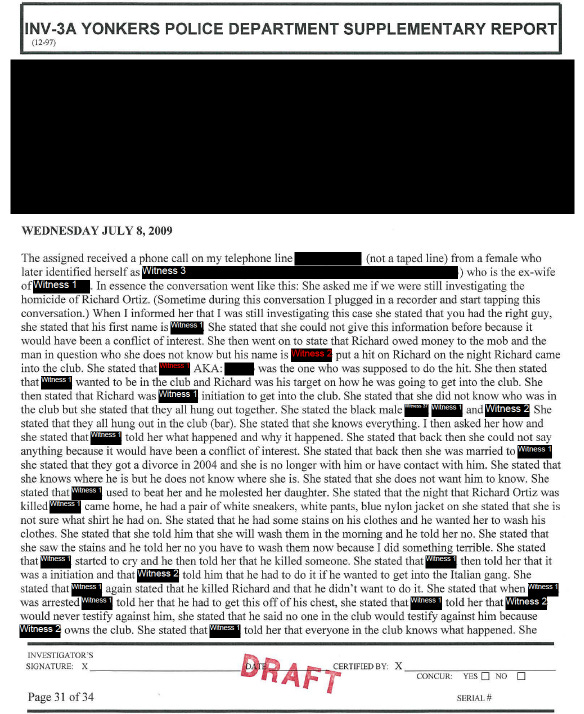
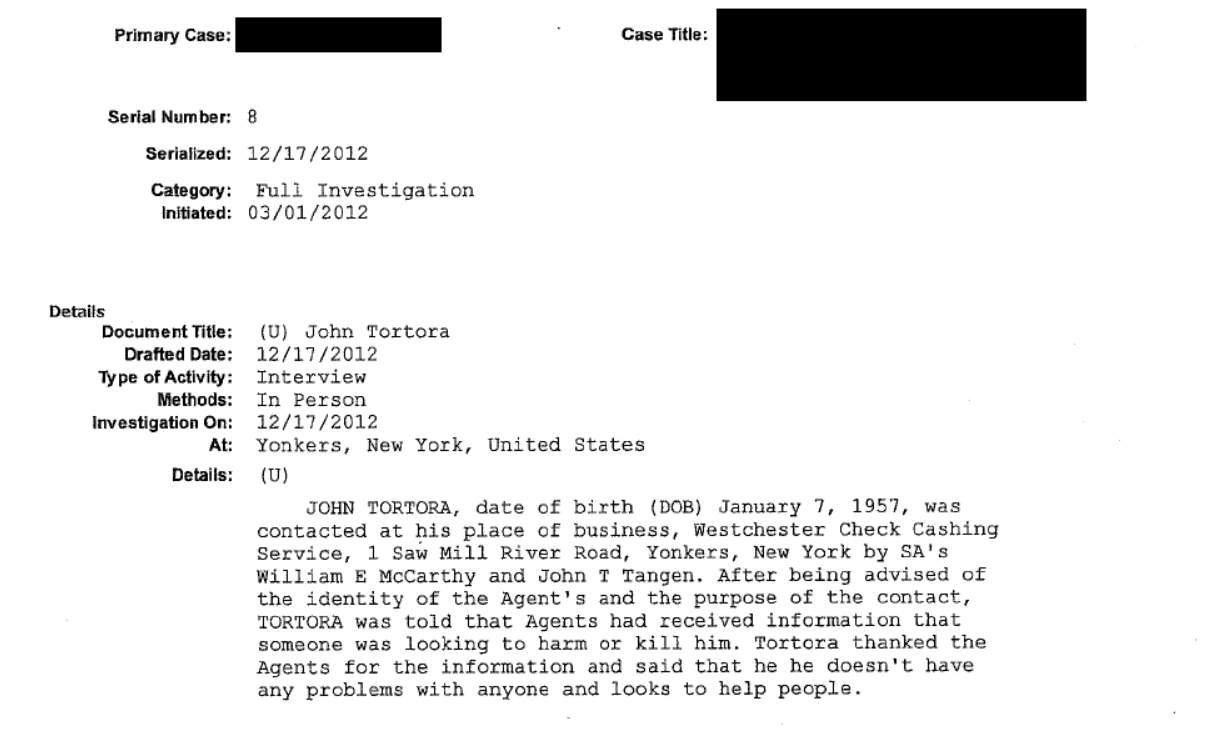
Perhaps most damning, a 2009 Yonkers PD report by Detective Geiss – from when the cold-case file was reviewed – failed to mention Tortora at all. That report (an excerpt of which is pictured above) shows multiple witnesses naming other individuals in Ortiz’s murder, while Tortora’s name never appears.
Defense counsel later argued that this report and similar exculpatory material were buried or glossed over once Francomano changed his story.
Comey Exposed in FOIA Case: The “Johnny T” Prosecution Unravels
Despite the house-of-cards nature of the evidence, prosecutors under Comey’s watch pressed forward, intent on making Tortora the poster child for a long-unsolved mob hit. They constructed a sensational narrative: Tortora, allegedly an associate in the Genovese crime family, ordered Ortiz killed because Ortiz had stolen from mob-run “Joker Poker” gambling machines and snitched about it.
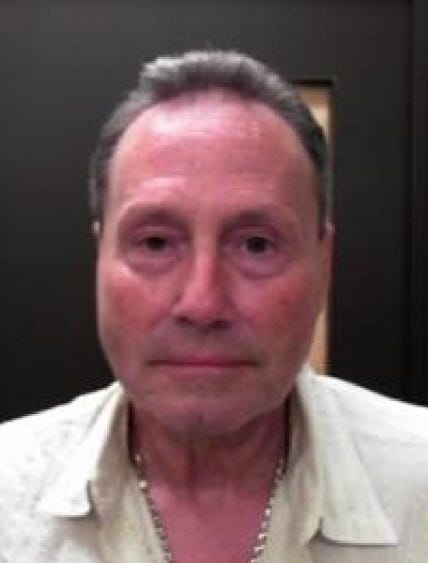
It was a sexy story for the headlines – the kind of tale federal law enforcement loves to tell, with Johnny T cast as a cold-blooded mafia boss settling scores.
The only problem: none of it was true, according to Tortora’s defenders and the ultimate outcome of the case.

“None of this had anything to do with Tortora,” defense attorney Barry Levin argued in court, flatly debunking the government’s theory. The evidence of Tortora’s involvement simply wasn’t there beyond Francomano’s word – and Francomano’s credibility was shredded by his own lies and plea deals.
Sure enough, when push came to shove, the murder charge didn’t stick. Facing a relentless defense, prosecutors quietly dropped the murder allegations before trial. They never convicted Tortora of killing Ortiz. Instead, the feds pivoted to a face-saving fallback: obstruction of justice.
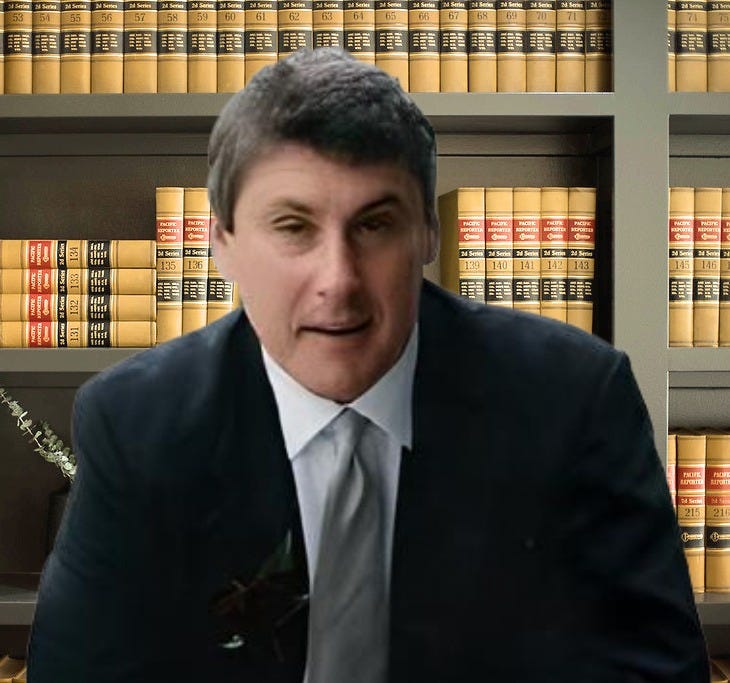
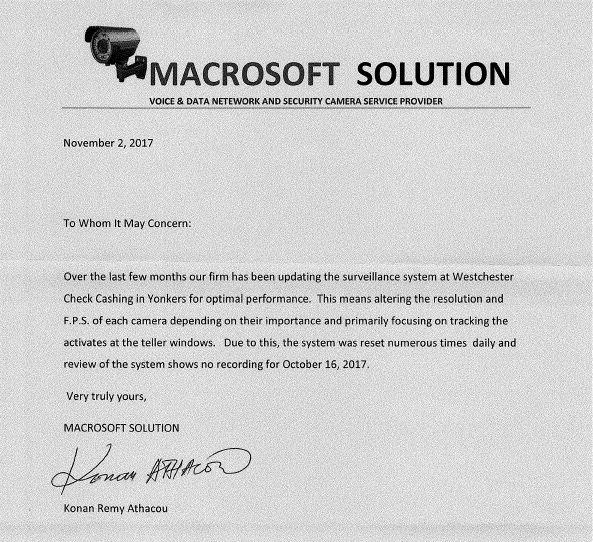
When Tortora balked at turning over some old surveillance tapes (from his pawn shop) to a grand jury – tapes that likely showed nothing useful – the government cried obstruction. Tortora was accused of destroying the footage under subpoena. He maintained the tapes were lost due to a technical mishap, not willful destruction, providing evidence of his good faith from a third-party vendor.
Regardless, backed into a corner, Tortora eventually pleaded guilty to obstruction and a related gambling charge to cut his losses. In 2020, he took a deal; by early 2022, Judge Sidney H. Stein in SDNY sentenced the then-64-year-old Tortora to four years in prison on those charges, using the bogus narrative of participation in the Ortiz murder to enhance Tortora’s jail time.
Even in that process, federal prosecutors couldn’t resist poisoning the well with the unproven murder claims. They openly treated Ortiz’s murder as “relevant conduct” at sentencing – effectively asking the judge to punish Tortora for a killing a jury never found him responsible for.
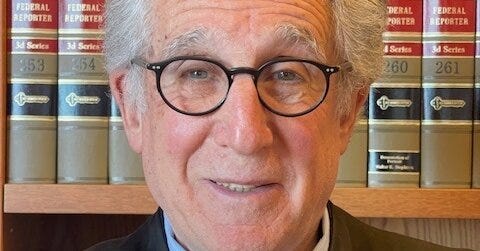
Tortora’s lawyer demanded a Fatico hearing (a proceeding to test the government’s evidence on the disputed murder allegation) and called the prosecutors’ bluff. The SDNY U.S. Attorney’s office folded – they had nothing solid to present on the murder, as they quietly conceded.
The entire Johnny T saga ended not with a RICO conviction or a murder sentence, but with a relatively garden-variety gambling and obstruction case. Tortora served his time and walked free, his name officially clear of the Ortiz murder.
But to Tortora’s supporters, the damage was done. A fortune’s worth of taxpayer money had been spent on the years-long federal crusade against Johnny T. His pawnshop business was wrecked by the raid and legal battle. He languished for nearly two years in pretrial detention under harsh conditions (including a notorious 6-day power blackout at Brooklyn’s MDC jail in 2019).
His family suffered, and his own health and reputation were irreparably harmed – all because, they argue, James Comey’s DOJ wanted a trophy prosecution. In the end, even the judge acknowledged the whiff of injustice: four years for obstruction was a heavy sentence, and Levin blasted it as disproportionate, “reflective of a system more concerned with appearances than justice.”
Comey Exposed in FOIA Case: Lawsuit Targets a Cover-Up and Comey’s Role
Now Richard Luthmann is determined to get the full truth on the record. In his FOIA suit, journalist Luthmann seeks to unearth the DOJ and FBI files behind the Tortora case. The complaint specifically cites James Comey, Jeanine Pirro, Carmine Francomano Jr., and Detective Geiss as key figures whose actions demand scrutiny.
Luthmann wants emails, memos, investigative notes, and interagency communications – anything that can answer the question: Did Comey and his allies weaponize federal law enforcement to pursue a personal vendetta, even after Judge Jeanine Pirro declared the case “non-prosecutable” based on the same facts?
Crucially, the FOIA lawsuit isn’t just a fact-finding mission; it’s a frontal attack on how the DOJ handled Luthmann’s records requests. According to the filings, Luthmann filed FOIA requests with the DOJ for all records related to the Ortiz/Tortora matter, including FBI files and any communications involving Comey and other officials.
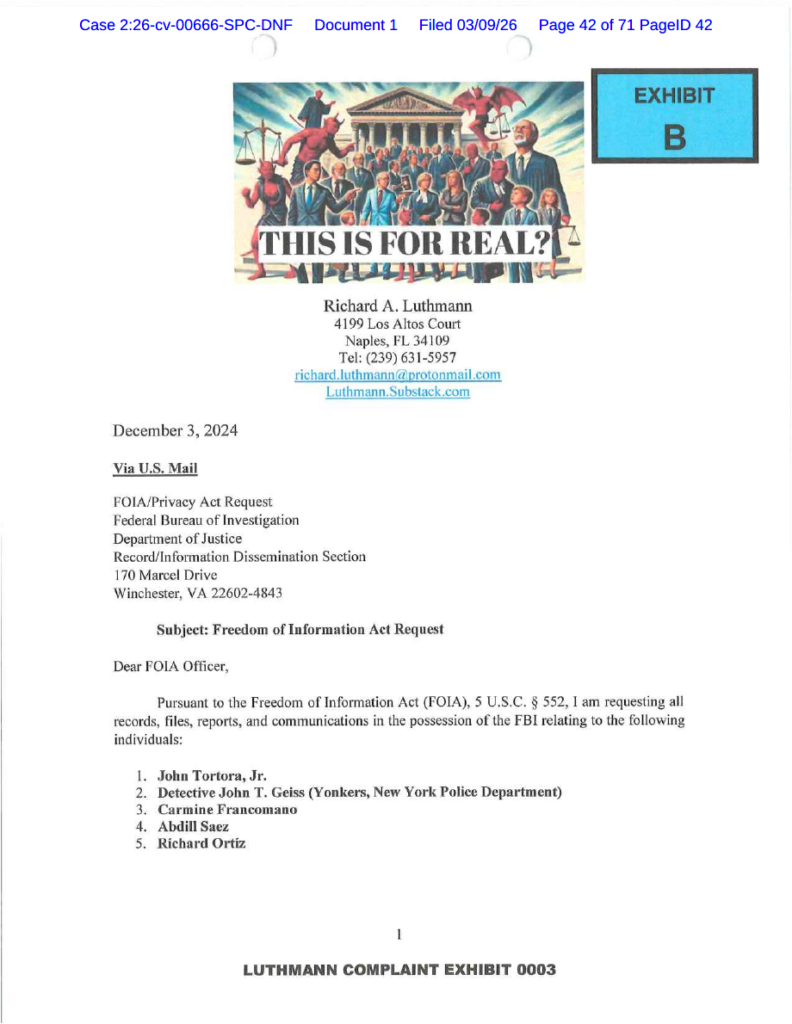
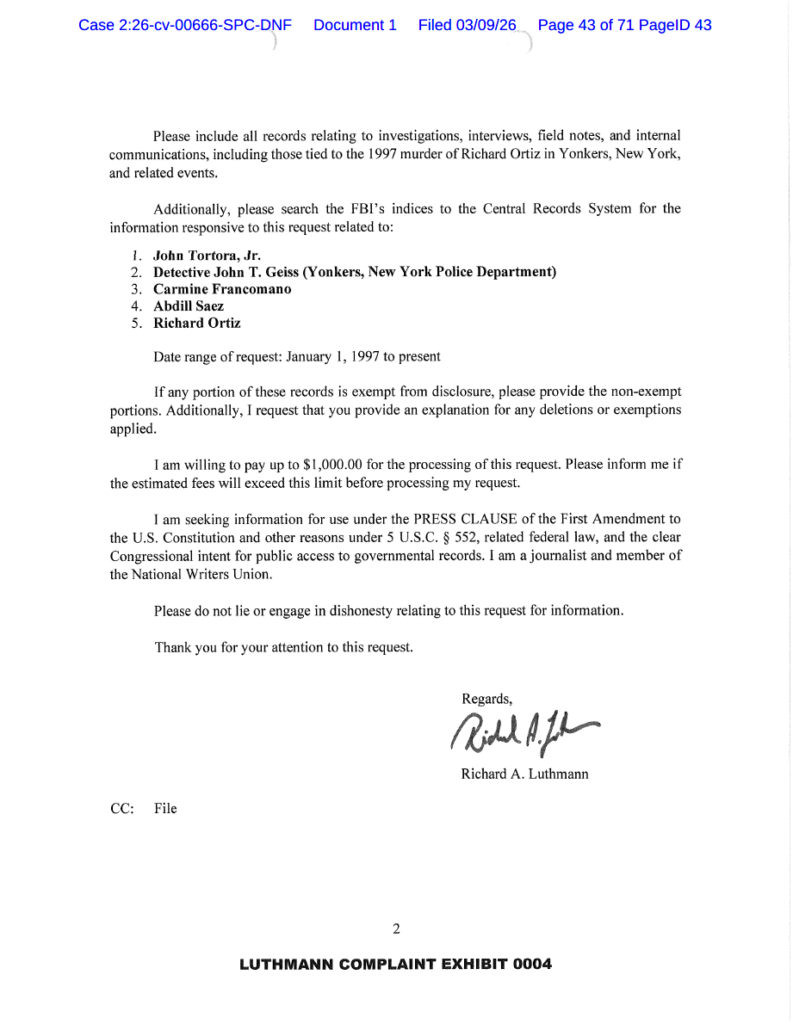
The response? Stonewalling and a bureaucratic shell game, says the complaint.
Rather than conduct a comprehensive search, the DOJ allegedly refused to perform a department-wide records sweep. The agency insisted that FOIA is “decentralized” and that Luthmann would have to aim his request at specific DOJ components (like the FBI, the Executive Office of U.S. Attorneys, etc.) one by one – a tactic the suit calls fragmentation.
In essence, Luthmann charges that the DOJ tried to slice-and-dice the FOIA request to avoid accountability, shuffling him through a maze of sub-agencies and siloed searches.
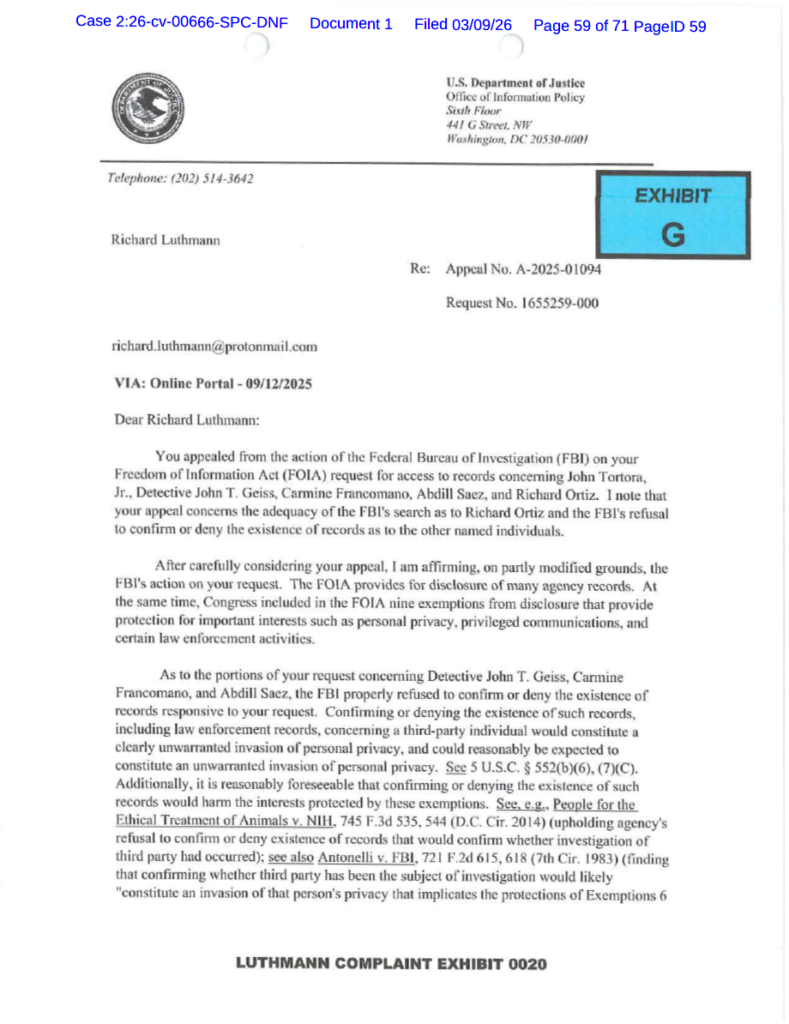
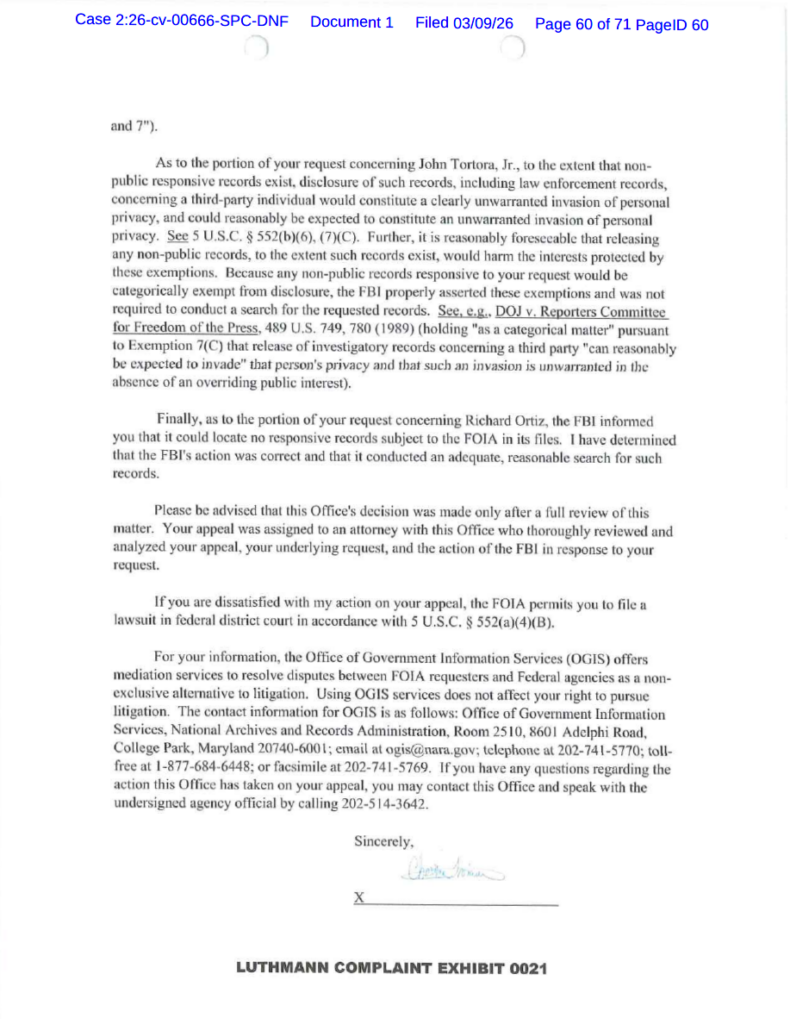
Indeed, official guidance on FOIA encourages requesters to identify the right component. FOIA.gov itself notes that “each [federal] agency is responsible for handling its own FOIA requests” – and the DOJ has over 40 separate components acting as quasi-independent FOIA offices.
But Luthmann’s lawsuit argues that this setup cannot be used as a get-out-of-FOIA-free card. The Department of Justice is a single “agency” under the law, he contends, and it must search all likely locations for responsive records, not hide behind internal divisions. Allowing DOJ to ignore wide-reaching requests by claiming “improper fragmentation” would subvert FOIA’s very purpose: “to encourage public disclosure of information so citizens may understand what their government is doing.”
The burden is on the government to justify withholding records – not on the requester to chase down every pocket where documents might reside.
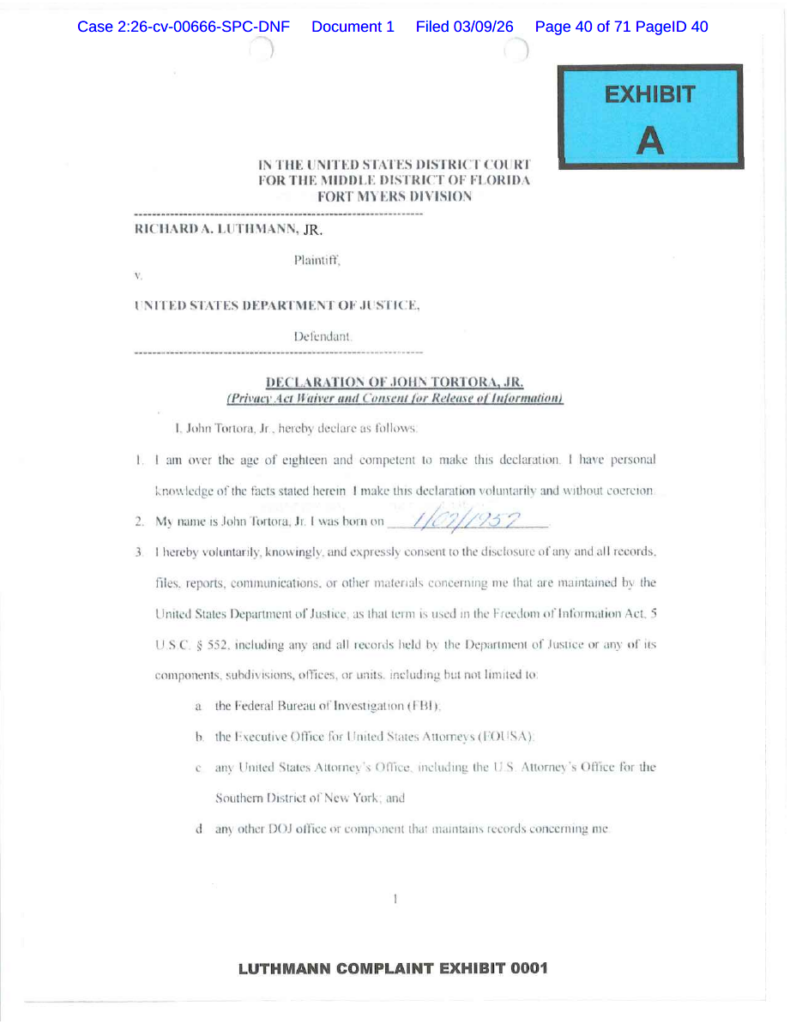
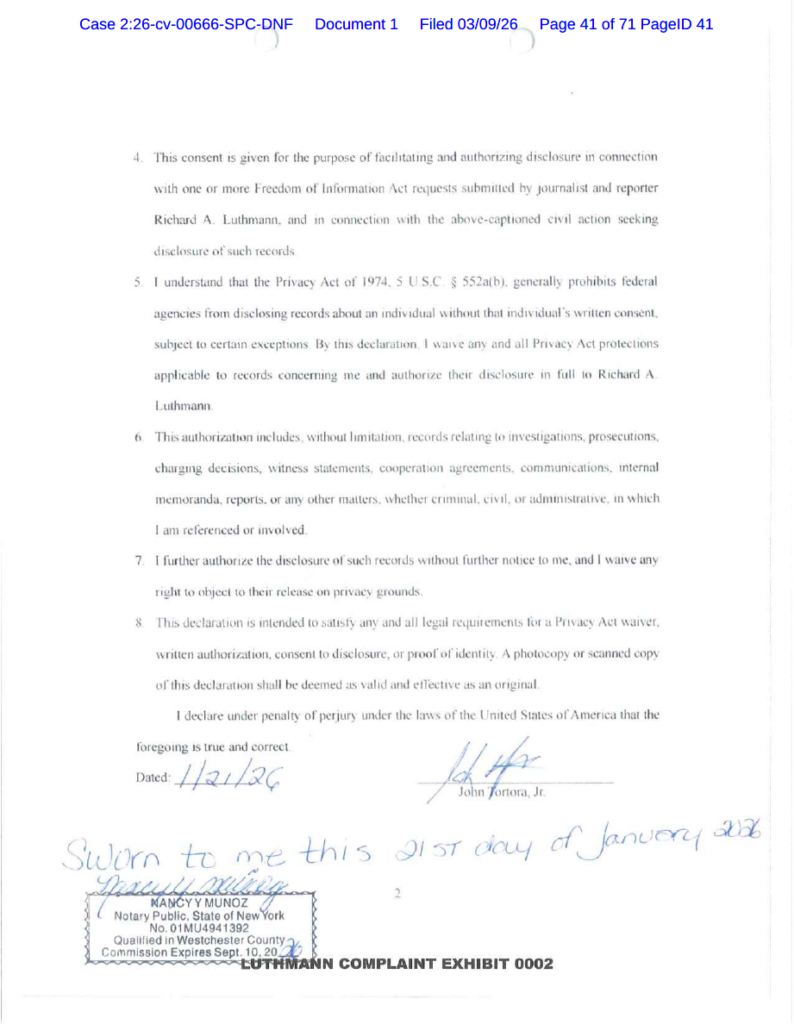
“The Feds are hiding behind the Privacy Act,” Luthmann said. “But I provided them with a waiver, and they still ignored it. Let’s see how their lawyers try to argue that Johnny T’s ‘privacy rights’ are standing in the way of the truth about his own case. That’s a Deep State argument if I ever heard one.”
Additionally, Luthmann’s legal argument takes an ambitious turn by invoking the Supreme Court’s Major Questions Doctrine as a lens to judge the DOJ’s FOIA obstruction. This doctrine, recently highlighted in cases like West Virginia v. EPA (2022), holds that when an agency claims an extraordinary power not clearly granted by Congress, courts should “greet the assertion with skepticism” and demand “clear congressional authorization” for it.
In the FOIA context, Luthmann suggests that DOJ’s position – effectively exempting itself from a full department-wide search unless each sub-unit is separately FOIA’d – is a bold power move nowhere sanctioned by the FOIA statute. FOIA defines “agency” to include executive departments like the DOJ, and commands that each agency make records available on request.
Nowhere does the law say the public must file piecemeal requests to dozens of DOJ sub-agencies to get a complete picture. If DOJ’s regulations or practices are adding that hurdle, Luthmann argues, it’s a major question of statutory interpretation. And absent an explicit blessing from Congress, DOJ’s fragmented approach should not stand.
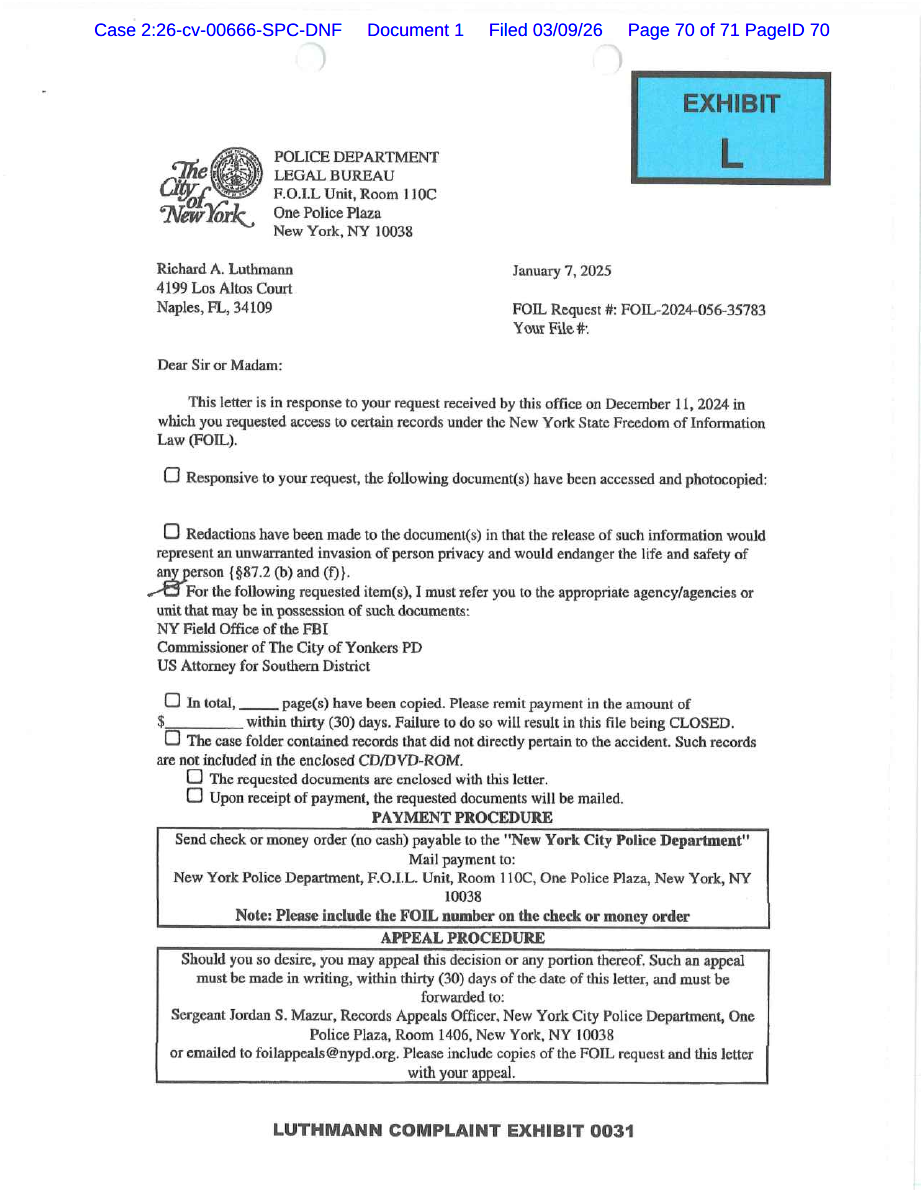
“FOIA is about transparency, not hide-and-seek,” Luthmann. “Once a person has shown that the government has records that should be produced under FOIA — and the NYPD has already told us — then absent an exemption, the burden of proof is on the government and not on the requester to know the DOJ org chart by heart.”
The lawsuit also challenges the DOJ’s refusal to perform what Luthmann calls an “adequate search.” It’s not enough, he argues, for the FBI to have done a cursory name check, or for the Executive Office for U.S. Attorneys to say “we found nothing” if higher headquarters (Main Justice) or other components (perhaps the Office of the Attorney General or Office of Legal Counsel, if they were involved in decisions) weren’t even asked.
Given James Comey’s personal involvement alleged in the complaint, emails or directives from Comey or his staff might reside outside the FBI’s FOIA reach – for instance, on DOJ servers or with Comey’s special assistants. By refusing a central search, DOJ could conveniently keep such records out of sight.
Luthmann’s suit calls this tactic out, asserting that FOIA’s mandate to agencies would be hollow if an official could simply scatter communications across different divisions to avoid disclosure.
Comey Exposed in FOIA Case: Courtroom Bravado Meets Street-Fight Ethics
In signature Richard Luthmann style, the FOIA complaint and accompanying filings pull no punches. The prose swings between courtroom legalese and streetwise outrage, reflecting Luthmann’s persona as a former lawyer turned irreverent muckraking journalist. The filings quote witnesses calling Comey and his cohorts out by name.
One source in Yonkers blasted the entire pursuit of Tortora as a personal crusade: “All the Feds had a hard-on for Johnny T, because everyone on the street loved him,” the source is quoted. “Even the biggest pricks like [James] Comey tried to take him down for penny-ante bullshit.”
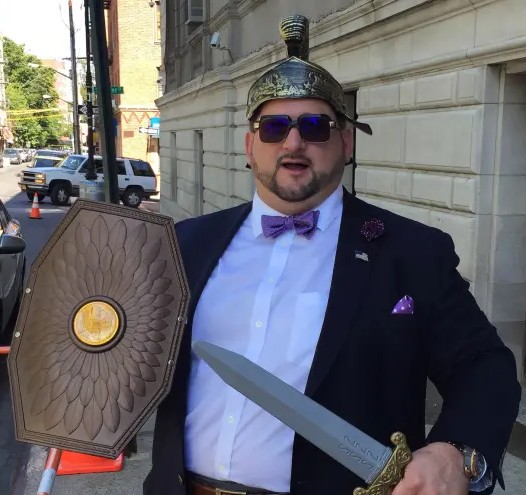
Such colorful language is rarely seen in federal court pleadings, but Luthmann – who has famously challenged a legal adversary to “trial by combat” – is not known for restraint. The FOIA suit reads as both a demand for information and an indictment of DOJ’s tactics in the Tortora affair and beyond.
The complaint underscores that current District of Columbia U.S Attorney Jeanine Pirro’s initial refusal to prosecute Tortora back in the late ’90s speaks volumes. If the local DA (widely known as a firebrand TV judge, Fox News legal commentator, and now a no-nonsense federal prosecutor) wouldn’t touch the case because it was flimsy, how then did it suddenly become a federal priority decades later?
Luthmann’s answer: James Comey’s influence.
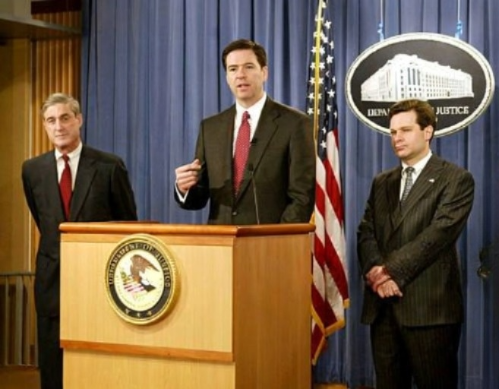
Comey, the suit posits, never forgot the Yonkers murder that went unpunished. When he ascended to power at the FBI, he had both the motive and the means to reopen it under a federal racketeering guise, the same way he had done in 2001 as U.S. Attorney before 9-11 hit.
One of Luthmann’s questions is whether Comey pushed his agents to target Tortora not based on any new evidence, but out of personal zeal – effectively settling an old score from his hometown.
By filing in the Middle District of Florida, Luthmann also removed the case from the New York courts that handled the criminal matter. Southwest Florida is, after all, Luthmann’s adopted turf. It’s no coincidence that the lawsuit lands in Fort Myers, far from the influence of SDNY’s establishment.
“As plaintiff, I asserted my Florida residency to establish venue. I have much more confidence that the crooked deep state forces in the Yankee North won’t get to the Florida legal establishment, but I still have some reservations,” Luthmann said. “I don’t think anyone down here is going to do a YUGELY ILLEGAL favor, risking their pension and potential prosecution to do someone they’ve never dealt with face-to-face – and with a guaranteed record of the meeting.”
Luthmann says that the way the entrenched Feds have operated in blue cities and states like New York for the past half-century is “worse than the mafia.”
“If this were Brooklyn, I’d probably already be whacked, and they’d make it look like an accident,” Luthmann said. “They already did it to me once.”
The case has been assigned to U.S. District Judge Sheri Polster Chappell (with Magistrate Judge Douglas Frazier), and it will likely follow the usual FOIA litigation track. The DOJ’s answer or motion is expected within sixty days of service.

“It’s a poorly-kept secret that Magistrate Judge Frazier is about to retire,” Luthmann said. “The word on the street is that they’ve already selected a replacement, so I expect some reshuffling.”
Luthmann is no stranger to this: he actually litigated prior FOIA cases, including one in the same court (Luthmann v. FBI, No. 2:21-cv-716) over records of his own federal prosecution, which resulted in a 2024 ruling largely siding with DOJ’s withholdings.
But this time, he appears ready to battle not just over documents, but over the fundamental principle of FOIA compliance.
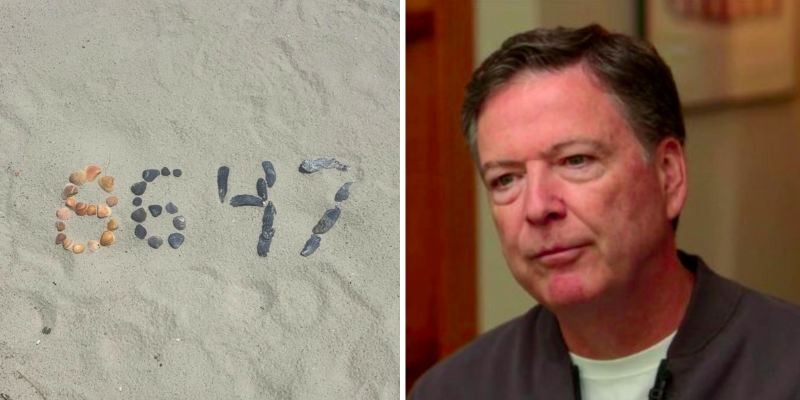
“I take this as a personal mission to expose these DEEP STATE HACKS and make our Commander in Chief proud. The people want an end to all of this,” Luthmann said, quoting biblical verse: “Touch not my anointed ones, do my prophets no harm.”
Did James Comey Weaponize Federal Power?
As Luthmann’s David vs. Goliath FOIA fight begins, the broader stakes are coming into focus. This isn’t just about one man’s FBI file; it’s about trust in the justice system. The tale of Johnny T Tortora raises a chilling possibility: that a high-ranking official like Comey might leverage the immense power of federal law enforcement to pursue a personal vendetta under the guise of a legitimate prosecution.
“The purpose of FOIA is to encourage public disclosure of information so citizens may understand what their government is doing,” the Eleventh Circuit has emphasized.
In that spirit, Luthmann’s suit seeks to shine sunlight on an episode of DOJ history that, in his view, stinks of corruption and abuse of power.
The Supreme Court’s recent skepticism of agency power grabs could play a role. If an executive agency cannot, without clear authority, enact sweeping regulations affecting the economy (as in the West Virginia v. EPA case), can the DOJ, without clear authority, carve itself an exemption from full transparency?
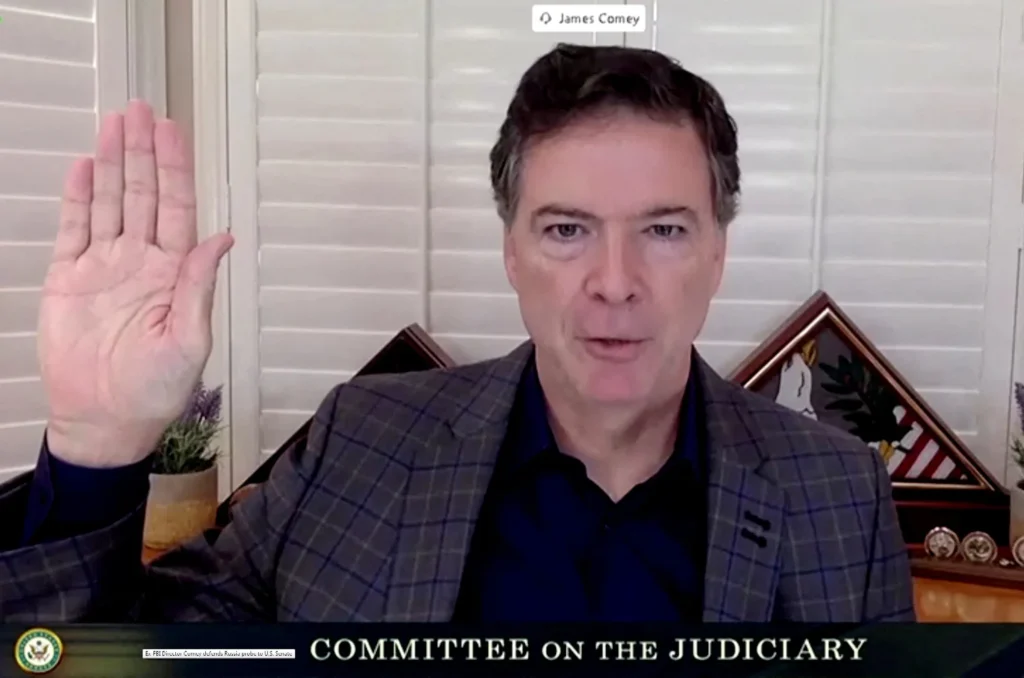
The answers will come in legal briefs and court hearings in the months ahead.
“The legal elements in this case will take it to the Eleventh Circuit and maybe all the way to SCOTUS,” Luthmann said. “The age of the FOIA administrative shell game is over.”
But beyond the legalese, the human story remains front and center. John Tortora, now approaching 70, has lived under the cloud of a murder he was never proven to have had any role in. His supporters in Yonkers still call him “Beloved Johnny T,” remembering how he helped neighbors with loans and treated people kindly despite alleged mob ties. To them, the federal case was a grave injustice orchestrated by ambitious officials.
James Comey, once a hometown kid turned top G-man, is cast in the unlikely role of antagonist – “disgraced” in Luthmann’s words, and perhaps unable to let sleeping dogs lie.
As the FOIA lawsuit unfolds, the central question it asks is as provocative as it gets: Did James Comey turn the FBI into his personal tool to hunt an old target from Yonkers? The very fact that such a question can be credibly raised is a stark reminder of how much trust in institutions has eroded.
Luthmann’s courtroom and street-fight bravado ensures this story won’t be told in gentle whispers. He’s dragging the FBI and DOJ into the sunlight, “equal parts court drama, news thriller, and Shaolin street fight,” as his biography proclaims.
And he won’t stop on this one until, as he says, every last filing, feud, and exposé is laid bare.
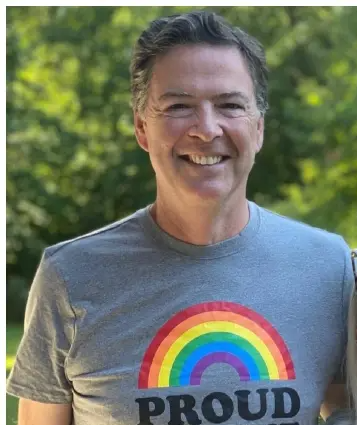
Did Comey have a personal hard-on to nail Johnny T?
The documents, if they see daylight, may tell the tale. In the meantime, observers nationwide await an answer. FOIA was designed for exactly this scenario: to “let citizens know what their government is up to,” the Supreme Court has long held.
Nearly 30 years after Richard Ortiz’s murder, the truth about the investigation may finally emerge. And if Luthmann has his way, those truths will be printed in black and white for all to see, unfiltered and unafraid.
Leave a Reply