
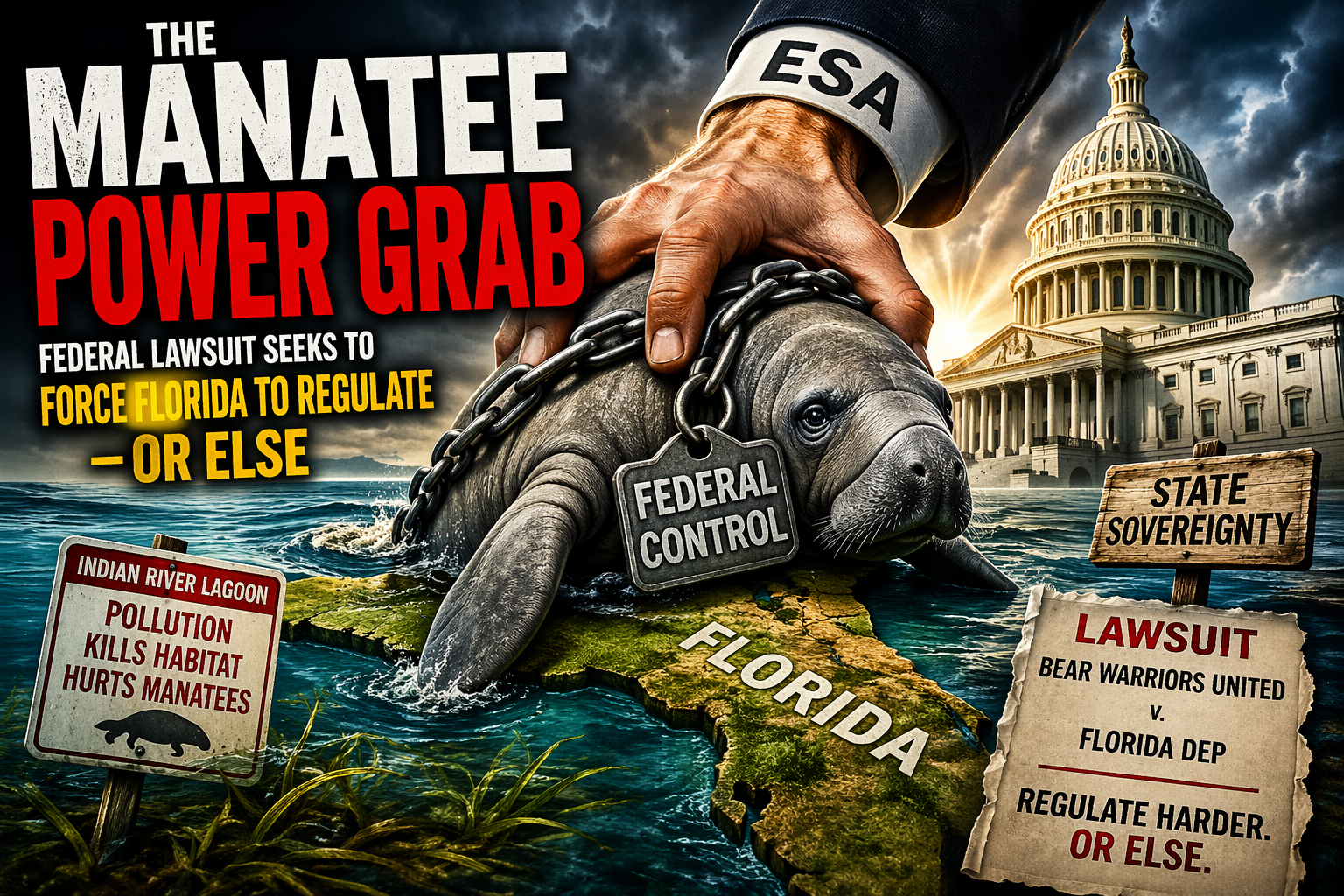
Washington’s Green Machine Comes for Florida’s Sovereignty in Federal Court
LUTHMANN NOTE: This isn’t about manatees. It’s about power—raw, unchecked, and dressed up in environmental virtue. What the activists are pushing here is a legal theory under the Endangered Species Act (ESA) that allows Washington to hijack Florida’s regulatory system without ever passing a law to do so. That’s not how the Constitution works, and if the Eleventh Circuit caves, it won’t stop at septic tanks and seagrass. It’ll spread—quietly, surgically—into every corner of state governance. The feds won’t need new legislation. They’ll just need lawsuits. And suddenly, your state agency isn’t yours anymore. That’s the real danger here. This piece is “The Manatee Power Grab.”

By Richard Luthmann
(FLORIDA, USA) – Leave it to the modern regulatory state to turn a manatee case into a constitutional mugging. What is now barreling toward the Eleventh Circuit in Bear Warriors United v. Lambert is being sold as an environmental protection dispute, a supposedly noble fight over seagrass, septic systems, and the fate of one of Florida’s most recognizable creatures.
That is the packaging. The product inside is something else entirely: a raw federal power play dressed up in wildlife language.
The real question is not whether manatees matter. Of course they do. The real question is whether the Endangered Species Act (ESA) can be twisted into a legal crowbar to pry open Florida’s sovereign regulatory machinery and force the state to govern according to federal demands. That is the dangerous theory now on the table.
Bear Warriors United claims the Florida Department of Environmental Protection is violating the ESA not because the agency itself is directly dumping pollutants into the Indian River Lagoon, but because Florida allegedly has not regulated private parties harshly enough to satisfy the activists’ vision of environmental enforcement.
That is the scam at the center of this lawsuit. It converts supposed state inaction into actionable federal wrongdoing and tries to make Florida liable for not wielding its own police powers aggressively enough on Washington’s behalf.
That is not cooperative federalism. That is commandeering with a dolphin-smile press release.
If the Eleventh Circuit blesses that theory, Florida will not just lose an environmental case. It will lose ground in the broader war over whether states remain sovereign governments or mere branch offices of the federal administrative empire.
The Manatee Power Grab: The Activists’ Theory – Regulate Harder, or Else
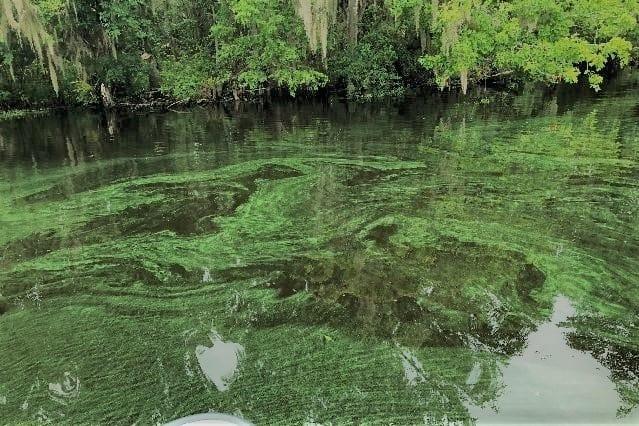
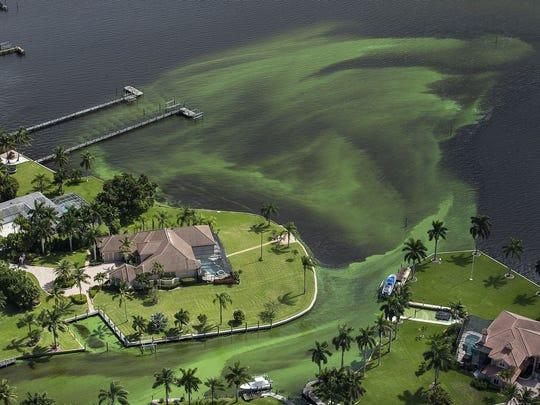
The mechanics of the lawsuit are wrapped in ESA jargon, but the thrust is brutally simple. Bear Warriors United says nitrogen discharges from septic tanks and wastewater treatment systems contribute to eutrophication in the Indian River Lagoon, degrade seagrass habitat, and thereby harm manatees that depend on that habitat.
So far, fine. That is the usual environmental causation chain. But then comes the leap, and it is a big one.
Instead of merely targeting direct polluters or demanding federal enforcement against those actually discharging pollutants, the plaintiffs argue that Florida itself is committing a prohibited “take” because it has failed to regulate those sources with sufficient zeal.
In other words, the state is not accused of directly harming manatees so much as it is accused of failing to crack enough skulls in the regulatory arena.
That is where this case turns from a standard environmental suit into a constitutional ambush. This theory relies on the broad reading of “harm” associated with Babbitt v. Sweet Home Chapter of Communities for a Great Oregon, 515 U.S. 687 (1995), where habitat modification can count under the ESA if it impairs protected species’ feeding, breeding, or sheltering.
But even if one accepts that broad understanding, this suit still goes much further. It seeks to weaponize that concept against a sovereign state for not regulating private conduct in the preferred manner.
That is the key move. It does not merely enforce federal law. It attempts to conscript Florida’s regulatory discretion and convert it into a mandatory instrument of federal policy.
That is not law enforcement. That is an attempted hostile takeover of state authority by lawsuit. Manatees may be the emotional mascot here, but the legal objective is control.
The Manatee Power Grab: The Constitution Has a Name for This – Commandeering
There is a reason the anticommandeering doctrine exists, and this case is Exhibit A. The federal government may regulate private actors directly. It may pass laws, impose penalties, and send in its own agencies to do its own dirty work. What it may not do, under the Constitution’s basic division of powers, is force a state to carry the federal government’s regulatory water.

That is the line the Supreme Court has recognized in cases like Murphy v. NCAA, and Reno v. Condon, 528 U.S. 141 (2000), and it is the line this lawsuit tries to obliterate.
Florida’s position is that the district court effectively allowed the ESA to be used as a federal whip against state regulation of private parties. That should have been the end of it. Congress cannot order Tallahassee to regulate more aggressively just because activists are unhappy with the pace of state enforcement.
Washington can regulate nitrogen discharges itself. It can go after private violators itself. It can unleash its alphabet soup of agencies and bureaucrats if it wants to. But it cannot point to the Florida Department of Environmental Protection and bark out commands like a plantation overseer telling the state how to govern.
Once that line is crossed, the consequences do not end with environmental policy. If failure to regulate private conduct to federal satisfaction can itself become a federal offense by the state, then every domain of state policy becomes vulnerable to the same racket. Land use, licensing, health mandates, education policy, transportation controls—name your battlefield.
The feds set the goal, activists file the suit, and state agencies get dragooned into compliance. That is not constitutional governance. That is federal extortion through litigation.
The Manatee Power Grab: The Lower Court Bought the Contradiction and Called It Law
The district court’s handling of Florida’s objection, at least as presented in the source material, reads like the kind of opinion you get when the result is chosen first and the constitutional reasoning is patched together afterward.

The court acknowledged that anticommandeering does not block federal laws that regulate state activities, but rather dictates how states regulate private parties. Fair enough. That is a real principle.
But then the court turned right around and accepted a claim that depends exactly on using federal law to dictate how Florida must regulate private parties. That is not a close call. That is a head-on collision with the very distinction the court claimed to recognize.
The court also invoked the idea that Congress may regulate activities in which states and private actors both engage, but the state conduct at issue here is not ordinary market participation. Florida is not selling widgets or running a trucking company. It is exercising sovereign authority—issuing permits, setting standards, enforcing rules, and deciding how state law should operate within state borders.
That is not an “activity” in the generic sense. That is governance. And governance is precisely where the anticommandeering doctrine is supposed to do its work. Yet the district court appears to have shrugged off that distinction and left the door wide open for activist plaintiffs to transform every perceived state regulatory shortfall into a federal court emergency.
That is how constitutional guardrails disappear: not always in one giant explosion, but in a series of clever little exceptions dressed up as urgent causes. In this case, the cause is manatees. Tomorrow it will be something else.
The mechanism, however, will be the same—federal leverage over state sovereignty, sold as virtue and imposed as law.
The Manatee Power Grab: If Florida Loses, Every State Should Start Sweating
What makes this case so combustible is not just the environmental backdrop but the precedent it could set if the Eleventh Circuit affirms the logic below. If Florida can be tagged under the ESA for not regulating private discharges strongly enough, then any state with a regulatory apparatus becomes a sitting duck whenever federal policy advocates decide state enforcement is too soft, too slow, or too politically inconvenient.
The federal government will not need to legislate a direct command. Activists will do the work through citizen suits. Judges will dress the outcome in concern for the public good. And the states will discover, one injunction at a time, that their sovereign powers now come with federally supervised marching orders.
The First Circuit’s old Strahan v. Coxe reasoning is an earlier example of this kind of thinking (939 F. Supp. 963 (D. Mass. 1996)). It looks constitutionally shaky after Murphy.
Moreover, the environmental context does not grant a constitutional hall pass. The federal government can target pollution, protect species, and punish actual violators all day long.
What it cannot do is draft the states into service and demand they regulate according to federal wishes, simply because they already occupy the field. Florida’s choice to have a state environmental agency does not amount to consent to federal occupation of that agency.
If the Eleventh Circuit has the spine to say so, it will not be attacking environmental protection. It will be defending the constitutional structure that prevents the federal government from swallowing the states whole.
That is why The Manatee Power Grab matters. This is not just about a gentle sea cow in troubled waters. It is about whether Florida governs Florida, or whether Washington does—and just sends Tallahassee the bill.
Leave a Reply