

A Papal Vision That Connects Labor, Liberty, and Divine Truth

By Richard Luthmann
Pope Leo XIV assumed the papal name “Leo” in conscious homage to Pope Leo XIII, signaling a renewal of the Leonine legacy in Catholic leadership. Leo XIII’s papacy (1878–1903) inaugurated the Church’s modern social teaching, most famously through his 1891 encyclical Rerum Novarum, which confronted the injustices of the Industrial Revolution. This “immortal document” set the template for Catholic social doctrine and earned Leo XIII the title “the great Pope of the ‘social question.’”
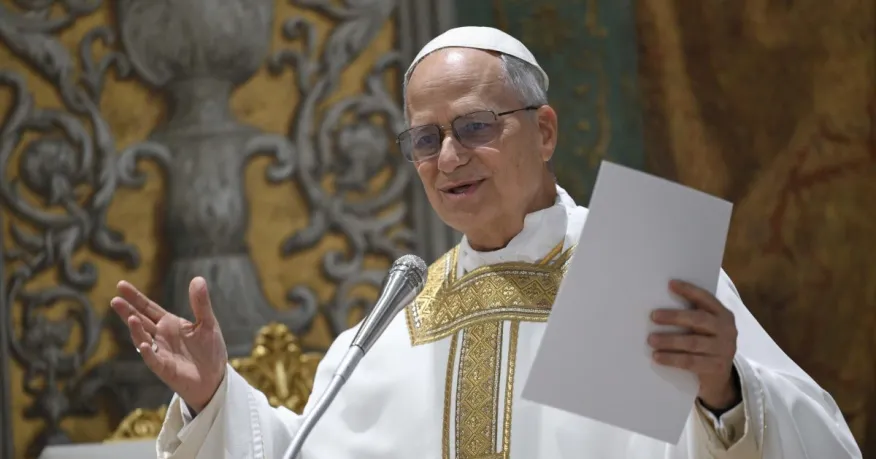
By choosing the name Leo XIV, the current pontiff aligns himself with that tradition. He indicates an intent to continue on the trajectory that Leo XIII began—a trajectory characterized by a robust engagement with social issues, grounded in natural law and the dignity of the human person.
The modern Leonine papacy thus looks to Rerum Novarum as a foundational charter and aspires to carry its principles into the 21st century’s new social challenges. In an era of economic globalization and cultural change, Pope Leo XIV is expected to echo Leo XIII’s emphasis on justice, the rights of workers and families, and the moral duties of states and individuals.

This continuity suggests that the Leonine ideals—defending human dignity, promoting social justice, and teaching timeless moral truths—remain central under Leo XIV’s leadership, guiding the Church’s social mission in today’s world.
The Modern Leo: The Foundations of Catholic Social Teaching
Leo XIII’s Rerum Novarum is widely regarded as the seminal text of Catholic Social Teaching, laying the groundwork for the Church’s formal social Magisterium. Promulgated in 1891, Rerum Novarum addressed the “condition of the working classes” and affirmed core principles of social justice: the right of workers to a just wage and to form unions, the right to private property tempered by the common good, and the duties of both capital and labor under a moral law.

The impact of this encyclical was profound and enduring. In fact, its centenary and earlier anniversaries were commemorated by subsequent popes with landmark documents that applied Leo XIII’s insights to new times. Through these tributes—from Quadragesimo Anno (Pius XI, 1931) to Mater et Magistra (John XXIII, 1961) and beyond—the Church signaled that Leo XIII’s social teaching was not a one-time statement but the start of an ongoing tradition.
Leo XIII grounded his social doctrine in the natural law and the Gospel, insisting that enduring social harmony must build on respect for human rights and divine truth. He taught that the state should protect the weak and that societal arrangements must serve human dignity, reflecting God’s plan. This Leonine foundation gave the Church a new voice in modern social debates, a voice Pope Leo XIV now seeks to amplify.
By harkening back to Leo XIII’s principles, the modern papacy reaffirms that the Church’s social doctrine rests on permanent truths about man and society, even as it develops with changing circumstances.
The Modern Leo: John Paul II – Champion of Leo XIII’s Social Doctrine
The late Pope St. John Paul II is often hailed as the greatest modern interpreter and defender of Leo XIII’s social teaching. He deeply studied Leo XIII’s writings and built upon them in his own encyclicals—especially Laborem Exercens (1981) and Centesimus Annus (1991).

In Laborem Exercens, written on the 90th anniversary of Rerum Novarum, John Paul II reaffirmed Leo XIII’s legacy as “decisively important” for the Church and the world. He explored the theme of human work as “a key, probably the essential key, to the whole social question,” continuing Leo’s focus on the dignity and rights of workers.
A decade later, Centesimus Annus commemorated the centenary of Rerum Novarum and explicitly paid homage to Leo XIII. John Paul II noted that “the whole Church owes [a] debt of gratitude” to Leo XIII and his “immortal document.” He observed that the “vital energies” stemming from that 1891 encyclical had only increased with time, inspiring generations of Catholic social action.
Through Centesimus Annus, John Paul II invited a “re-reading” of Leo’s text to apply its fundamental principles to the new “things” of the contemporary world. He linked the collapse of oppressive regimes and the challenges of capitalism to the themes Leo XIII first addressed, insisting on a society grounded in truth, human dignity, and solidarity.

His writings—especially Sollicitudo Rei Socialis (1987)—all draw from the Leonine wellspring.
John Paul II thus served as a bridge between Leo XIII’s 19th-century vision and the needs of the late 20th century, ensuring the trajectory of Catholic social teaching remained true to its roots while expanding to new issues. His scholarly and spiritual reflections on Leo XIII’s social doctrine provide a lens through which the Church (and now Pope Leo XIV) continues to view social questions.
The Modern Leo: Religious Freedom and the Principle of a Free Society
A critical area where past teaching and modern perspectives intersect is religious freedom. The Second Vatican Council’s Declaration on Religious Freedom (Dignitatis Humanae, 1965) famously stated that “the freedom of man is to be respected as far as possible and is not to be curtailed except when and insofar as necessary.”
This assertion—that society should default to the “fullest possible” freedom—has been lauded even by secular commentators. Jesuit theologian John Courtney Murray noted that secular experts regard it as “the most significant sentence in the Declaration” and “a statement of the basic principle of the ‘free society.’”
However, the Catholic understanding of a free society cannot be reduced to secular liberalism or mere moral relativism. The same document insists that religious liberty “leaves intact the traditional Catholic teaching on the moral duty of individuals and societies toward the true religion and the one Church of Christ.”

In other words, freedom in the political sphere (immunity from coercion) is not an absolute license; it is ordered to the freedom to embrace truth. John Paul II emphasized that authentic freedom is inseparable from truth and objective moral order. He warned that a freedom “which refused to be bound to the truth would fall into arbitrariness and end up submitting itself to the vilest of passions.”
History had shown, he argued, that many social evils arose from a distorted notion of freedom cut off from the truth about man. Indeed, when freedom is detached from truth and the law of God, it degenerates into selfishness—“a self-love which leads to contempt for God and neighbour.”
From the Catholic perspective, then, the idea of a truly free society is intelligible only within a moral framework grounded in natural law and, ultimately, in the truths of faith (as summed up in the Nicene Creed). Civil freedom exists not to exalt individual whim, but to allow persons, free from external coercion, to seek and adhere to the truth.
This vision creates a tension with purely secular interpretations of freedom. Yet, it undergirds the Church’s social teaching: human dignity demands both freedom from coercion and alignment with objective moral truth.
Continuing the Leonine Social Teaching Today
The hope for Pope Leo XIV’s pontificate is that he will carry forward this modern Leonine tradition, renewing Catholic social teaching for our time. This means reaffirming that the Church’s social doctrines—from defending workers’ rights to advocating for the poor and upholding human life—are rooted in unchanging principles of natural law and the Gospel.
Pope Leo XIV is expected to emphasize that true political freedom and a just social order flow from recognition of God-given human dignity.

As Pope John Paul II taught, a truly free society must give “total recognition…to the rights of the human conscience, which is bound only to the truth, both natural and revealed,” since acknowledging these rights is “the primary foundation of every authentically free political order.”
In continuity with Leo XIII and St. John Paul II, Leo XIV would stress that modern ills—from ethical relativism to economic exploitation—can only be healed by returning to foundational moral truths. The natural law origins of Catholic social doctrine provide common ground for all people of good will —believers and non-believers alike —to discern what is just.
By confirming these origins, Pope Leo XIV would underline that the Church’s social teaching is not a sectarian ethic but a proposal of truth accessible to reason and aimed at the common good.
Guided by the legacy of Pope Leo XIII and illuminated by the insights of John Paul II, the papacy of Leo XIV aspires to strengthen the moral foundations of a free society—one in which freedom and truth advance together for the genuine good of humanity.
Leave a Reply