

Ex-dentist-turned-lawyer Randy “Rocket” Shochet is accused of lying to a judge, faking evidence, and turning a federal lawsuit into a sham – now facing calls for disbarment.
LUTHMANN NOTE: I am being sued by Jeremy Hales, a YouTube content creator, for expressing my opinions that he’s a crocodile-copulating talentless hack. I will win because the facts are not arguable. They are documented, sworn, and now baked into the record. His lawyer, Randy Shochet of Trenton, Florida, didn’t make a close call. He made false ones. He didn’t correct them. He doubled down after notice. That is where lawyers lose their licenses. Courts forgive mistakes. They do not forgive lies, fabricated service, or sworn nonsense contradicted by public records. I warned him. Repeatedly. He ignored it all. Trump v. Clinton is the roadmap, and Shochet drove straight into the ditch. When judges see fraud, they act. When Bars see patterns, they end careers. His clock is ticking. This piece is called “YouTube Star’s Lawyer Slammed.”



By Dick LaFontaine with Michael Volpe and Richard Luthmann
Bombshell Motion Rips Shochet’s Courtroom Con
(GAINESVILLE, FLORIDA) – Attorney Randy Shochet – legal counsel for YouTube personality Jeremy Hales – is under fire after blistering new court documents sent for filing accuse him of orchestrating a fraudulent legal charade. In a motion to vacate a default judgment and dismiss Hales’s case, defendant Richard Luthmann (a contributor to this outlet) unloads on Shochet for “fraud on the court” and brazen misconduct.
The 126-page motion claims Shochet lied to a federal judge, submitted bogus paperwork, and hoodwinked the court into entering a default against Luthmann. Luthmann says Shochet misled the court at every turn – calling the lawyer “zero for three” in his sworn claims.

According to the filing, Shochet falsely swore that Luthmann wasn’t a Florida resident (he is), pretended Luthmann was in hiding (he wasn’t), and insisted his team did a “diligent search” that never happened. These bogus assertions paved the way for a default, effectively “winning” by deceit, where no judge had reviewed the paperwork.

Luthmann’s motion would have the federal court toss the clerk’s default, which he claims was procured by fraud. He seethes that Shochet doubled down even after being caught in falsehoods, which is a huge no-no.
“Randy Shochet is no Saint Peter,” the document quips, blasting the lawyer for refusing to repent despite repeated warnings. “Saint Peter required only three denials to grasp the gravity of his betrayal—but Plaintiffs’ counsel required much more, and even then declined to act … repeated notice did not yield repentance.”
Instead of correcting course, Shochet “persisted in… positions that had long since become untenable,” Luthmann’s papers say.

The recent Trump v. Clinton decision is a flashing red warning light for lawyers tempted to play fast and loose with the facts. The Eleventh Circuit made clear that Rule 11 duties do not end at filing, even for lawyers for Presidents and ex-Secretaries of State. Once an attorney learns that a factual claim is wrong, incomplete, or misleading, continuing to press it is sanctionable—period. The court emphasized that “continued advocacy after notice” can constitute bad faith even if the original filing was arguably colorable.
In plain English, lawyers who double down on false or shaky facts, ignore corrective evidence, or treat litigation like theater risk personal sanctions, fee awards, and professional discipline. The message is blunt and unmistakable: accuracy is not optional, candor is mandatory, and excuses will not save you once the record proves otherwise.
Luthmann’s motion describes an outrageous scheme to fake service of process: Shochet’s team left court papers with the wrong person – the defendant’s elderly father – then swore to the court that Luthmann was properly served. A federal judge already condemned that stunt as unlawful, noting that dumping papers at someone else’s house doesn’t cut it.
Shochet nonetheless barreled ahead, using the faulty service to claim that Luthmann, who has pending cases in the Florida federal courts with a listed address, is “evading service.” A member of the federal bar, Shochet didn’t even check PACER, the federal court case-filing system, to see whether Luthmann’s address was listed.

Luthmann sent Shochet at least half a dozen emails showing that he wasn’t evading service and that his address was public record. Luthmann even sent Shochet a copy of a Florida Declaration of Domicile, filed in 2022 with the Collier Clerk, showing that he was not a citizen of the State of New York.


But Shochet doubled down, using this bogus evasion argument to obtain an extension of time to serve Luthmann via the Florida Secretary of State from U.S. Magistrate Judge Zachary Bolitho.
Earlier this month, the Northern District of Florida federal court issued a Clerk’s Default on Luthmann, who was never served with process by Jeremy Hales, as strictly required by Rule 4 of the Federal Rules of Civil Procedure. Albra v. Advan, Inc., 490 F.3d 826, 829 (11th Cir.2007) (per curiam) (“[S]ervice of process that does not strictly comply with statutory requirements is void, even if a defendant had actual notice of the suit.”).
Now Luthmann is firing back. His motion calls Shochet’s tactics “careless and vexatious legal abuse” and urges the judge to throw out Hales’s “sham” lawsuit entirely.
It’s a dramatic courtroom showdown: a YouTube star’s attorney accused of conning the court, with Luthmann demanding the case be tossed in disgrace and Shochet punished severely.
YouTube Star’s Lawyer Slammed: Fraudster Dentist Scheme & Bar Rejection Haunt Shochet
This isn’t the first time Randy “Rocket” Shochet has been accused of deceit – not by a long shot. Decades before representing YouTuber Hales, Shochet was a dentist with a dirty secret.
In the late 1980s, Missouri regulators caught him billing insurers for phantom dental procedures and then lying under oath to cover it up. Shochet admitted “he committed insurance fraud and perjury” to investigators.

After a slap-on-the-wrist suspension of his dental license in 1992, Shochet tried to cheat the system again – secretly profiting from his practice during the suspension. He was caught red-handed and surrendered his dentistry license to avoid harsher punishment.
Instead of learning his lesson, Shochet simply switched careers. He went to law school, angling to become a lawyer. But Arkansas officials got wind of his past and slammed the door.
In 1998, the Arkansas Supreme Court voted 10-1 to deny Shochet admission to the Bar, finding he lacked the “good moral character” to practice law. The court recounted how Shochet “knowingly engaged in fraud and misrepresentation” and even “resorted to perjury” to thwart investigators. It blasted his excuses as “disingenuous” and said Shochet couldn’t “accept responsibility” for his actions.
In short, they branded him a liar and shut him out.
Amazingly, Florida saw fit to give Shochet a chance just a few years later. In 2005 – barely seven years after Arkansas declared him dishonest – Florida welcomed Shochet to its Bar. Now that decision is coming back to bite.

Shochet’s checkered past is resurfacing with a vengeance amid the Hales case. Observers are openly asking how a man with such a fraud-stained record “was able to gain admission” to the Florida Bar in the first place. And current colleagues see history repeating itself.
Attorney Bruce Matzkin, who has tangled with Shochet in the Hales lawsuit, flatly accuses him of suborning perjury – having Hales submit a false affidavit claiming to live in Ohio (to sue in federal court) when evidence shows Hales was actually based in Florida.
Matzkin believes Shochet “100% suborned a false, sworn affidavit” to mislead the judge, calling it an “intentional fraud on the court.” He points out that Shochet even piled on outrageous charges – like a bogus extortion claim that the judge swiftly tossed – in an effort to bully defendants.
Matzkin is not alone. A Gainesville-based lawyer who did not wish to be named had this to say:
“The Arkansas Supreme Court decision was obviously not known by the Florida Board of Bar Examiners when it granted Mr. Shochet the law license he abuses with this and other frivolous, vexatious litigation being pursued on behalf of Hales for the purpose of the YouTube content it generates. Unless Florida admits Mr. Shochet to the Bar despite his history of fraud and perjury committed in his failed attempt to gain admission to the Arkansas Bar, it appears Mr. Shochet purposely withheld the Arkansas Supreme Court’s decision from the Florida Board. of Bar Examiners. The Court should itself request that the Florida Bar investigate Mr. Shochet’s application for admission to determine if he committed perjury, as he had on his Arkansas Bar application.”
To many, Shochet’s bending of facts and law for leverage looks like the same old scam. They label Hales’s lawsuit a “planned, orchestrated fraud on the court” by Shochet and his client.
From dental charlatanism to courtroom shenanigans, Shochet’s pattern of deceit appears alive and well.
YouTube Star’s Lawyer Slammed: Does Disbarment Loom for “Rocket” Lawyer?
Now the question is: Will Randy Shochet finally face real consequences? Luthmann’s motion doesn’t just seek to dump Hales’s case – it effectively puts Shochet on trial. Buried in a scathing footnote, Luthmann suggests that “maybe only sanctions will bring about a ‘Road to Damascus’ moment” for Shochet’s conversion. He explicitly asks the judge to refer Shochet to The Florida Bar for disciplinary action.

In other words, Luthmann wants U.S. District Court Judge Robert L. Hinkle to unleash the Bar investigators on Shochet’s license.
And he’s not alone.
Complaints about Shochet are already stacking up. David “SupaDave” Teschendorf – a YouTube commentator outraged by Shochet’s antics – fired off a grievance letter urging the Bar to probe whether Shochet “obtained admission to the Florida Bar by fraud or material omission.” He cites Shochet’s history of fraud, perjury, and his 1998 Arkansas smackdown, arguing that if Shochet hid any of it from Florida, that “would be a fraud upon The Florida Bar,” warranting disbarment.
Michael Volpe, a veteran investigative journalist, also lodged a formal complaint, accusing Shochet of “knowing misrepresentations” and a gross lack of candor in the Hales litigation. Volpe, who has spent years exposing courtroom corruption, says he’s never seen anything like this.
“I don’t know if I’ve ever seen someone permanently barred from two professions,” Volpe remarked, referring to Shochet’s unique track record of being drummed out of dentistry and now possibly law.
Legal experts say Shochet’s days in a courtroom could be numbered. Lying to a judge, faking service documents, or suborning perjury aren’t just minor infractions – they’re the kind of career-ending violations that get lawyers disbarred in a hurry.
In fact, submitting a knowingly false affidavit or proof of service can even violate federal law (false statements to the government) and multiple ethics rules.
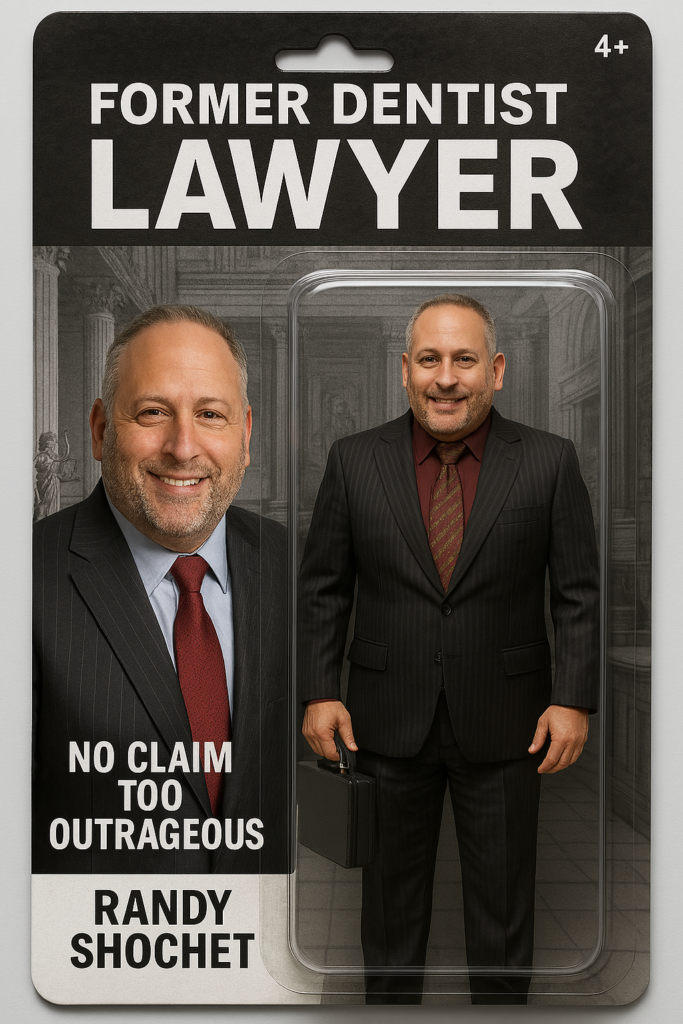
Under Florida’s Rules of Professional Conduct, a lawyer must not make false statements to a tribunal or engage in dishonesty. Breaching those duties can trigger swift discipline.
Florida courts have long taken a hard line on liars: the state’s Supreme Court calls false testimony “a serious offense” that “undermines the administration of justice.” Attorneys caught deceiving judges or regulators often face permanent disbarment as the only fitting penalty.
If The Florida Bar confirms that Shochet fudged facts and misled the court, he could be facing the nuclear option: loss of his law license. And any punishment won’t stop at Florida’s borders. Bar discipline is usually reciprocal: a disbarment in Florida would likely slam the door on Shochet in any jurisdiction.
After a lifetime of skating on thin ice, Randy “Rocket” Shochet may finally crash to earth. The very courtroom games he set in motion now threaten to blow up his career – with disgraced attorney Shochet potentially becoming a cautionary tale of how not to practice law.
Leave a Reply