
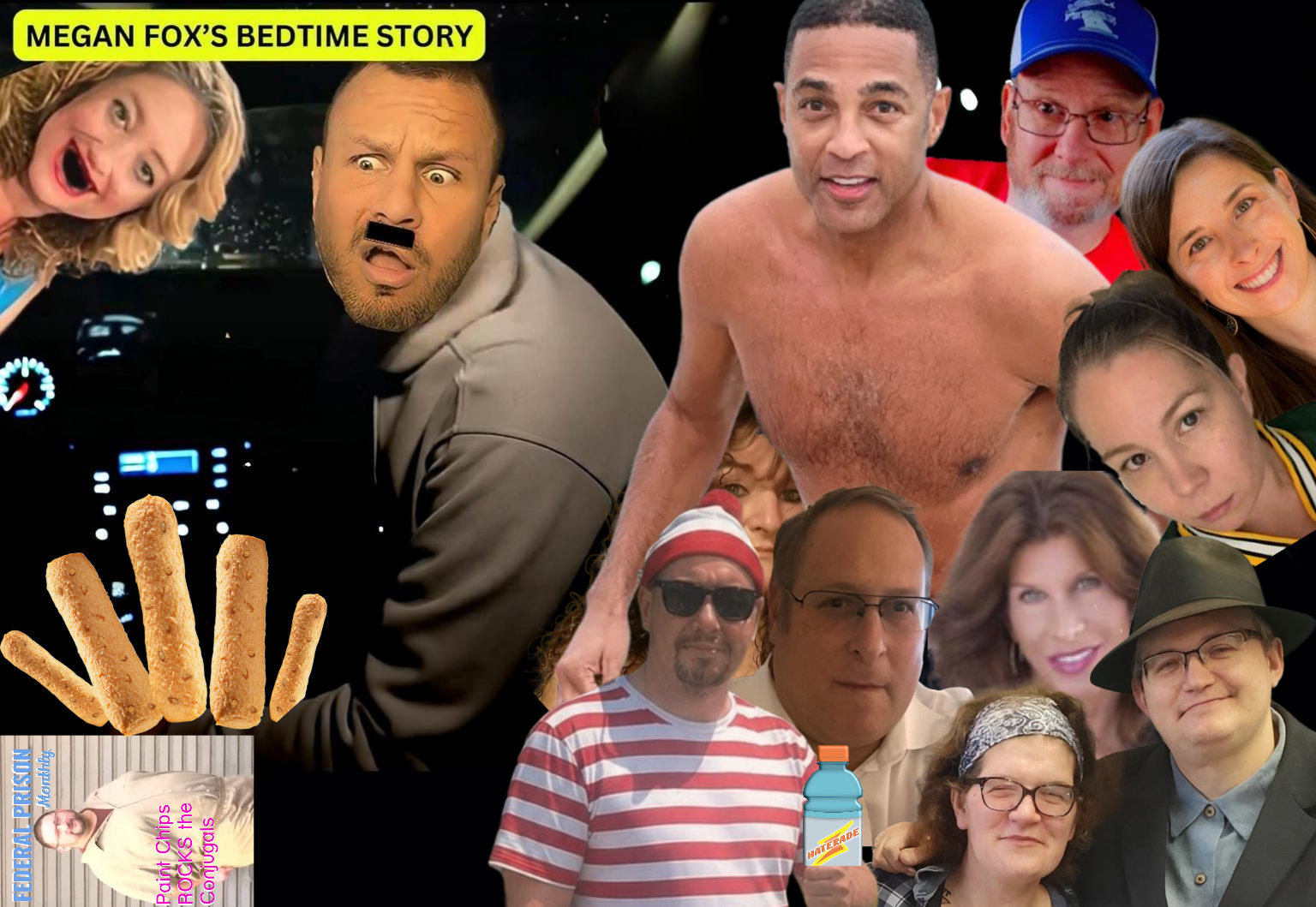
Luthmann demands that Hales and Shochet “show the frame” behind the revenge-porn claim.
LUTHMANN NOTE: This is where the Hales Media Ecosystem runs into the courthouse wall. You can shout “revenge porn” on YouTube. You can make thumbnails. You can rile up fans. You can pass the donation plate. But in federal court, you need law, facts, elements, and proof. Hales brought the claim. Shochet signed the papers. Luthmann demanded the frame. That is the whole ballgame. If the video says what they claim, show the timestamp. If the statute applies, explain the date problem. If the legal fees are real, show the receipts. FED 2 is now about records, not rage. This piece is “Federal Court Show-And-Tell.”

By M. Thomas Nast and Richard Luthmann
(GAINESVILLE, FLORIDA) – The federal courthouse in Gainesville has become the newest arena in the Jeremy Hales legal circus, and the latest episode of FED 2 is no ordinary docket twitch. It is a full-blown procedural street fight over judicial time, statutory gamesmanship, and whether a plaintiff and his lawyer can keep repeating a lurid courtroom allegation without pointing to the exact frame, timestamp, or image that supposedly proves it.

The case is Jeremy B. Hales v. Lynette Michelle Lacy Alexis Preston and Richard A. Luthmann, Jr., with Hales as Plaintiff and Luthmann as Defendant. The courtroom is not a YouTube thumbnail, and captions, like allegations, are supposed to be accurate.
At the center of the latest explosion is Magistrate Judge Zachary C. Bolitho’s denial of Luthmann’s request to file a limited reply on Count II, the Florida sexual-cyberharassment claim. Luthmann asked for permission to file a short reply on one narrow issue: which version of Florida Statute § 784.049 governs the claim.

The challenged publication was alleged to have occurred in January 2025. The later amendments to the Florida statute did not take effect until October 1, 2025. Luthmann’s point was simple. Apply the law that existed when the alleged publication occurred, not a later statute dragged backward like a legal time machine.
Bolitho denied the request, citing the local rule that a party ordinarily may not file a reply memorandum and finding no “extraordinary circumstances.”
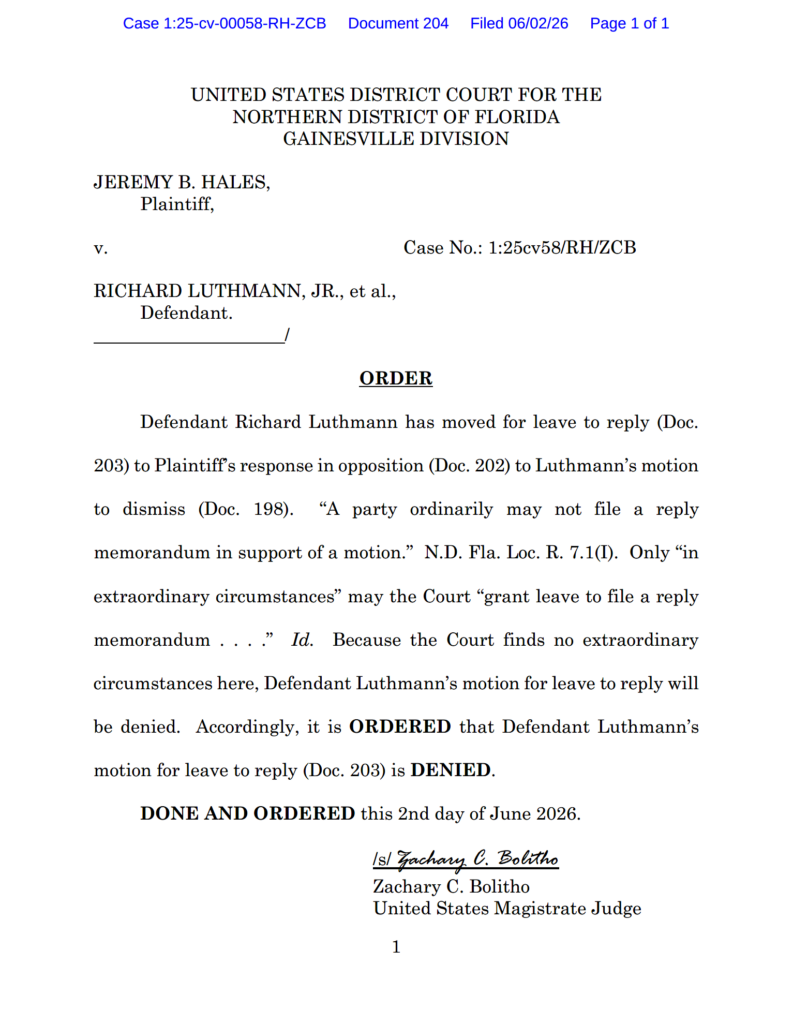
That one-page order became the match in the gas tank. Luthmann went live and told his audience that, in practical effect, the court had just treated judicial time as ordinary.
“If there is no extraordinary circumstance here, that means that considerations for the judge’s time and the expenditure of judicial resources are ordinary,” Luthmann said. “I always thought judges, and in particular Article III Judges, were pretty extraordinary. Judge Bolitho paints them as rather pedestrian, and their time and the resources they administer are no different than those of the butcher, the baker, or the candlestickmaker.”

Luthmann’s argument was not that every litigant should get endless briefing. His argument was that one short reply on a threshold statutory issue could save the court, the parties, and the docket from a swarm of later filings.
That is the “stitch in time” theory, and it is not just a slogan. Federal Rule of Civil Procedure 1 requires the rules to be construed and administered to secure the just, speedy, and inexpensive determination of every action. Fed. R. Civ. P. 1. Federal Rule of Civil Procedure 83 requires local rules to remain consistent with the federal rules. Fed. R. Civ. P. 83(a)(1).
Luthmann argues that if a local no-reply rule is applied so rigidly that it prevents a court from resolving a potentially dispositive legal defect early, then the local rule becomes a trapdoor rather than a case-management device.
The Eleventh Circuit has already warned courts about letting defective litigation metastasize. In Chudasama v. Mazda Motor Corp., the court emphasized that threshold legal defects should be resolved early because discovery and needless proceedings can impose enormous costs on litigants and courts. 123 F.3d 1353, 1367–68 (11th Cir. 1997).
In Perez v. Wells Fargo N.A., the Eleventh Circuit warned against practices that burden parties and consume scarce judicial resources. 774 F.3d 1329 (11th Cir. 2014).
In Vibe Micro, Inc. v. Shabanets, the court again pushed for clarity and precision rather than procedural sludge. 878 F.3d 1291, 1295–96 (11th Cir. 2018).
Luthmann’s live boiled those cases down to plain English: one reply now, or nine papers later.
Federal Court Show-And-Tell: The Statute Problem – January 2025 Is Not October 2025
The legal issue is not complicated, which may be why it is so dangerous to Hales’s theory. Count II depends on Florida’s sexual-cyberharassment statute, Fla. Stat. § 784.049. Luthmann’s position is that the version in force at the time of the alleged January 2025 publication controls.
Hales’s response, according to Luthmann, leaned into broader concepts of manipulated or fabricated imagery without squarely confronting the timing problem. The later Florida amendment may be more useful to a plaintiff trying to stretch the claim toward synthetic or altered imagery, but later amendments do not normally reach backward unless the Legislature clearly says so.
That is basic Florida retroactivity law. Florida statutes are presumed prospective unless the Legislature clearly expresses retroactive intent, and even then courts must consider whether retroactive application would impair vested rights, create new obligations, or impose new penalties. Menendez v. Progressive Express Ins. Co., 35 So. 3d 873, 877–78 (Fla. 2010); Metro. Dade County v. Chase Federal Housing Corp., 737 So. 2d 494, 499–500 (Fla. 1999); Old Port Cove Holdings, Inc. v. Old Port Cove Condominium Ass’n One, Inc., 986 So. 2d 1279, 1284 (Fla. 2008). A federal court sitting in diversity applies state substantive law. Erie R.R. Co. v. Tompkins, 304 U.S. 64, 78 (1938); St. Paul Fire & Marine Insurance Co. v. Lago Canyon, Inc., 561 F.3d 1181, 1188 (11th Cir. 2009).
That means the statutory version is not a side issue. It is the keyhole through which Count II must pass. Under Luthmann’s view, the 2024 version of § 784.049 targeted actual private sexually explicit imagery disseminated without consent and contrary to a reasonable expectation that the image would remain private. The statute was built for the classic revenge-porn scenario: intimate material, private context, nonconsensual exposure. It was not designed as a general-purpose blunderbuss for vulgar satire, political mockery, public-source collage, or grotesque internet parody.
That is where the case gets ugly for Hales. Luthmann argues the challenged media was not an actual private intimate image entrusted by Hales to Luthmann. It was not a secret recording. It was not a private file stolen from a safe, phone, account, or bedroom. It was a satirical publication built from public imagery and commentary. Hales may hate it. Hales may call it offensive. Hales may try to label it something worse. But dislike does not amend a statute, and outrage does not create a privacy expectation.
Federal Court Show-And-Tell: Rule 72
After Bolitho denied leave to reply, Luthmann filed Rule 72 objections to the District Judge. Rule 72(a) allows a district judge to modify or set aside a magistrate judge’s non-dispositive order if it is clearly erroneous or contrary to law. Fed. R. Civ. P. 72(a). Luthmann’s objections argue that the order denied a narrow filing without meaningfully addressing the statutory-timing issue, the limited scope of the proposed reply, the lack of prejudice, the prior attempt to obtain a stipulation, or the risk of unnecessary future motion practice.
The live framed it with courtroom theater, but the legal theory is serious. Luthmann is not asking for a privilege unavailable to the other side. His objections even offer Hales a short sur-reply limited to the same issue if the District Judge believes that is appropriate. That is not ambush litigation. That is targeted issue-framing. The motion sought to sharpen the blade before the court cuts, not to bury the court under paper.
The deeper issue is the relationship between local efficiency rules and actual efficiency. A no-reply rule can prevent bloated briefing. But if applied blindly, it can also prevent the court from hearing a short answer to a new or muddied issue raised in opposition. That is where Luthmann says the denial collapses under its own weight. The court can either resolve the statutory version now or risk reconsideration, supplemental briefing, and appellate noise later.
In Luthmann’s telling, this is not about getting the last word. It is about getting the right law. That is the phrase that should haunt the docket. The wrong statute applied early can infect everything downstream. It can infect dismissal analysis, discovery, sanctions, settlement posture, attorney’s fees, and appeal. If the statutory issue is dispositive, then pretending it is ordinary is like calling a loaded gun a paperweight.
Federal Court Show-And-Tell: Show The Frame
The second bombshell from the live was Luthmann’s show-cause motion. Hales and his counsel, Randall Mark Shochet, have allegedly represented that the challenged media depicts Hales engaged in sexual conduct with a journalist. Luthmann says that is false, materially false, and central to Count II. His demand is brutally simple: show the frame.
Not the rhetoric. Not the thumbnail. Not the outrage. Not the audience tears. Show the exact frame, still image, timestamp, or media segment that supports the allegation. If the plaintiff and his lawyer told a federal court the media shows X, they should be able to identify where X appears. That is not harassment. That is litigation hygiene.
Luthmann’s motion asks the court to require Hales and Shochet to show cause why sanctions, corrective action, or other relief should not issue if their repeated description of the media is contradicted by the exhibit itself. The motion invokes the court’s inherent authority, 28 U.S.C. § 1927 as to counsel, and Rule 11 concepts, while making clear that Luthmann is asking the court to act on its own authority rather than trying to bypass Rule 11’s party-motion safe harbor.
The legal spine is strong. Rule 11 requires factual contentions to have evidentiary support after a reasonable inquiry. Fed. R. Civ. P. 11(b)(3). Section 1927 permits sanctions against counsel who unreasonably and vexatiously multiply proceedings. 28 U.S.C. § 1927. A court need not accept a litigant’s characterization of an exhibit when the exhibit itself is before the court and central to the claim. Hoefling v. City of Miami, 811 F.3d 1271, 1277 (11th Cir. 2016); Griffin Industries, Inc. v. Irvin, 496 F.3d 1189, 1205–06 (11th Cir. 2007). And when video evidence flatly contradicts a party’s version of events, the court need not accept the contradicted version. Scott v. Harris, 550 U.S. 372, 380 (2007).
That is the courtroom equivalent of “roll the tape.” Luthmann has now put the media before the court, according to his live discussion, as a digital exhibit. If Hales and Shochet are right, they should have no problem identifying the moment. If they are wrong, the foundation of Count II may crack before discovery even begins.
Federal Court Show-And-Tell: The Filed Exhibit Becomes The Battlefield
The live repeatedly returned to the fact that the challenged media has been lodged or filed as an exhibit in the federal case. Luthmann called it a newly minted court exhibit and used that fact to hammer home the difference between internet chatter and evidence. On the internet, a mob can squint at a meme and call it whatever serves the narrative. In federal court, the exhibit has to speak for itself.
That is why the show-cause motion matters. Hales’s Count II theory depends on the disputed characterization of the media. If the media is merely offensive satire, parody, or commentary, then the revenge-porn label begins to look like litigation branding rather than statutory fact. If the media does not contain actual private intimate imagery of Hales, then the old statute’s privacy-expectation element becomes a brick wall.
Luthmann also tied the issue to First Amendment avoidance. Courts should avoid construing statutes in ways that create serious constitutional problems when a narrower interpretation is available. Edward J. DeBartolo Corp. v. Florida Gulf Coast Building & Construction Trades Council, 485 U.S. 568, 575 (1988). If Hales’s theory turns Florida’s revenge-porn law into a weapon against satire, commentary, or political mockery built from public images, the First Amendment problem is obvious.
Hustler Magazine, Inc. v. Falwell protects outrageous parody absent constitutionally actionable false statements of fact. 485 U.S. 46, 50–57 (1988). Greenbelt Cooperative Publishing Ass’n v. Bresler protects rhetorical hyperbole that no reasonable reader would take literally. 398 U.S. 6, 13–14 (1970). Milkovich v. Lorain Journal Co. preserves protection for speech that cannot reasonably be understood as asserting provably false fact. 497 U.S. 1, 20 (1990).
Hales may claim injury. He may claim humiliation. He may claim reputational harm. But a revenge-porn statute is not a feelings statute. It is a statutory cause of action with elements. Luthmann’s point is that Count II has to live or die by those elements, not by the heat of the livestream machine surrounding the case.
Federal Court Show-And-Tell: The Hales Legal-Fee Numbers Come Under Fire
Then the live took a hard turn from federal procedure into money. Leslie Ferderigos, a defendant in another Hales-related case and a retired attorney, has put Shochet on formal notice over alleged misrepresentations concerning legal fees and online fundraising. According to the notice discussed on the live, Hales allegedly made public statements claiming massive and shifting legal-fee totals while supporters solicited donations through a GoFundMe campaign.
The numbers matter because they allegedly moved around like a carnival shell game. In the materials discussed during the live, Hales is alleged to have told audiences various figures: $390,000, $480,500, $436,500, $438,000, $440,500, $471,500, $481,500, $487,500, $1 million, and then days later that he was still short of half a million. Those are not small discrepancies. They are not rounding errors. They are the kind of numbers that demand receipts.
The Ferderigos notice also referenced a GoFundMe campaign that allegedly stated the Hales’ legal bills had already cost Jeremy and George $539,700 out of pocket, while raising more than $36,000 toward a $200,000 goal. The notice alleges these representations are materially false and potentially implicate Florida fraud statutes and federal wire-fraud concepts. Those are allegations, not adjudicated findings. But they are now part of the paper war, and they put Shochet in a dangerous position if the claims are tied to fees paid to or through his firm.
Luthmann’s live did not treat this as background noise. He framed it as potential impeachment material and possible discovery fuel. If Hales claims one number on one livestream, another number on another livestream, and a different number in a fundraising pitch, those statements may become relevant to credibility, damages, billing records, trust-account issues, and the public monetization of litigation.
Lisa Lee And The Out-Of-Court Smear Machine
The live also discussed Lisa Lee’s notice to Shochet, which alleges defamatory, harassing, and intimidating out-of-court conduct by Hales, Martha George Rizk, Megan Fox, and Matthew Lewis, also known online as That Umbrella Guy. Lee’s notice alleges that these figures made false statements about her and other private citizens during active litigation. Again, those are allegations, not findings. But they fit Luthmann’s broader thesis: the Hales world is not merely litigating cases. It is content-producing, audience-mobilizing, fundraising, smearing, and litigating at the same time.

That ecosystem problem is the real story. A normal lawsuit begins in a complaint and proceeds through motions, discovery, trial, or settlement. The Hales model, as Luthmann describes it, is different. The lawsuit becomes content. The content feeds the audience. The audience feeds the donations. The donations feed the lawsuit. The lawsuit feeds the next thumbnail. Around and around it goes until the court system becomes a prop in a monetized grievance machine.
That is why the notices from Leslie and Lisa matter. They move the battlefield from “who said what online” to “what did counsel know, when did counsel know it, and what duties arise when a client allegedly uses out-of-court broadcasts to harass opponents, solicit money, or distort the status of active litigation?” Lawyers are not potted plants. They cannot knowingly allow the courthouse to become a stage set for conduct that, if proven, prejudices proceedings or misleads the public.
Federal Court Show-And-Tell: FED 2 Is Now About Receipts
The live made one theme impossible to miss: receipts. The court has the exhibit. The court has the filings. The parties have the statements. Now the question is whether Hales and Shochet can back up the story they have told.
If the challenged media really depicts what they say it depicts, they should identify the exact frame. If the statute really reaches the publication, they should explain why the January 2025 version does not control. If the legal-fee numbers are real, the billing records should prove them. If the GoFundMe claims are accurate, the trust records, invoices, retainers, and receipts should line up. If the out-of-court smear allegations are false, the record should show that too.
But if the receipts do not exist, FED 2 may become something far bigger than a failed claim. It may become a map of how litigation, social media, fundraising, and reputational warfare can be fused into one machine. That is the kind of story courts dislike because it makes the courthouse look less like a forum for justice and more like a content studio with subpoenas.
Luthmann’s live was vintage Luthmann: part legal seminar, part alley fight, part media autopsy, part political-theater flamethrower. But beneath the combat language is a clean legal point. Courts are supposed to apply the right law. Lawyers are supposed to make accurate factual representations. Plaintiffs are supposed to plead statutory elements. Public fundraising claims are supposed to be true. And if a litigant says a video shows something, federal court can ask the only question that matters.
Show the frame.
The Bottom Line
FED 2 is no longer merely Hales versus Luthmann. It is now a credibility case, a statutory-timing case, a judicial-economy case, and a media-ecosystem case. Judge Bolitho denied the reply. Luthmann took it upstairs under Rule 72. Hales and Shochet now face a show-cause demand over whether their repeated description of the media matches the exhibit itself. Leslie Ferderigos has opened the legal-fee front. Lisa Lee has opened the out-of-court harassment front. And the whole Hales content machine is now being forced toward the one place where hashtags, thumbnails, and livestream fury do not decide facts: the record.
In the end, the courthouse does not care how many subscribers a plaintiff has. It does not care how many fans shout in the chat. It does not care how many times a content creator repeats a label. A court asks for pleadings, evidence, law, and proof. FED 2 has reached that moment. The noise is loud. The paper is flying. The docket is alive. But the question is still simple enough for anyone to understand.
Hales brought the claim. Luthmann demanded the proof. Now the court may have to decide whether the story collapses when the video is actually viewed.
Leave a Reply