
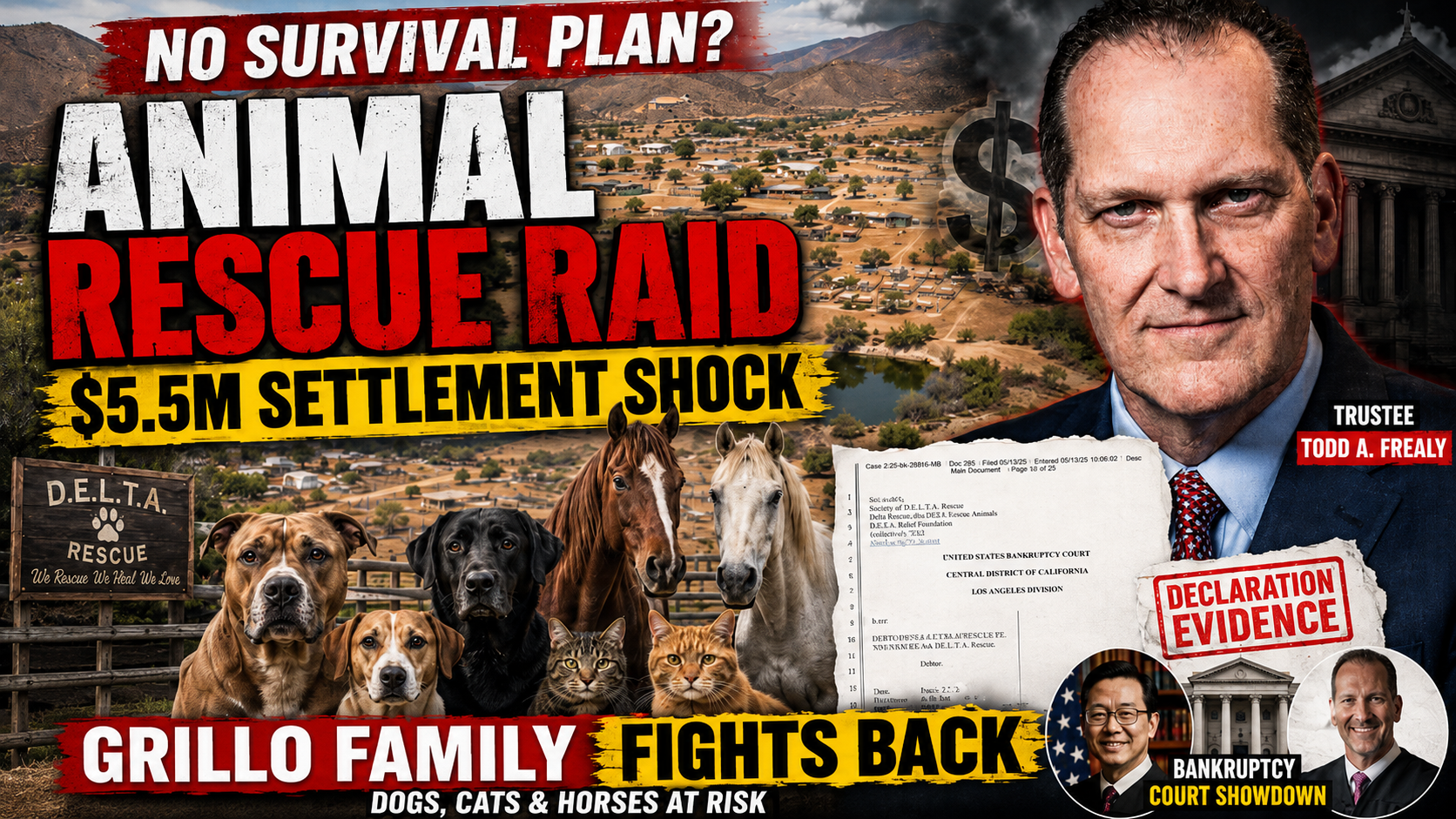
D.E.L.T.A. Rescue fight explodes as the Grillo family warns that dogs, cats, and horses could pay the price.
LUTHMANN NOTE: This is where journalism has to kick the courthouse door open. Dogs, cats, and horses do not understand Bankruptcy Rule 9019, trustee discretion, unliquidated fee claims, or investment liquidation. They understand food, medicine, shelter, safety, and the humans who promised they would not be thrown away. Erica Grillo has dragged the hidden issue into daylight: this is not merely a creditor dispute. It is a test of whether the bankruptcy system will demand a real animal-survival plan before allowing a financial machine to grind through a living sanctuary. No survival plan, no deal. That should be the rule. This piece is “Animal Rescue Raid.”


By Rick LaRivière and Richard Luthmann
A Voice for the Voiceless
(LOS ANGELES, CALIFORNIA) – This is no ordinary bankruptcy fight. This is a courtroom cage match over the fate of hundreds of dogs, hundreds of cats, and a herd of horses who cannot file pleadings, cannot hire lawyers, and cannot walk into federal court to tell Judge Neil W. Bason that their lives may hang in the balance on what happens next.

In the Chapter 11 case of Dedication & Everlasting Love To Animals, better known as D.E.L.T.A. Rescue, Trustee Todd A. Frealy is asking the Bankruptcy Court to approve a $5.5 million settlement and authorize liquidation of additional investments. On paper, it looks like a settlement motion. In the real world, critics say it looks like a financial meat cleaver hovering over a care-for-life sanctuary.
That is where Erica Grillo stepped forward. In her declaration, Grillo identifies herself as D.E.L.T.A.’s Secretary, an officer of the organization, and the daughter of founder Leo Grillo. More importantly, she positions herself as the person speaking for the animals while the professionals talk in claims, ledgers, fees, and liquidation authority.
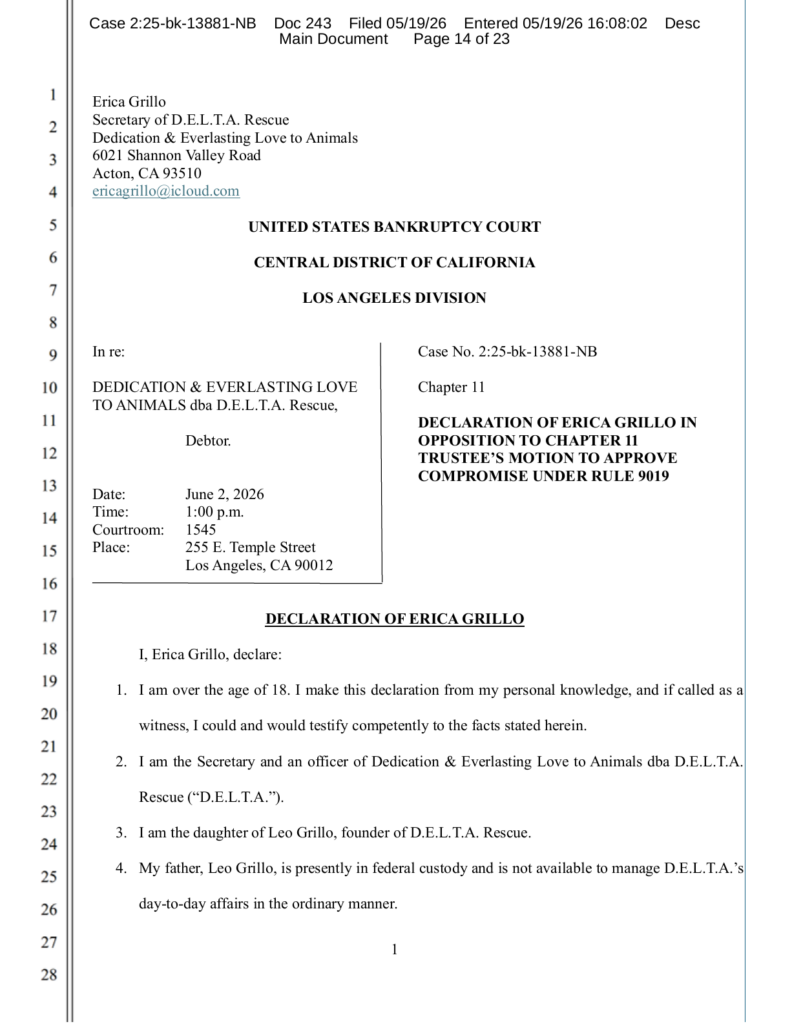
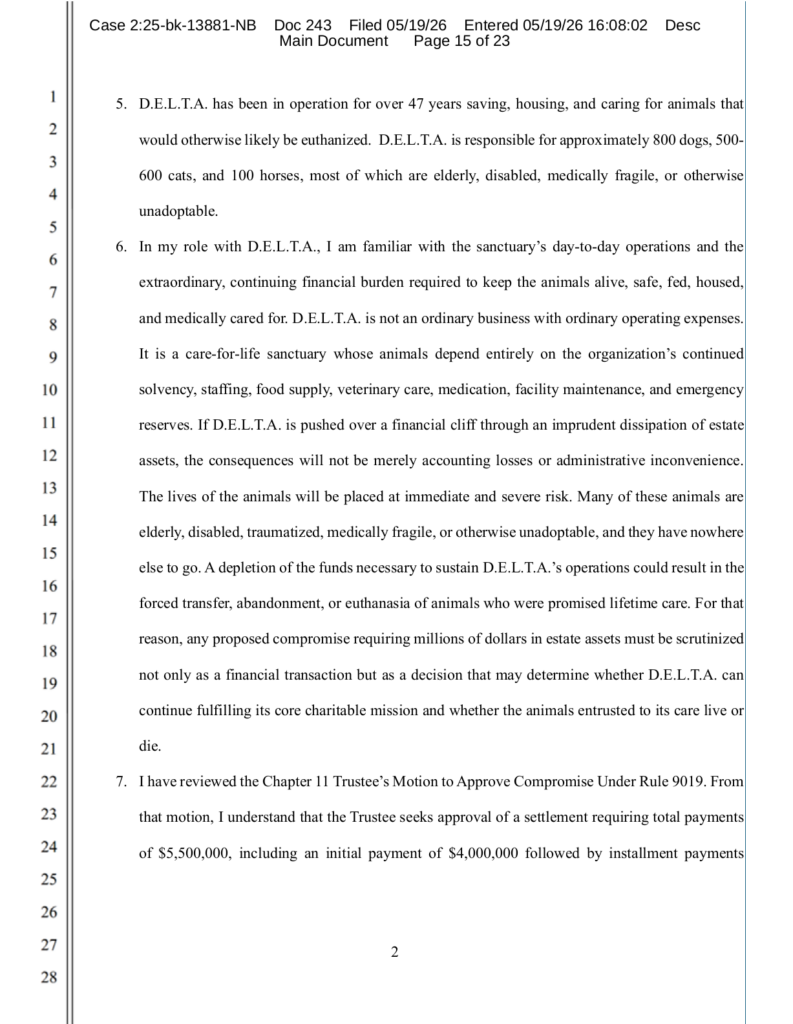
She told the Court D.E.L.T.A. has operated for more than 47 years and is responsible for approximately 800 dogs, 500 to 600 cats, and 100 horses, many elderly, disabled, medically fragile, traumatized, or otherwise unadoptable. These are not “assets.” These are living beings promised lifetime care.
Grillo’s warning is direct: if D.E.L.T.A. is pushed over a financial cliff, the consequences will not be accounting losses. They may be forced transfers, abandonment, or euthanasia.
That is the moral thunderclap in this case.
Animal Rescue Raid: Frealy’s Settlement is Clean Numbers, Dirty Consequences
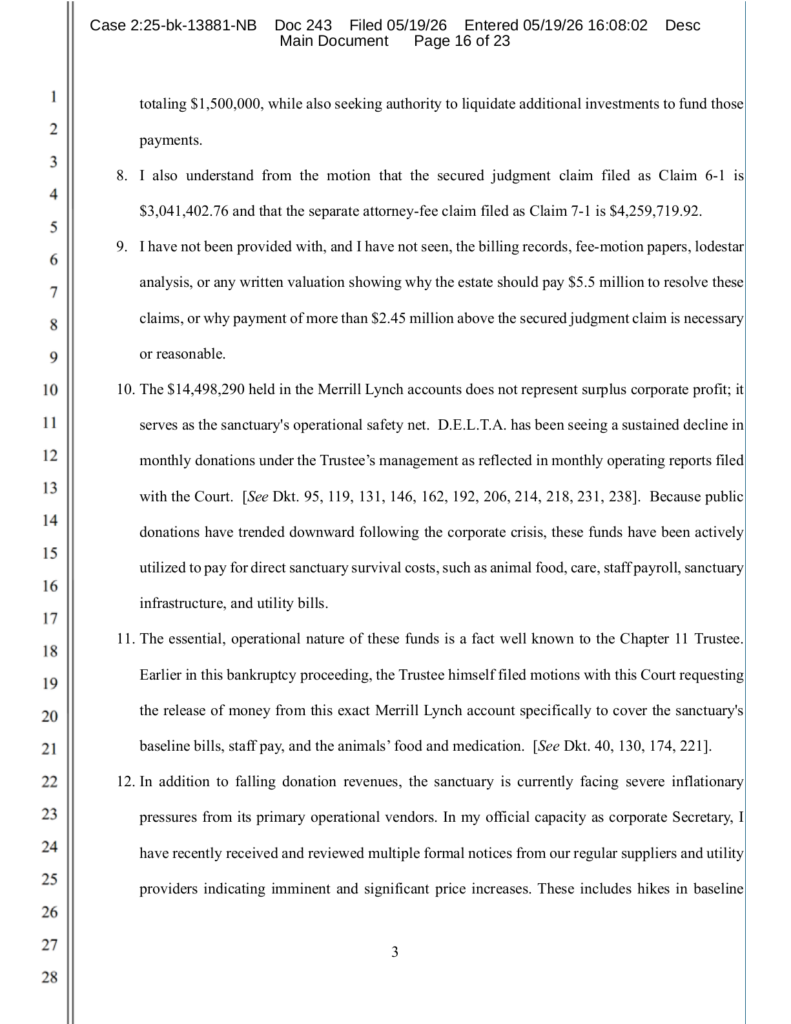
Frealy’s motion asks the Court to bless a $5.5 million legal compromise, including a $4 million initial payment and $1.5 million in installments, while also authorizing liquidation of additional investments to fund the deal.
Objectors do not deny that the Valentines litigation must be addressed. What they challenge is the size, speed, and evidentiary emptiness of the deal. The opposition states the secured judgment claim is approximately $3,041,402.76, while the separate attorney-fee claim is more than $4.25 million, unliquidated, and, by the Trustee’s own showing, likely reducible.
Yet Frealy still wants approval of a settlement roughly $2.46 million ABOVE the secured judgment claim without giving the Court the full fee motion, billing records, time summaries, lodestar analysis, or competent valuation showing why that premium is justified.

That is where this begins to stink. When a nonprofit sanctuary’s investment reserves are the food bowl, medicine cabinet, payroll account, emergency fund, and winter blanket for more than a thousand animals, the Court should not be asked to rubber-stamp a deal on generalized “business judgment.”
Business judgment is not a magic wand. It does not turn a shaky record into evidence. It does not transform untested attorneys’ fees into sacred debt. It does not answer the central question: what happens to the animals after the money is gone?
Grillo’s declaration says the Merrill Lynch accounts are not surplus profit. They are D.E.L.T.A.’s operational safety net. She states the funds have been used for animal food, care, staff payroll, infrastructure, utility bills, and the basic costs of keeping the sanctuary alive. She also says donations have declined under Trustee management, while vendor and utility costs have risen.
Animal Rescue Raid: Locked Out While the Deal Was Cut
The most explosive part of the filing may be Grillo’s account of the mediation. She says D.E.L.T.A. tried to participate in the April 13, 2026, mediation before retired Bankruptcy Judge Robert F. Kwan. She says she was supposed to attend in her official capacity as corporate Secretary to protect the operational interests of the sanctuary and the animals.

Then, according to her declaration, the rules changed. She says she was barred from the room, denied a Zoom link, denied a telephone dial-in, and forced to sit outside while the Trustee, insurer, creditor, and lawyers negotiated a $5.5 million deal behind closed doors.
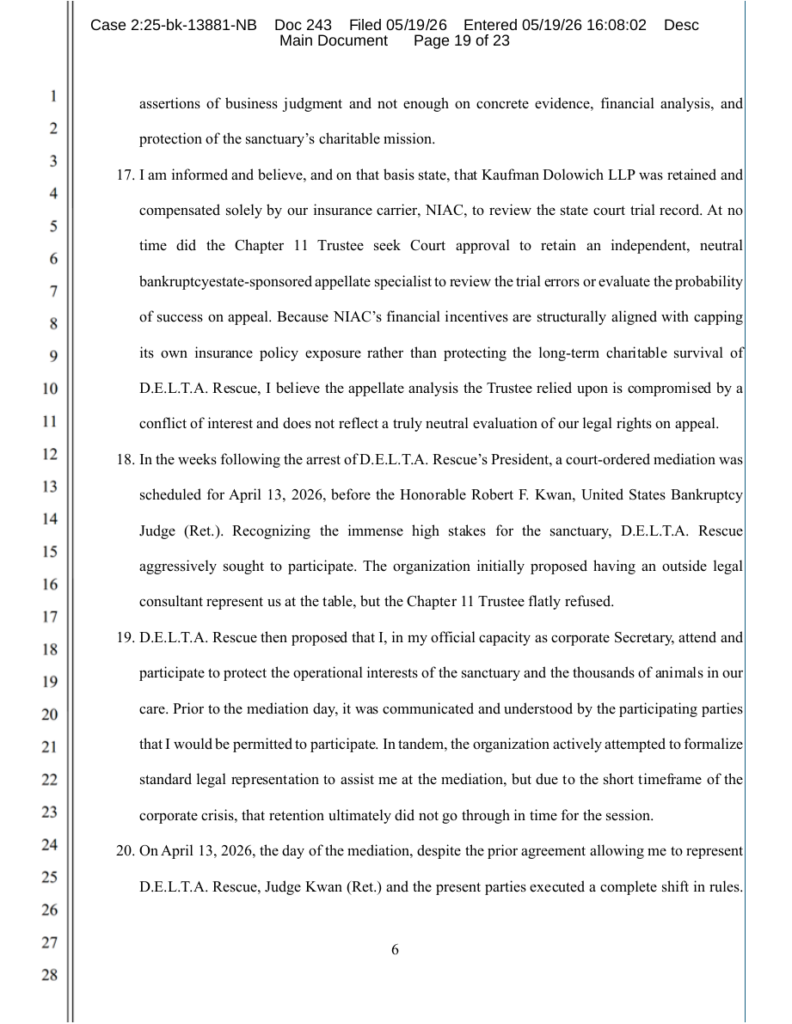
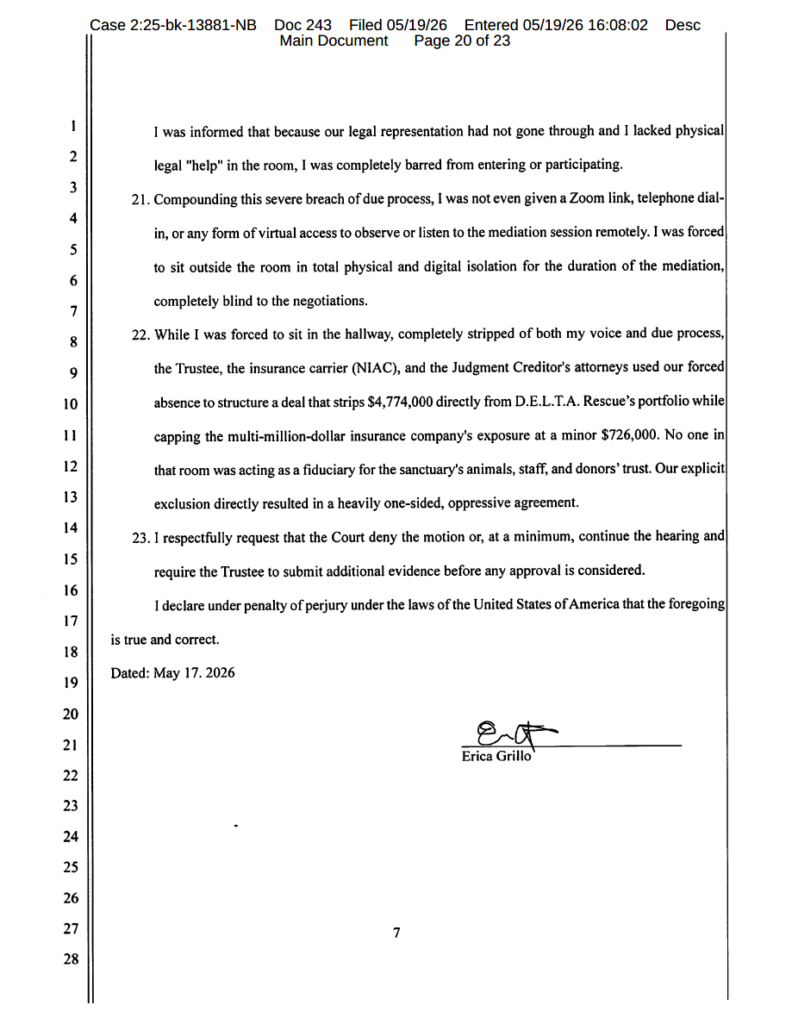
If true, that is not merely bad optics. That is a five-alarm fairness problem. Who represented the animals in that room? Who represented the staff who feed them? Who represented the donors who gave money for lifetime care? Who represented the sanctuary’s future?
A trustee may have legal authority over the estate, but authority is not omniscience. Frealy is not a sanctuary operator. He is not a veterinarian. He is not the person who knows which animals are fragile, which ones need medication, which ones cannot be moved, and which ones will die if the money dries up or the operation collapses.
This is why the filing paints Frealy not as a careful steward, but as a cold liquidation operator treating a living sanctuary like inventory.
Critics are not saying the Court should ignore creditors. They are saying Frealy has not shown the Court the full cost of what he is asking it to approve. They are saying the judge should not be turned into a co-signer on a deal whose foreseeable consequences could be dead animals and a gutted charitable mission.
Animal Rescue Raid: Frealy Gets Questions — But No Answers Yet
Before publication, Frealy was given detailed written questions. As of press time, he had not provided an animal-survival plan, restricted-fund tracing analysis, independent appellate review, fee-claim valuation, post-settlement operating budget, or assurance that no D.E.L.T.A. animals would be euthanized or abandoned as a consequence of the proposed settlement. Here is what we asked:
From: Richard Luthmann <ri**************@********il.com>
Date: On Thursday, May 21st, 2026 at 1:47 PM
Subject: Press Inquiry: D.E.L.T.A. Rescue Rule 9019 Settlement, Animal-Welfare Risk, and Trustee Disclosures
To: ta********@***yb.com, ta*@*************ns.net, Ch*************@***********ts.gov
CC: fr*************@********il.com, fr**********@***il.com, RA**********@********il.com, Ri***********@****on.me, mt*********@********il.com, pi*************@***oo.com, ju*******@****on.me, mv*******@***il.com, kj*@***yg.com, da******@***oj.gov, ro********@***oj.gov, er*********@****ud.com, mi************@*************er.com, ya***********@*************er.com, mi************@************cy.com, Da*********@****ca.gov, ta********@***yb.com, ta*@*************ns.net, ar***@****pc.com, je******@****pc.com, ru***@****pc.com, us*****************@***oj.gov, sh**********@*****aw.com, ra**********@*****aw.com, sh**************@**********ro.com, li********@**so.law, li**@****pc.com, in**@********ls.org, ji*************@*****il.com, ji**@********ls.org, ka***@********ls.org, es*****@**df.org, su*****@**df.org, Pr*****@**df.org, Me***@**df.org, ev****@**df.org, al*@**df.org, me********@**df.org, in**@**df.org, me***@**df.org, me***@****sa.org, to**@****sa.org, br******@****sa.org, ac*************@****sa.org
Mr. Frealy:
We are independent journalists preparing coverage concerning your Chapter 11 trusteeship of Dedication & Everlasting Love To Animals dba D.E.L.T.A. Rescue, the pending Rule 9019 settlement motion, and the objection filed by Erica Grillo, Leo Grillo, Charles Leonard, and John Rustin.
The issue is no longer merely a bankruptcy settlement. It is whether a court-supervised fiduciary is treating a care-for-life animal sanctuary like a stack of liquidation paper while hundreds of dogs, hundreds of cats, and horses sit on the other side of the ledger.
The opposition states that D.E.L.T.A. Rescue is responsible for approximately 800 dogs, 500–600 cats, and 100 horses, many of whom are elderly, disabled, medically fragile, traumatized, or otherwise unadoptable. Erica Grillo’s declaration warns that depletion of the sanctuary’s operating funds could place animals at immediate risk of forced transfer, abandonment, or euthanasia.
Your motion asks the Bankruptcy Court to approve a $5.5 million settlement and authorize liquidation of additional investments to fund it. Critics say the filing reads like a cold financial maneuver designed to push a massive settlement through without a full animal-survival record, without a tested attorney-fee valuation, without a donor-restriction tracing analysis, and without a concrete operational plan showing how D.E.L.T.A.’s animals stay alive after millions of dollars are stripped from the sanctuary’s reserves.
Worse, critics question whether the filing was presented in a way that effectively asks Judge Neil W. Bason to become the judicial co-signer of a deal whose foreseeable consequences may include the financial collapse of a care-for-life sanctuary and the deaths of animals who were promised lifetime care.
Before publication, we request your full response to the following questions:
1. Where is the animal-survival plan?
Before asking the Court to approve a $5.5 million settlement and authorize additional liquidation of D.E.L.T.A. investments, did you prepare or obtain a written animal-welfare impact analysis showing how the sanctuary will continue feeding, housing, medicating, staffing, and caring for approximately 800 dogs, 500–600 cats, and 100 horses?
If such a plan exists, please provide it.
If no such plan exists, why did you ask the Court to approve a settlement that may materially affect the survival of medically fragile and unadoptable animals without first presenting the Court with a formal survival plan?
Did you consult any veterinarian, sanctuary operator, animal-welfare expert, or long-term care specialist before concluding that the settlement would not endanger the animals?
2. Are you treating living animals like liquidation inventory?
D.E.L.T.A. is not an ordinary debtor. It is a care-for-life sanctuary. Many of its animals allegedly have nowhere else to go. Do you accept that your fiduciary analysis must include the sanctuary’s charitable mission and animal-care obligations, not just creditor payment mechanics?
What specific protections have you built into your settlement plan to prevent animal deaths, abandonment, medical neglect, food shortages, staff reductions, or transfers to unsafe placements?
Will you state under oath that no D.E.L.T.A. animal will be euthanized, abandoned, transferred to a kill facility, deprived of veterinary care, or denied food or shelter as a result of the settlement and liquidation you propose?
If you will not make that statement, why not?
3. Why should the estate pay millions above the secured judgment claim without a real evidentiary record?
The opposition states that the secured judgment claim is approximately $3,041,402.76, while the proposed settlement is $5,500,000. It also states that the separate attorney-fee claim remains unliquidated and that your own filings indicate the fee claim is likely reducible.
Why should D.E.L.T.A.’s animal-care funds be used to pay roughly $2.46 million above the secured judgment claim before the attorney-fee claim is adjudicated?
Did you provide the Court with the full fee motion, billing records, time entries, lodestar analysis, billing-rate analysis, or expert review supporting the fee portion of the settlement?
If not, why did you ask the Court to approve what critics call an outlandish lawyer windfall without giving the Court the documents needed to test it?
4. Was the filing designed to rush the Court into blessing a dangerous deal?
Critics say your settlement motion appears structured to move fast, keep the record thin, and force the Bankruptcy Judge into approving a deal without the hard evidence needed to understand the consequences for the animals.
Why should the public not view the motion as a “thief in the night” maneuver — not because it was literally filed at night, but because it appears to seek approval of a massive liquidation and settlement without the full fee record, without a complete animal-care impact record, without asset-specific liquidation details, and without a transparent survival budget?
Why did you not voluntarily provide the Court with a supplemental evidentiary package showing the projected effect of the settlement on D.E.L.T.A.’s monthly operating budget, food costs, veterinary costs, payroll, utilities, investment income, and emergency reserves?
Do you believe the Bankruptcy Court should approve a settlement affecting hundreds of vulnerable animals without that record?
5. Who in the mediation room represented the animals?
Erica Grillo declares that she was supposed to participate in the April 13, 2026, mediation but was barred from the room, denied a Zoom link, denied a telephone dial-in, and forced to sit outside while the settlement was negotiated.
Is that accurate?
Who decided to exclude her?
Did you object to her exclusion?
If the Debtor’s corporate Secretary and officer were excluded, Leo Grillo was unavailable, and the settlement was negotiated among the Trustee, the creditor, the insurer, and their professionals, who specifically represented the operational interests of D.E.L.T.A.’s animals, staff, donors, and charitable mission?
How can the settlement be described as fair, informed, or arm’s length if the person most familiar with the sanctuary’s daily animal-care operations was allegedly locked out?
6. Did NIAC get protected while D.E.L.T.A.’s animals got the bill?
The opposition argues that NIAC’s contribution is limited to $726,000 while D.E.L.T.A.’s estate is asked to pay millions from its investment portfolio. It also questions whether potential bad-faith claims against NIAC were properly evaluated.
Did you obtain an independent written analysis of potential bad-faith claims against NIAC before recommending the settlement?
If so, please provide it.
If not, why did you agree to a structure under which the insurer contributes a relatively small amount while the sanctuary absorbs the overwhelming financial burden?
Did you obtain a binding written commitment from NIAC to pay the $726,000?
If NIAC fails to pay, does the estate become responsible for that amount, too?
7. Did you rely on conflicted appellate advice?
Erica Grillo’s declaration states that the appellate review was allegedly performed by Kaufman Dolowich LLP, which she understands was retained and compensated by NIAC. She questions whether that analysis was neutral.
Did you obtain an independent, estate-paid appellate evaluation from counsel whose loyalty was solely to the bankruptcy estate and D.E.L.T.A.’s charitable mission?
If not, why not?
Did you disclose to the Court any potential structural conflict arising from reliance on appellate advice connected to the insurer whose financial interest may be to cap exposure and end litigation quickly?
What specific appellate issues were reviewed, and what probability-of-success analysis did you rely upon?
8. Did you trace donor-restricted funds before attempting to liquidate charitable investments?
The opposition argues that D.E.L.T.A.’s Merrill Lynch portfolio may include public donations, testamentary bequests, and specialized gifts restricted for animal care and lifetime sanctuary operations.
Did you conduct a tracing analysis to determine whether the funds you seek to liquidate are donor-restricted, subject to charitable trust principles, or protected under California law or UPMIFA?
Did you consult the California Attorney General’s Charitable Trusts Section before seeking authority to liquidate those assets?
If no tracing analysis was performed, why are you asking the Court to authorize liquidation of charitable assets that may not be freely available for payment of an unadjudicated private attorney-fee claim?
9. How much do you and estate professionals stand to gain from this settlement?
The opposition asks the Court to require disclosure of the effect of the proposed disbursements on trustee compensation under 11 U.S.C. §§ 326 and 330.
How much compensation, commission, or fee benefit could you receive if the settlement is approved and funded?
How much could your firm or estate professionals receive?
Does the size or speed of the settlement distribution affect trustee compensation, professional fees, administrative claims, or case-closing incentives?
Will you disclose in plain English whether approval of this settlement creates any financial benefit to you or your professionals beyond ordinary hourly compensation already approved by the Court?
10. Why should you remain a Trustee if you cannot answer these questions?
If you cannot produce an animal-survival plan, restricted-fund tracing, independent appellate analysis, full fee-claim valuation, NIAC bad-faith evaluation, investment-liquidation schedule, tax analysis, lost-income analysis, and post-settlement operating budget, why should the Court and the public trust you to control the fate of a 47-year animal sanctuary?
Do you deny that approval of this settlement on the present record could place D.E.L.T.A.’s animals at risk?
Do you deny that the animals’ lives are directly tied to the preservation of the investment principal you seek to liquidate?
Do you deny that asking the Court to approve this settlement without a full animal-welfare and financial-impact record risks turning the Bankruptcy Court into the judicial cover for a decision that could kill animals promised lifetime care?
Please tell us that you are not a SADIST who wants to see these animals DEAD, or a HACK who doesn’t care whether they live or die as long as you get YOUR FEE. That is a terrible picture.
We request your response as soon as possible, as we expect to go to press soon. If we hear from you after press time, we will incorporate your responses into a follow-up.
Thank you for your attention to this matter!
Regards,
Richard Luthmann
Writer, Journalist, and Commentator
Tips or Story Ideas:
(239) 631-5957
ri**************@********il.com
LINKTREE
Muck Rack Profile
Substack: This is For Real.
Editor-In-Chief: FLGulf.news
Editor-In-Chief: NYNewsPress.com
Editor-In-Chief: TheFamilyCourtCircus.com
Contributor: Frank Report
Contributor: Sun Bay Paper
Follow Me on Facebook X Instagram LinkedIn TRUTH Rumble Newsbreak SPOTIFY YouTube
Sent with Proton Mail secure email.
Frealy’s silence is loud enough to wake the whole kennel.
The questions went to the heart of the matter. Did Frealy obtain a written animal-welfare impact analysis before asking to liquidate millions? Did he consult veterinarians, sanctuary operators, or long-term care experts? Did he trace donor-restricted funds before seeking to use charitable assets for an unadjudicated private attorney-fee claim? Did he obtain independent appellate advice, or did he rely on analysis connected to NIAC, the insurer whose own exposure may be capped by the deal? Did he analyze possible bad-faith claims against NIAC? Did he calculate the lost investment income that supports operations? Did he disclose how approval and funding of the settlement may affect trustee or professional compensation?

These are not gotcha questions. They are survival questions. If Frealy can answer them, he should. If he cannot, the Court should not approve the deal on the present record.
A care-for-life sanctuary is not a busted warehouse. Dogs, cats, and horses cannot be liquidated into neat columns.
Erica Grillo has now forced the real issue into the open: this case is not just about paying claims. It is about whether the bankruptcy system will protect a charitable mission or allow a trustee’s cold paper shuffle to push vulnerable animals toward the death line.
Leave a Reply