
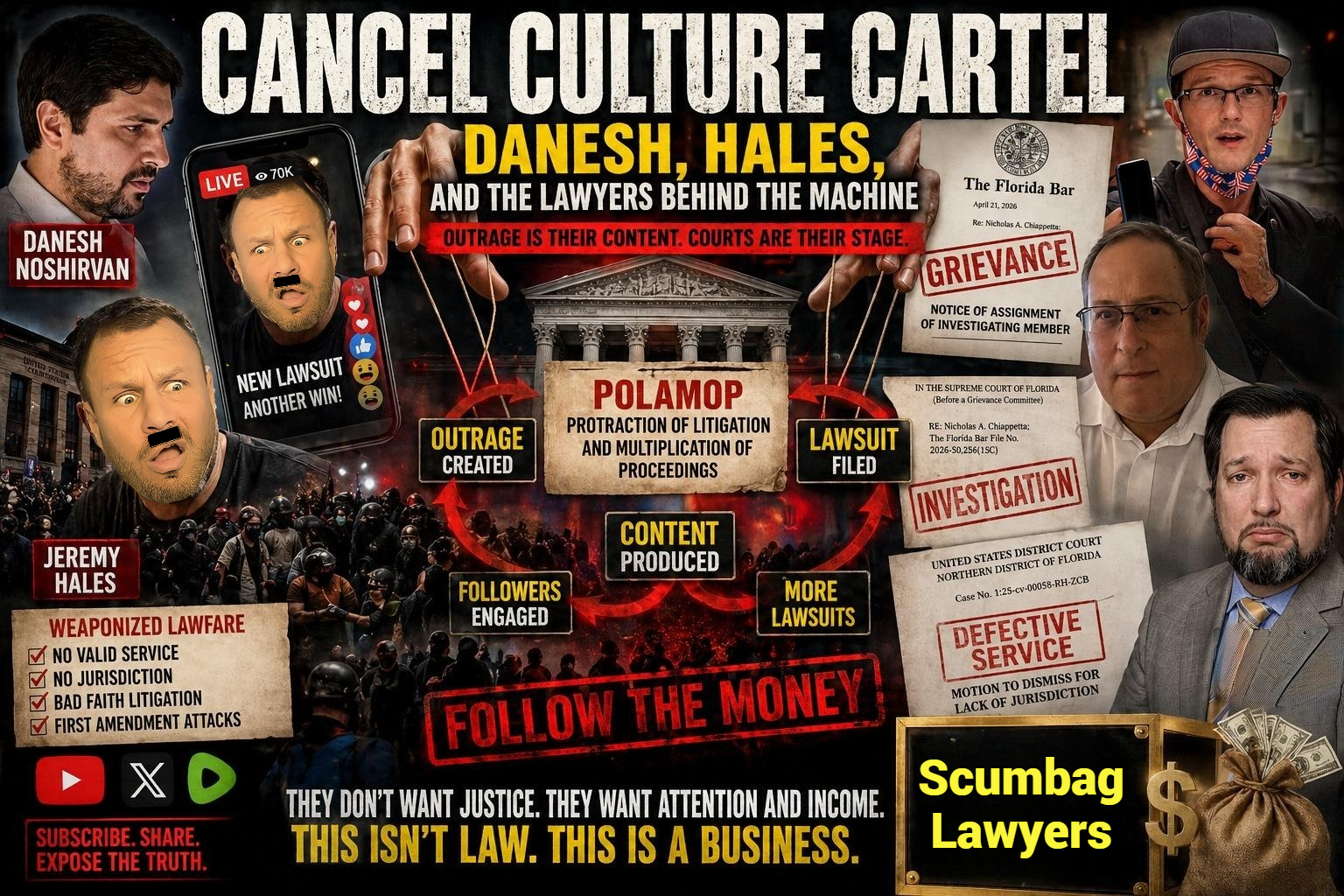
Jeremy Hales’ Own Mouth Links Danesh Noshirvan, Nick Chiappetta, Randy Shochet, and the Litigation-for-Clicks Content Machine
LUTHMANN NOTE: The Cancel Culture Cartel story is not about internet noise. It is about unconcealment. Jeremy Hales said the quiet part out loud, and the hidden machinery showed itself. The influencers create outrage. The lawyers create filings. The docket becomes content. The audience becomes money. Danesh Noshirvan and Jeremy Hales are not isolated characters; they are part of the same litigation-content ecosystem. Nick Chiappetta and Randy Shochet matter because lawyers make the machine possible, particularly in federal court. The public has a right to see the wires. The cartel worked in the shadows. Now the lights are on. This piece is “Cancel Culture Cartel Busted.”
By M. Thomas Nast with Richard Luthmann
(FLORIDA, USA) – Truth is not the story powerful people prefer. It’s not the polished narrative cooked up by lawyers, influencers, and paid cheerleaders after the damage is done. Truth is the moment the fake world cracks, the hidden machinery shows, and the public finally sees the wires.
Hales let the truth slip last year, and now it’s having devastating consequences not just for him, but for fellow Mega-Influencer Danesh Noshirvan and his legal team. It happened on Luthmann’s recent live show “Cancel Culture Cartel: Danesh, Hales and the Lawyers Behind the Machine.”
The show opened with Jeremy Hales, in his own voice, speaking from May 2025 and narrating what he thought was a victory lap. To his mind, Richard Luthmann had “finally been served after all of his dodging and fake addresses,” Hales announced.
Then he dropped the line that opened the whole machine: “With the collaboration of their legal team, the plaintiffs, we got him served right there outside of the courthouse.”
There it was. No subpoena was needed. No deposition trap was required. No leaked text chain had to surface. Hales said it himself. He, Danesh, and their respective lawyers were acting in concert.
He was also wrong. Luthmann was not hiding behind fake addresses. The service story was a mess of bad assumptions, shifting addresses, stale theories, and jurisdictional smoke. Hales’ version was not journalism. It was content creation, the cartoon that his audience needed to keep the storyline alive.
Hales also claimed Luthmann was in another Florida federal case for “witness intimidation” and “defamation,” invoked reporter privilege, and was online threatening to “destroy” another plaintiff.
Those claims were packaged like breaking news, but they were narrative ammunition for the Hales-Danesh axis, including the false-service stunt and public claims Hales and Danesh pushed to their audiences.
That was the smoking gun. Hales placed himself inside the Danesh Noshirvan litigation ecosystem, commenting from afar, but describing collaboration with legal teams and plaintiffs around courthouse service. That connects the Hales world to the Danesh world through lawyers, process servers, federal courthouses, online amplification, and content strategy.
Hales. Danesh. Shochet. Chiappetta. The docket. The clip. The filings. The audience. That is not a coincidence. That is machinery.
And all of that equals discovery.
Cancel Culture Cartel Busted: Fed Two Becomes The Battlefield
The show then moved into “Fed Two,” the Northern District of Florida case where Jeremy Hales is suing Richard Luthmann for distributing satire tagged as “revenge porn” (more on that below). Here is where influencer theater gives way to hard federal procedure. The case Hales first tried to build as a sprawling legal circus with a dozen defendants has narrowed, with the other defendants having fallen away.
Michelle Preston’s portion remains stayed by bankruptcy.
That leaves Luthmann as the only active target in the cage, standing against Hales and attorney Randall Shochet as they try to keep a wounded case alive through amended pleadings, disputed service theories, and motion practice that looks less like litigation than a production schedule.
The docket tells the story better than the hype. Hales moved again to amend, and the court granted leave. Before that, Luthmann filed a limited notice to place conferral defects and counsel conduct on the record. That filing was not a general appearance, a merits response, a consent to jurisdiction, or a waiver of anything.
Luthmann was preserving objections to service, personal jurisdiction, procedure, contract defenses, and the merits. The notice was designed to expose the jurisdictional void and prevent reliance on defective process. Hales and Shochet want the benefit of a federal lawsuit without first proving that the court obtained lawful authority over Luthmann.
“GERM never served me. He does not get personal jurisdiction by bluster, stale addresses, process-server scavenger hunts, or YouTube victory laps,” Luthmann said. “Rule four is not a technical ornament.”
Shochet’s conduct sits in the middle of the mess. His emails did not look like meaningful conferrals. They looked like ultimatums wearing lawyer clothes. The exhibits to Luthmann’s filing show Shochet gave notice of a motion and demanded a response within twenty-four hours, while Luthmann responded that an email sent at or near filing is not a meaningful conference under the Northern District’s rule.
Cancel Culture Cartel Busted: Satire Is Not Revenge Porn
Hales’ surviving claim tries to drag Florida’s sexual-cyberharassment statute into a place it was never meant to go. Designed to address real privacy violations involving intimate images, the statute was never intended to punish public satire aimed at a public-facing mega-influencer. That distinction matters.
The complaint does not identify a real private sexually explicit image or a reasonable expectation that the image would remain private. It does not plead the statute’s core injury with facts, but instead takes mockery, labels it abuse, and asks a federal court to treat parody like contraband.
Moreover, the video “Megan Fox’s Bedtime Story” is not some hidden, intimate photograph stolen from a phone. It is public-facing ridicule in the old American tradition of rough political and cultural mockery. It belongs closer to Mad Magazine, Hustler, and carnival barking than to a revenge-porn statute.
Hales built his brand, monetized his personality, and cultivated public controversy. Then he acted shocked when the public hit back with ugly jokes. That is not a legal injury, but rather the price of becoming a public character in a free country.
Luthmann’s filed motion makes the point in black and white, arguing the Third Amended Complaint does not plausibly allege the statutory core: a real, private, sexually explicit image published against a reasonable expectation of privacy.
It also argues that public satire, parody, criticism, and political commentary cannot be recast as tort liability merely because the target dislikes the content, invoking Hustler Magazine, Inc. v. Falwell, and saying the claim raises obvious First Amendment problems.
“The First Amendment is not optional because GERM has thin skin,” Luthmann said. “Hustler Magazine v. Falwell still means something. Jerry Falwell sued over an outrageous parody that was crude, offensive, and humiliating. The Supreme Court protected it because constitutional protection does not evaporate when satire gets mean.”
Luthmann is right. If that rule dies, every public figure with money and a lawyer gets a veto over ridicule. And that is what makes Hales’ claim dangerous. It does not merely target one journalist. It targets the public’s right to mock powerful online actors who live off attention, monetize conflict, and then sprint to court when the joke lands on them.
Hales wants the benefits of fame without the burdens of scrutiny. He wants the audience, the revenue, the brand, and the stage, but not the hecklers, and the Constitution does not give influencers that bargain.
Cancel Culture Cartel Busted: The Chiappetta Problem
The spotlight then shifted from Hales’ lawyer to Danesh’s lawyer, Nicholas Chiappetta, and that turn mattered because the alleged Cancel Culture Cartel does not run on influencers alone. It needs lawyers, filings, and drama wrapped in legal letterhead. It needs officers of the court willing to turn online combat into docket activity.
In the Danesh Noshirvan universe, Chiappetta is not background noise; he is the operating system.
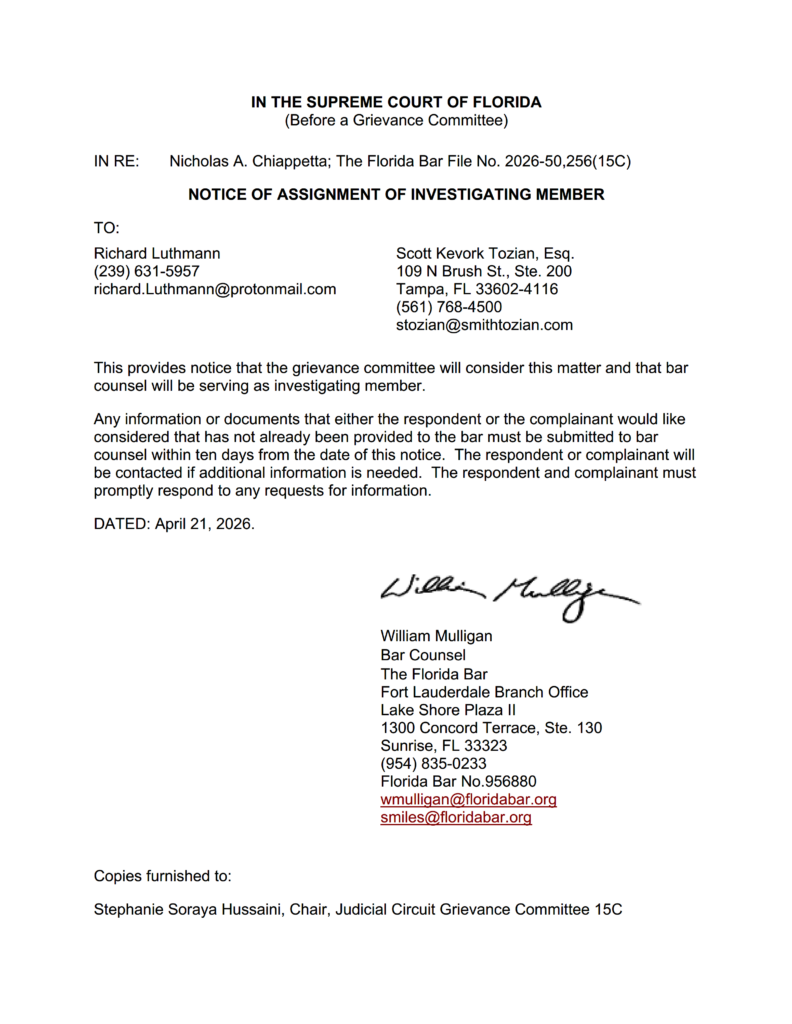
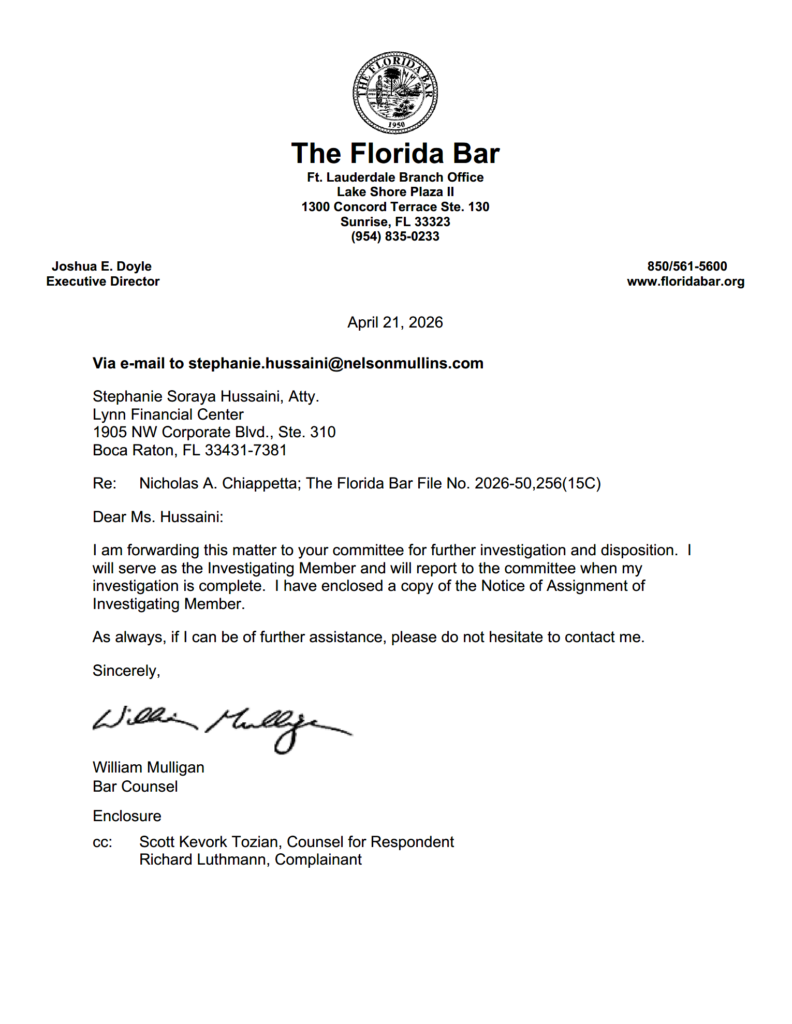
The Florida Bar paper trail is real. An April 21, 2026, Bar letter says Bar Counsel William Mulligan forwarded the Nicholas A. Chiappetta matter to a grievance committee for further investigation and disposition. A companion notice, issued in the Supreme Court of Florida grievance process, states that the grievance committee will consider the matter and that Bar Counsel will serve as the investigating member.
That means the Chiappetta disciplinary matter has moved well beyond YouTube chatter, Substack mockery, and courthouse gossip, and is inside the Florida Supreme Court’s formal disciplinary pipeline.
This creates one hell of a problem for Danesh because Chiappetta is not merely some lawyer whose name appears once on a caption; he is indispensable to the Noshirvan litigation ecosystem, tied to filings, conferral fights, sanctions threats, settlement blowups, deposition battles, and the legal scaffolding around Danesh’s content-war machine.
If Danesh is the face, then Chiappetta is the legal muscle. One pushes the narrative online, and the other helps move the machinery through the courts.
Luthmann also drilled into the strange email-account issue. Chiappetta admittedly created a Yahoo account resembling another lawyer’s email address in the Noshirvan case, telling on himself while denying any “nefarious use.”
That denial does not end the story; it starts the questions: Why create it at all? Why create an account that looked like another lawyer’s identity? Why was it allegedly visible in a litigation setting? Why should any lawyer, much less an officer of the court, be anywhere near games involving another attorney’s digital identity?
Nick Chiappetta is now an attorney caught impersonating a colleague, and prior criminal records, including traffic matters and a Cook County drug-paraphernalia entry, all while facing a potential suspension from the Bar that would effectively cripple all of Noshirvan’s litigation.
Cancel Culture Cartel Busted: The Pedophile Trick And The Content Farm
Danesh Noshirvan remains the center of the second litigation universe, the mega-influencer whose “accountability” brand became a digital punishment machine. Luthmann’s live featured journalist Joseph Anthony Camp, who documented unrest during the George Floyd riots and later became a target of Danesh and Antifa.


Camp sent Danesh a formal demand letter seeking a public apology, retraction, copyright protections, takedowns, and $600,000 in monetary compensation, demanding that Danesh’s alleged false statements and copyright infringements caused PTSD, emotional distress, and related damages. Camp demands an apology for Danesh calling him a pedophile and requires the removal of content across platforms.

That connects to the ugliest tactic in the ecosystem: the pedophile trick. Call someone a pedophile, a child predator, a child stalker. Then force that person to spend months or years proving the smear false, while the target loses time, money, reputation, health, and peace. The influencer gains views.
Danesh used the tactic. Hales claimed the tactic was used against him. Lawyers filed around it. That is the pattern.
In the Fed One Hales litigation, John Cook filed a court request over Hales’s claims that he and Preston made ongoing posts calling Hales a child predator. Cook says no such posts exist, and even a $2,000 reward failed to produce one. Hales’s allegation appeared later to preserve jurisdiction, not because it was real, and the Cook filing matters because it attacks the same nuclear label that drives so much of the cancel-culture machine.
This is POLAMOP: Protraction of Litigation and Multiplication of Proceedings. It is litigation as content infrastructure, federal court as a studio set, service of process as a stunt, conferral as ambush, accusation as monetization, and lawfare for clicks.
Hales makes content from litigation and money from litigation content. The business model is “YouTube POLAMOP,” a phrase coined by attorney Bruce Matzkin.
But now, Hales admitted to collaboration, and Danesh sits inside the same ecosystem. Shochet pushes defective service and fee theories, while Chiappetta faces a formal Bar review. The filings are no longer isolated, and the clips are no longer random.
The hidden thing is now revealed.
The public can criticize, journalists can investigate, viewers can mock, and citizens can petition. But lawyers carry a higher burden in signing papers, invoking court power, triggering subpoenas, service fights, sanctions motions, and injunction demands.
If Florida federal court judges want to know why their courtrooms are becoming content factories, they should start with the officers of the court who keep feeding the machine.
The cartel worked in the shadows, and then Hales opened his mouth. Now the lights are on.
Leave a Reply