
Federal case shrinks as “ecosystem” theory vanishes
LUTHMANN NOTE: This case tells you everything you need to know about modern lawfare. When the broad conspiracy theory collapses, they pivot. When the facts don’t hold, they narrow. What’s left here is not some grand wrongdoing—it’s speech. Satire. Commentary. The First Amendment doesn’t protect polite opinions. It protects the sharp, uncomfortable ones. And now, that’s the battlefield. The procedural defects alone are enough to challenge this filing, but the deeper issue is whether courts will let litigation become a content weapon. That’s the real story. Not the complaint—but why it exists in the first place. This piece is “Jeremy Hales Legal Retreat.”


By Frankie Pressman with Richard Luthmann and Michael Volpe
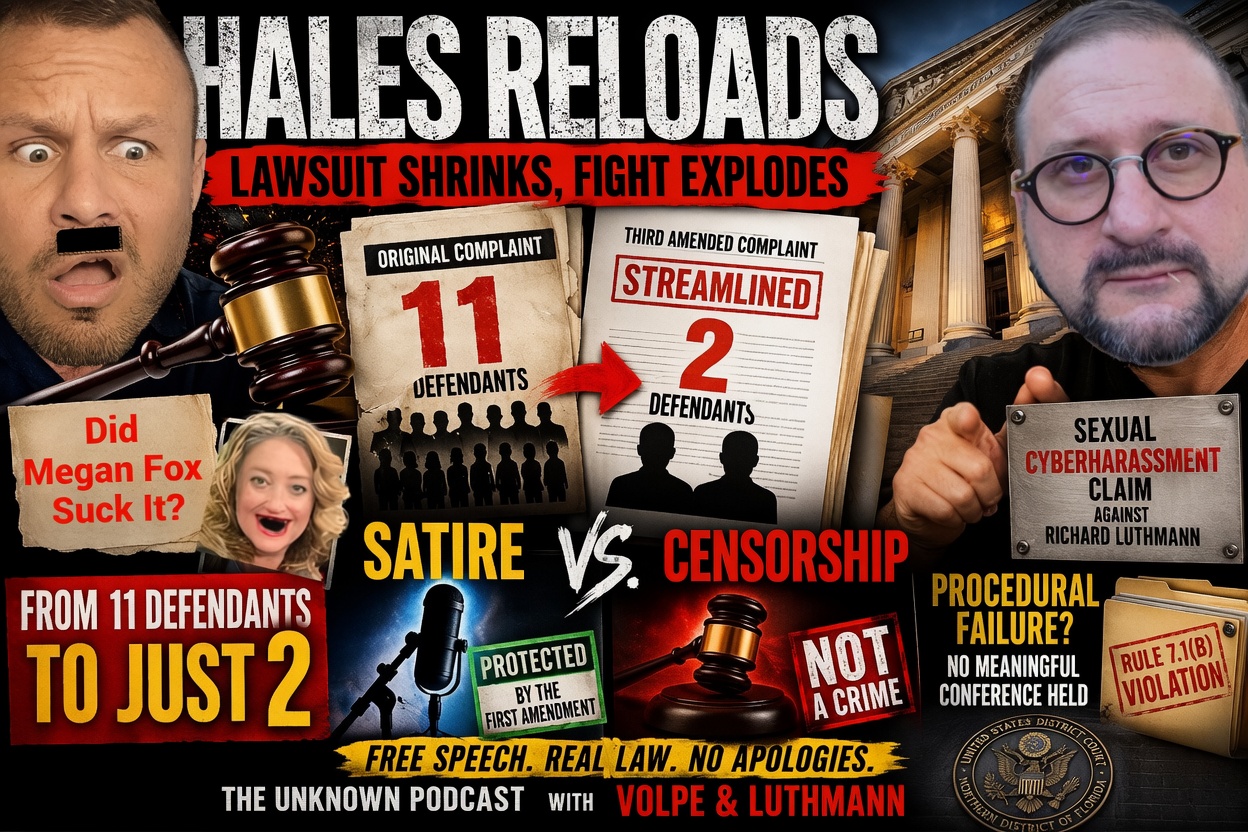
(GAINESVILLE, FLORIDA) – The federal case against Jeremy Hales just took a hard turn—and not the kind his side is pitching as a victory lap. After a bruising trip through the Northern District of Florida, Hales is back with a motion to file a Third Amended Complaint that cuts away the sprawling “anti-Hales ecosystem” theory and narrows the action to two claims against two defendants.
On The Unknown Podcast, Michael Volpe and Richard Luthmann call it what it looks like: a reset after a courtroom beatdown.

What used to read like a wide-angle conspiracy has been trimmed to a tight frame. Gone are the sweeping allegations and the long list of targets. In their place: a malicious prosecution claim against Michelle Preston and a Florida sexual cyberharassment claim against Luthmann. It’s leaner, yes—but also a tacit admission that the original theory couldn’t carry the weight.
Jeremy Hales Legal Retreat: The Great Walk-Back
The old complaint swung big. It named a crowd and tried to bind them together under a made-up umbrella—the so-called “anti-Hales ecosystem.” That label did a lot of work in the pleadings, but not enough in court. The new filing ditches the brand entirely and concedes the obvious: this case isn’t about a coordinated network anymore. It’s about two discrete episodes involving two people.
That’s not a refinement; it’s a retreat. When you move from a narrative of coordinated harm to isolated claims, you’re not sharpening your spear—you’re lowering your sights.
Volpe walks listeners through the procedural reality. The prior complaint didn’t just stumble; it got carved up. The magistrate flagged the defects, and District Judge Robert Hinkle allowed a repleader—with a deadline. April 2 came and went. No amended complaint.
Now comes the motion for leave to amend after the bell. The pitch is “streamlining” for judicial economy. The read from the outside is simpler: after the shotgun pleading failed, the plaintiff is back with a slingshot, hoping a smaller target survives where the bigger one didn’t.
Jeremy Hales Legal Retreat: The Case Against Luthmann
The remaining claim against Luthmann does the heavy lifting. It alleges that he published a sexually explicit image or video identifying Hales by name and likeness, without consent and without a legitimate purpose, causing reputational and emotional harm. The relief sought tracks Florida’s sexual cyberharassment statute—damages, fees, and injunctive relief.
Strip away the adjectives and that’s the core: publication, identification, lack of consent, alleged harm. It’s a cleaner claim than the original sprawl, and that’s the point. The question is whether it’s clean enough to live.
Here’s where the fight actually is. And here is the video in question:
Luthmann’s answer isn’t complicated: it’s satire and commentary about a public figure. Not revenge porn. Not a private disclosure. Speech—sharp, unflattering, and unmistakably opinionated.
The law doesn’t grade tone. It asks what a reasonable viewer would understand. If the content reads as parody—if it signals exaggeration, ridicule, or commentary—the analysis moves away from liability and toward protection. That’s the fulcrum this case balances on.
Jeremy Hales Legal Retreat: The First Amendment Strikes Back
The hosts lean into the precedent everyone in this lane knows: Hustler Magazine v. Falwell. The rule that comes out of that line of cases is blunt. Public figures don’t get to convert offensive parody into damages simply because it stings. Emotional distress, even when intended, doesn’t defeat First Amendment protection where the speech is clearly satirical.
That principle does not require politeness. It protects the ugly edges of public discourse—precisely the kind that gets litigated when tempers flare. If the court sees parody, the statute has a problem. If it sees a literal, nonconsensual explicit disclosure, the defendant does. That’s the fork in the road.
Layered on top is a culture fight that spills into the pleadings and the podcast. The “Deuce Foreskin” controversy becomes a proxy war over bigotry, context, and accountability. Volpe argues that labeling someone a bigot is generally not actionable; courts routinely treat such statements as opinion, not fact.
Luthmann, for his part, doesn’t dodge his own history. He acknowledges a past anti-Jewish remark, calls it wrong, and says he has apologized. The exchange is uncomfortable and revealing. It doesn’t decide the case—but it colors it, reminding everyone that litigation doesn’t happen in a vacuum. Words have histories, and those histories follow the speakers into court.
Jeremy Hales Legal Retreat: Content Or Courtroom?
Then there’s the piece lawyers quietly win on: process. Luthmann says the plaintiff’s side skipped the “meaningful conference” required by Northern District of Florida Local Rule 7.1(B), relying instead on a last-minute email notice. The rule is explicit about what doesn’t count.
That matters because courts expect parties to narrow disputes before filing motions. If the conferral is defective, the motion can be bounced without ever reaching the merits. It’s not glamorous, but it’s real leverage—and in a case already on its back foot, it’s the kind that can sting.
By the time the episode lands its final punches, the thesis is clear. This isn’t just a lawsuit; it’s a media event. Filings become episodes. Motions become content drops. Audiences become stakeholders.
That doesn’t make the claims frivolous by definition. It does raise the stakes for how the court reads them. Judges are not content moderators. They’re gatekeepers for claims that survive pleading standards and procedural rules. When a case looks like it’s doing double duty—as litigation and as programming—it invites a harder look.
The complaint is smaller now. The questions are not. If the court reads the content as satire, the First Amendment looms large. If it reads it as nonconsensual explicit publication, the statute takes over. Either way, the next ruling won’t just decide a motion—it will draw a line between speech that offends and speech that pays.
And in this fight, that line is the whole story.
Leave a Reply