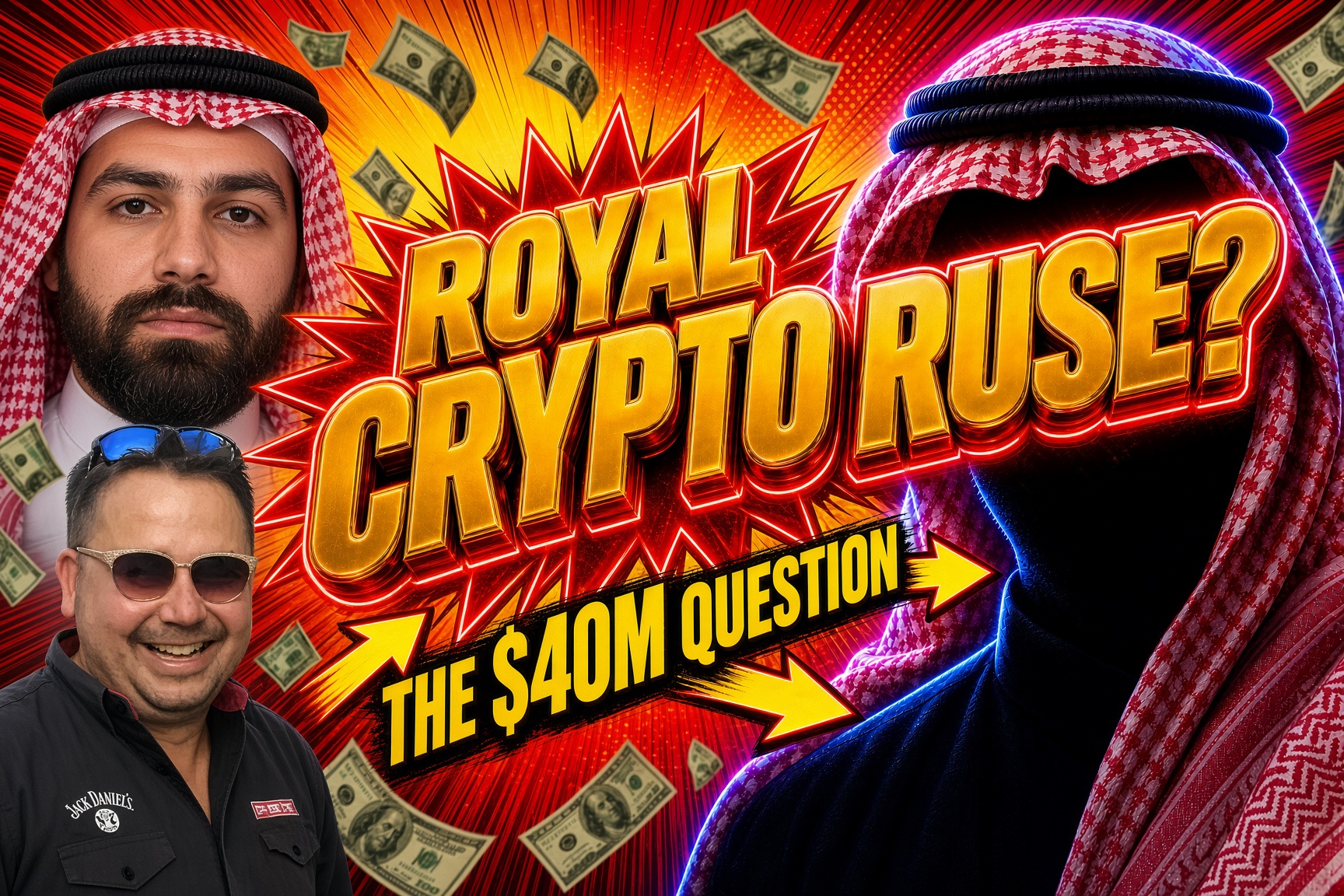
Backers say Rocky Rustad showed them a document presented as royal identification. When they pressed for withdrawals, answers grew scarce.
By Richard Luthmann
The Prince, the Passport, and the $40M Royal Crypto Ruse
Rocky Rustad pitched a cryptocurrency deal. Investors bought in.
The Canadian businessman promised an exclusive Bitcoin arbitrage arrangement backed by a Saudi royal. He even showed a Saudi Arabian prince’s passport as proof of his high-level connection.
Rustad swayed dozens of investors into investing over $40 million, promising virtually risk-free profits.
Rustad claimed he could exploit price gaps using a Saudi royal insider’s access—buying Bitcoin cheaply in the Middle East and flipping it for instant gains in Tether (USDT). Investors from North America to the Gulf were told this was a surefire arbitrage opportunity backed by Saudi royalty.

“Near-term payouts” were repeatedly promised, usually within a month or two.
Those payouts never fully arrived. Instead, after taking the money, Rustad went dark.
The Saudi passport Rustad touted as their golden ticket was fake.
Promised Riches: Bitcoin-USDT Swaps with a “Royal” Backer
Rustad wooed investors with a tale of crypto riches. He described a secret arrangement to convert Bitcoin to USDT (Tether) in lightning-fast trades, leveraging a Middle Eastern contact’s huge Bitcoin stash.
According to multiple investors, Rustad claimed a Saudi energy magnate — allegedly a prince — needed to liquidate vast Bitcoin holdings.
Rustad’s story went that this insider found Bitcoin too volatile for business and wanted stable USDT instead. Rustad positioned himself as the middleman who could help swap the prince’s Bitcoin for USDT at a steep discount, then immediately resell the Bitcoin at market price.
It was billed as a risk-free arbitrage: near-simultaneous trades within 30- to 45-minute windows that supposedly guaranteed profit with “minimal market exposure:
Investors were shown spreadsheets of steady returns and told to expect high monthly yields and instant withdrawal rights — none of which materialized.
To cement the deal’s legitimacy, Rustad produced what appeared to be a Saudi royal’s passport, identifying his mysterious partner as “Prince Saud:’
That prop gave Rustad’s pitch an aura of insider credibility.
He boasted of exclusive overseas connections and assured backers they’d get monthly distributions like clockwork. The chance to arbitrage Bitcoin with a royal family member was a can’t-miss opportunity — on paper.
Rustad’s promises proved empty, and his so-called Saudi benefactor turned out to be fake
Rocky’s Royal Story Unravels: Fake Prince, Fake Passport – Scheme Unravels


WHY THE PASSPORT DOES NOT HOLD UP
Sources say Rustad showed investors a copy of a Saudi passport to prove his partner was a member of the royal family.
It fails on four counts.
The family does not match.
The passport is in the name “H.R.H. Prince Saud Farid Bin Abdulaziz Bin Salman Bin Abdulaziz Al Saud.” In Arabic names, “bin” means “son of.” The name says the holder is the son of Prince Abdulaziz bin Salman, Saudi Arabia’s energy minister, and the son of King Salman.
Published biographies, including one from the prince’s university, say he has three children: Prince Salman, Prince Khalid, and Princess Sultana. None is named Saud or Farid.
The two names on the passport do not match.
Every passport has two lines of letters and numbers at the bottom. Border machines read these lines. On this passport, the printed name gives the holder’s first name as Saud. The machine-readable line gives it as Farid: “ALSAUD<<FARID<ABDULAZIZ.” On a real passport, the two names match.
The birth date fails its own test.
Under the international passport standard, each date in the machine-readable line is followed by a check digit. The check digit is calculated from the date using a fixed formula, so a machine can tell whether the date has been altered. The passport gives a birth date of February 12, 1994. For that date, the check digit should be 4. The passport shows 7.
The expiration date is not valid.
The printed expiration date is November 22, 2026. In the machine-readable line, it should appear as 261122. Instead, it reads 603792. That would be the 37th month of the year.
The passport number, T706554, does pass its check digit. Whoever made the document got that part right.
The International Civil Aviation Organization, a United Nations agency, publishes the passport standard in a document called Doc 9303. Anyone can check these calculations.
Once this fake was exposed, confidence in Rustad’s entire enterprise was shattered. The Saudi “whale” at the center of the arbitrage story was a myth, and with it went the foundation of Rustad’s scheme.
The bogus passport provides smoking-gun proof that Rustad’s operation rested on forgeries.
The fallout was swift: panicked investors realized that Rustad built his arbitrage empire on a forged passport and false promises.
Rocky’s Royal Story Unravels: Ghosted Investors and Phony Excuses
As money poured in, Rustad played a double game — placating some investors with trickles of cash while stringing along the rest. Early on, he paid out selectively, handing partial returns to a few squeaky wheels to keep skepticism down. Most got nothing at all.
One investor confirms they received no principal or profit, despite Rustad’s constant assurances that payouts were just “weeks away. ”
At first, Rustad stayed in touch—group chats, phone calls, and Excel sheets showing profits. Then, as withdrawal requests mounted, he went silent.
Months passed with “radio silence” from Rustad. When pressed, he rolled out a repertoire of excuses.
Rustad’s chief claim is that the funds were “locked up” on two crypto platforms, sFOX and AguaNow.
Rustad repeatedly told investors that these exchanges – one supposedly in North Carolina, the other in Canada – were holding the money and blocking withdrawals. The same story played out for over a year: millions in limbo due to technicalities or third-party issues.
“He would call with a new excuse, then disappear;’ one source said.
For many, the final straw was Rustad’s vanishing act in 2025: after July of that year, he stopped responding, even as pleas for answers turned to talk of lawyers and law enforcement. Rustad left his investors in the dark — along with tens of millions of their dollars.
Rocky’s Royal Story Unravels: Living Large While Investors Languished
While his investors were left empty-handed, Rustad appeared to be living the high life.
In April 2025, Rustad paid C$3.575 million cash for a luxury Calgary home titled in the name of his long-term partner, Lindsay Kraus. Public records show no mortgages or liens on the property until a C$71,000 HELOC was taken out in December.


Given Kraus’s reportedly modest income, she very likely couldn’t have bought a mansion on her own.
Sources suggest the funds came from an account Rustad controlled.
It may be a textbook laundering of investor money into real estate: a multimillion-dollar asset parked under a girlfriend’s name, safely out of reach of Rustad’s creditors.
Kraus has not been accused of wrongdoing.
She and Rustad live in the plush Calgary home.
Beyond the mansion, Rustad lived lavishly. He traveled the world in style — flying private, attending exclusive events, and reportedly staying in five-star hotels.
One source says Rustad flew to Dubai and Monaco as his backers begged for updates on their funds.

Between the Calgary mansion, luxury vacations, private jets, and parties, Rustad’s spending spree sent a message to his victims: their money was making someone rich—just not them.
Rocky’s Royal Story Unravels: Lawyers, Letters, and No Comment
To bolster his legitimacy, Rustad invoked lawyers’ names. Investment documents list a Canadian firm, Blue Rock Law, and attorney James “Jim” Colvin as legal counsel tied to Rustad’s crypto program.
Investigators emailed Blue Rock Law Partner Stewart Maier and Jim Colvin for comment on Rustad’s activities.
The emails inquired whether they represented Rustad or held investor funds in escrow.
Neither Colvin nor Blue Rock Law replied.
When contacted by phone, Colvin’s office did not provide a statement. It remains unclear whether they represent Rustad or whether he used their names for appearance, like the fake prince.
Rocky’s Royal Story Unravels: Scam or Market Flop?
Was Rocky Rustad’s operation an honest investment gone bad or a calculated scam from the start?
Rustad’s pitch was predicated on ultra-short trading windows that minimized exposure to volatility. The trades were supposedly so fast and arbitraged so tightly that Bitcoin’s price swings wouldn’t matter.
If that were true, a crypto market downturn couldn’t vaporize the money.
Yet by mid-2025, investors were told the cash was inexplicably stuck. Rustad went dark. He had been reporting profits throughout.
“Unless it was fraudulent from the beginning, he was reporting that he was making people money. So what happened?” one victim asked.

Investigators agree that the pattern of fake statements, phantom trades, and perpetual excuses aligns with a Ponzi-style fraud.
Rustad’s behavior — lavish spending, hiding assets, ghosting investors — is that of a con man in damage-control mode.
This doesn’t look like a bad trade or a crypto crash — it looks like an old-fashioned scam in new tech clothes. As our investigation continues, Rustad may face consequences as the evidence against him mounts.
More revelations are coming.
Editor’s note: One or more investors in Rocky Rustad’s crypto program have retained Richard Luthmann, Frank Parlato, and an attorney familiar with criminal law in Canada and the United States, as well as a licensed private investigator, to investigate, gather news, and report on this matter. No promises or conditions about publication were made. No one is shown our reports before they are published.


Leave a Reply