
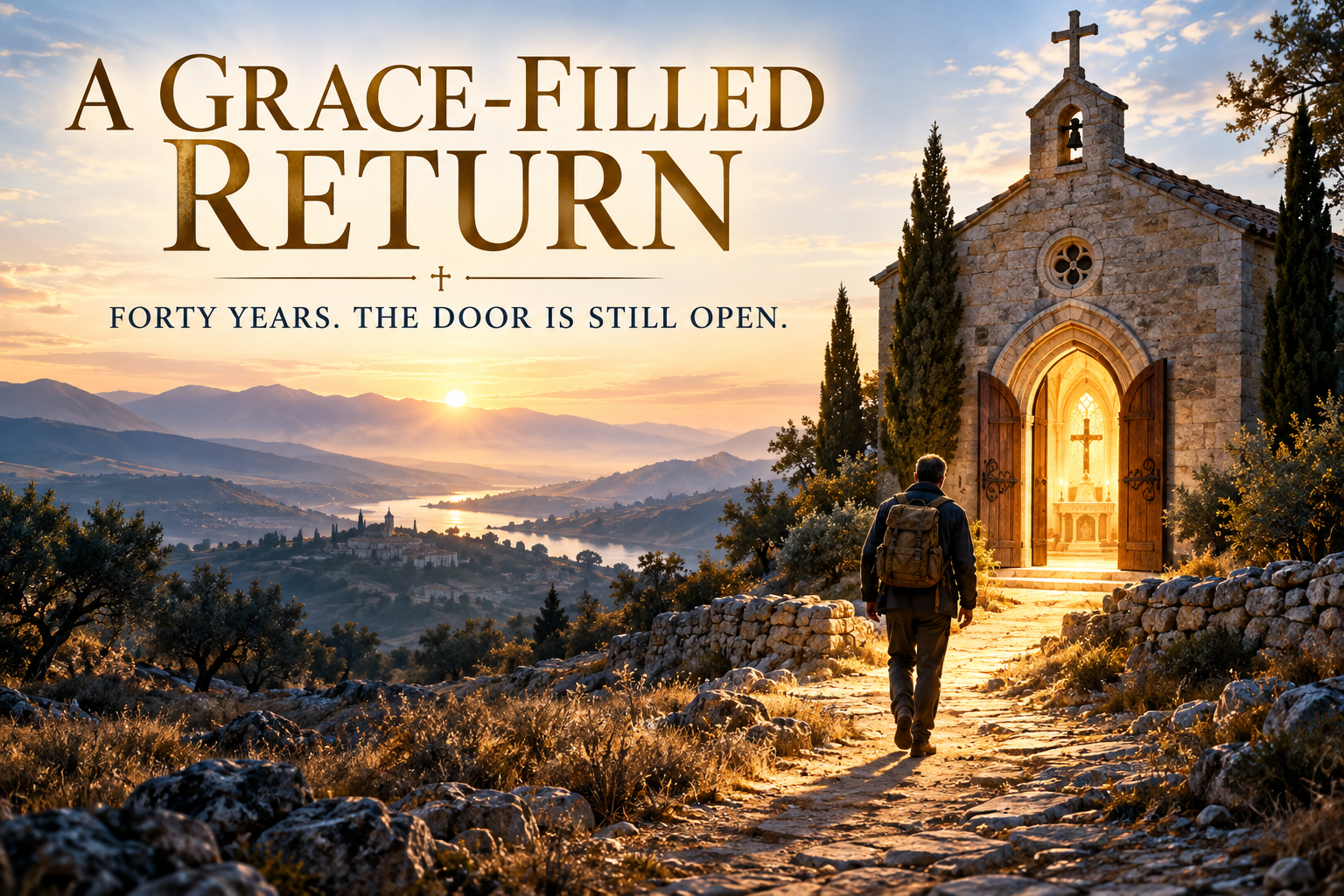
After 40 years away, Jeff Lukich found his way back to the Catholic Church. His story offers others a place to begin.
LUTHMANN NOTE: Forty years is a long time to stay away. Shame can make the next Sunday feel even farther. As a Catholic, I believe that is where this story matters most: the moment someone decides to walk through the door despite everything telling him to stay outside. We should make that step easier. Invite someone to Mass. Offer to sit beside him. Leave the interrogation for another occasion. Confession requires honesty, and returning takes courage. Lukich’s story reminds me that we have no business treating a returning soul as a suspect. When someone finally comes home, make room in the pew. This piece is “A Grace-Filled Return.”

By Greg Maresca
We all know someone who left the Church. Perhaps we feel inadequate to approach the situation, even though, as believers, we know such a decision has eternal consequences.
Jeff Lukich’s The Long Way Home is that practical roadmap for such an undertaking. He admits he didn’t leave the Church abruptly over dogma or scandal; he just slowly drifted away until he woke up in a wilderness he never meant to enter.
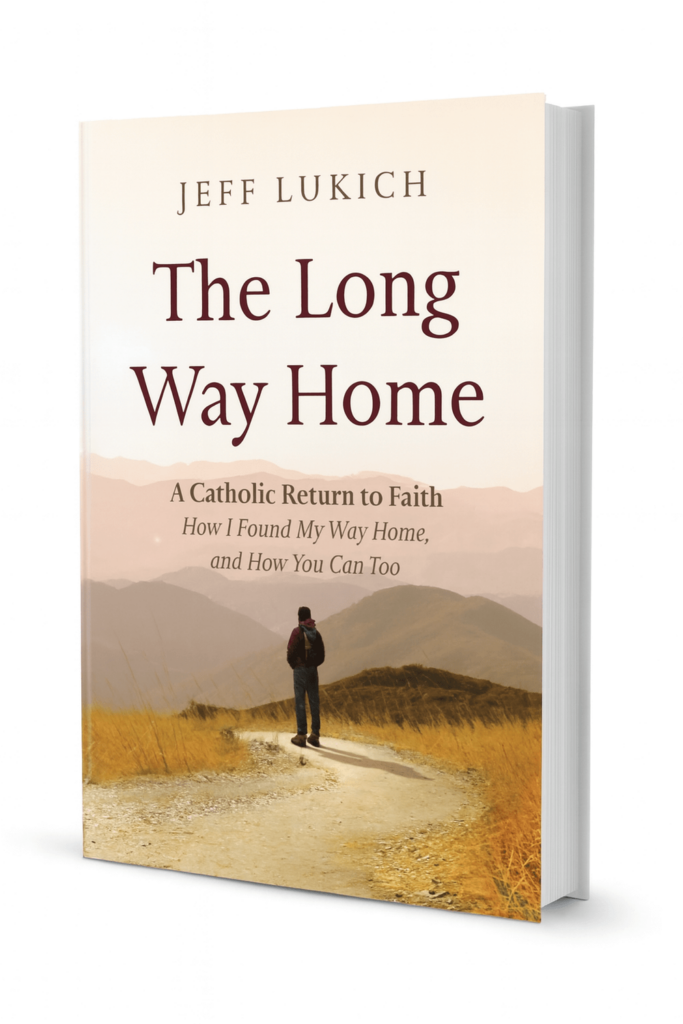
Lukich recounts his own 40 years of wandering through the secular desert that, on many levels, defines our post-Christian culture.
Throughout Scripture, 40 is not an incidental numeral by any means. It marks a season of trial, purification, and preparation. It is the number of the desert, the test, the cleansing, and the return.
It is Noah’s flood, Moses on Mount Sinai, Israel’s journey in the wilderness, Elijah’s passage to Horeb, and Nineveh’s time to repent. It is the presentation of Jesus in the Temple that took place 40 days after His birth. Moreover, it is the concentrated 40-day fast Jesus endured against Satan’s ceaseless mocking and temptation before beginning His public ministry.
Lukich’s long wandering mirrors that same biblical rhythm, as he finally made the conscious effort to turn toward home with courage, clarity, and conviction. He writes with disarming personal candor, plenty of experience, and acquired wisdom, underscoring how no one falls too far or wanders too long for redemption.
The book’s most arresting chapter arises from its engagement with reconciliation.
This finely tuned opus offers a powerful message of possibility and a glimpse into Lukich’s soul, serving as a beacon of hope for anyone with the courage and wisdom to return.
Part testimony and part guidebook, this uplifting work reminds the seeker that the Church remains open, that God never stops calling her prodigals to return, that no distance is too great for grace to reach, and that the journey back can commence today.
Lukich’s tome can be contrasted with Rome Sweet Home by Scott Hahn, co-authored with Kimberly Hahn, and Rediscover Catholicism by Matthew Kelly, as they all deal with roaming, grace, return, and the Church as home.
Each reversion tale is certainly unique and shaped by more than just words, but by wounds, wandering, and intellect. Lukich makes that connection of finding faith again in his relatable story of trust and vulnerability. The Long Way Home offers encouragement, not condemnation; answers, not confusion; and conveys how grace breaks through the world’s pandemonium in personal ways.

His wife, Mary Beth, follows him into the Church. Minus the epilogue, bibliography, and appendix, which offers plenty of online resources and prayers, the book is a lean and very readable 119 pages. This read is not just for the fallen-away but is a practical guide for others within the faith community, offering ways to encourage and guide those making the trek home.
Lukich’s story reminds the faithful that conversion is not a single moment but a lifelong process of seeing, understanding, and trusting God more profoundly. It is ongoing, daily, and often challenging. He underscores how grace works slowly, persistently, and creatively, and how the Church remains a place where truth, tradition, and the sacraments always await those who seek them.
This ongoing conversion is nourished through the sacramental life, especially confession and the Eucharist. Lukich, like many before him, cites the Eucharist as the decisive reason for returning. It was the yearning for Christ’s true Body, Blood, Soul, and Divinity.
The Church always calls her prodigals to return.
Some hear it, while many ignore it, but that clarion call remains.
Conversion is the work of grace. Debate can lead people to the threshold of faith, but supernatural faith is ultimately a gift of the Holy Spirit.
God never stops pursuing the wanderer, whether he is gone for forty days or forty years.
Lukich’s return proves that even the longest desert still ends at God’s House.





Leave a Reply