
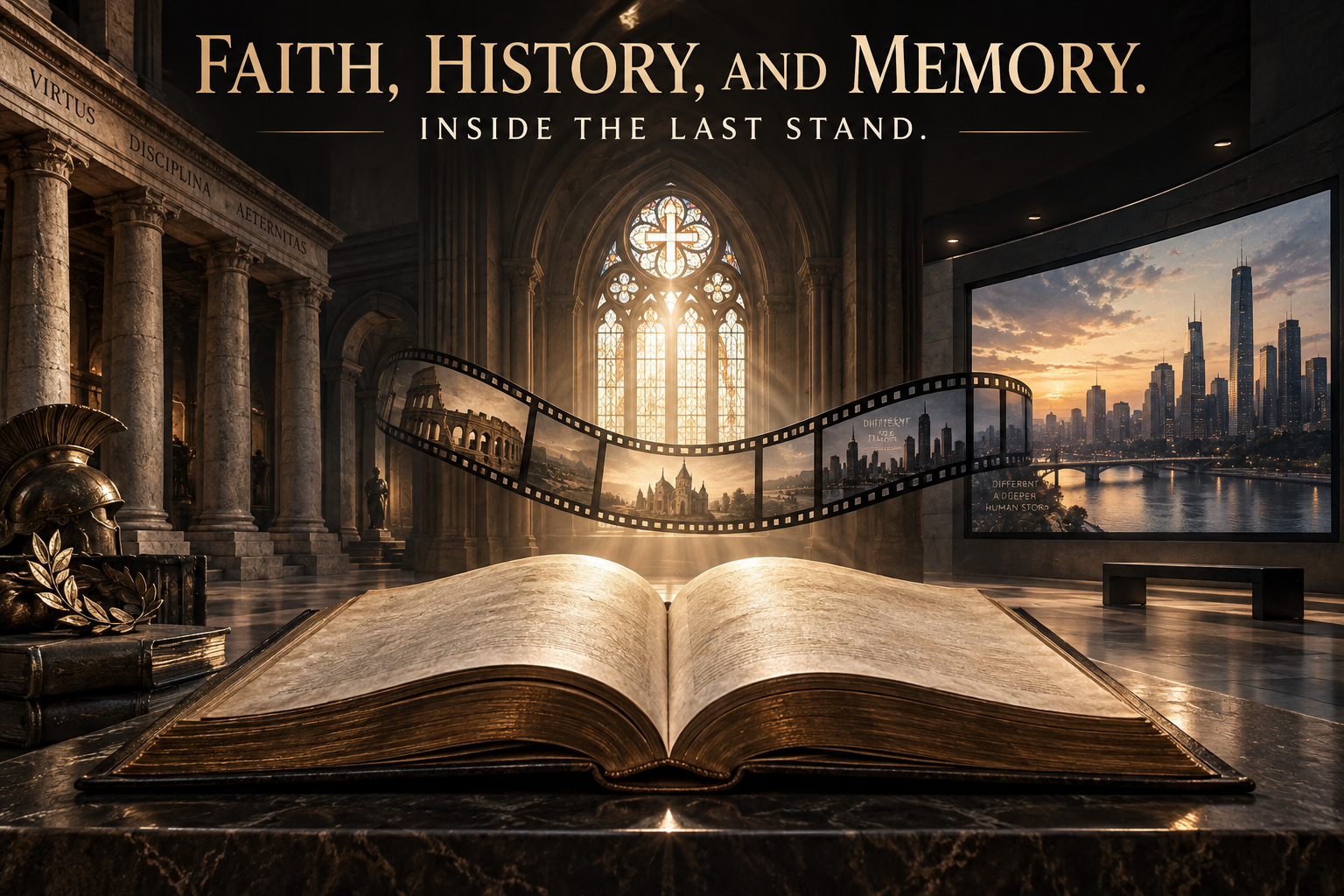
Greg Maresca reviews Seth Gruber’s book and documentary about Christianity, historical memory, and Western culture.
LUTHMANN NOTE: Faith, history, and memory belong together. Faith gives us obligations that outlast convenience. History reminds us that we arrived in a world shaped by other people’s sacrifices, mistakes, and courage. Memory makes that inheritance personal: a mother’s prayers, a father’s example, the names we still speak after the chairs are empty. We want our children to understand what they have received and why it matters. That requires telling the truth about the past, including its failures. We honor those who came before us by remembering honestly, putting what they taught us into practice, and confronting those who seek to distort the inheritance of the Western Tradition. This piece is “The Last Stand.”

By Greg Maresca
The Last Stand: Christ or Chaos: The War for the West is an uncompromising book and documentary written and narrated by Seth Gruber that is less entertainment and more a wake-up call. It challenges one to confront the difficult questions about culture, morality, and the value of human life grounded in reality rather than some abstract philosophy.
The Last Stand is undeniably bold, a masterpiece that refuses to whisper when shouting is essential. Gruber’s wide-ranging opus juxtaposes the parallel lines of past and contemporary morality into a distinct narrative that examines America’s pagan moral drift.

Gruber dilutes nothing.
Using historical footage, interviews, and commentary, he builds an impeccable case for how our country’s institutions have abandoned the moral principles that once anchored them.
Gruber underscores how language, media, and political rhetoric have reshaped public perception and how technology and convenience influence morality. The prevailing culture has become adept at sanitizing truth, but it is Gruber who strips away that veneer, leaving little room for nuance.
Some political philosophers have argued that a republic lasts about 250 years before collapsing as voters eventually vote themselves benefits from the public treasury. Our nation’s Founders didn’t give timelines, but they did give warnings: Ben Franklin’s “A republic, if you can keep it,” John Adams’ fear of democratic self-destruction, and James Madison’s warning about political divisions.
Culture wars are nothing new.
The same fight over abortion, the family, and poverty has been waged since ancient Rome. Back then, the Church was the lone institution with the courage to stand tall when society bowed. What has changed, Gruber argues, is how the Church and most Christians now conform and retreat from the prevailing culture.
“While the enemy and his schemes are not new,” Gruber writes, “the silence and forgetfulness of the blood-bought bride of Christ is. In fact, I’ll go as far as to say that the first 1,900 years of Church history stand as an indictment against the last 100.”
Gruber’s argument is unpretentious, convincing, and impossible to dismiss. It has little to do with economics or elections, but with what we have allowed ourselves to forget. We have forgotten the sanctity of life, human dignity, and the moral foundations that made America unique among nations and, yes, great.

Gruber refuses to treat abortion as an isolated issue. Abortion is the number one symptom of a deeper civilizational unraveling along with the loss of objective truth, the triumph of radical individualism, and the cultural drift that leaves most numb and indifferent.
Gruber moves effortlessly from the intellectual roots of what St. Pope John Paul II labeled “the culture of death” to the consequences of its policies and human cost. Gruber exposes how language is weaponized to anesthetize the public’s conscience, how institutions hide behind benign neutrality, and how political leaders disguise moral abandonment in linguistic twists that masquerade as compassion.
The book and subsequent film highlight how all human conflict is ultimately theological.
The prose is crisp, direct, and undaunted. Gruber understands moral truths do not require apology. He is not trying to impress academics or score political points. He is attempting to awaken a nation that has grown much too comfortable with triviality and, especially, refocusing its failed memory bank. His work draws power from his moral earnestness, a quality increasingly rare in an age of distraction and cynicism.
Western erosion did not happen overnight. It materialized slowly through a thousand small compromises each justified by convenience, comfort and complacency.
In 1934, British anthropologist J.D. Unwin concluded that when societies abandon sexual restraint, decline occurs within three generations. Commencing in 1973, the current generation is number three.
People are not powerless. Cultural renewal begins with moral clarity to see reality as it is, not as we wish it to be. Gruber challenges Americans to reclaim what this nation once believed about human dignity and to live as if those beliefs still matter, provided we want a nation worth handing to our children.
By passing a theatrical release, the documentary’s filmmakers are focusing on church, campus, and community screenings throughout the country, while the book is available at all major book outlets.
Gruber challenges the intellect, which is something that rarely occurs in a world overrun with memes and soundbites. History will judge us not by our intentions but by what we allowed. A nation cannot survive if it abandons the morality that once defined it.
When a society loses its ability to call insanity “insanity,” it should not be surprised when insanity takes charge. Recovery only begins when fashionable delusions are dismissed as foolishness and speaking truth to power rules the day.
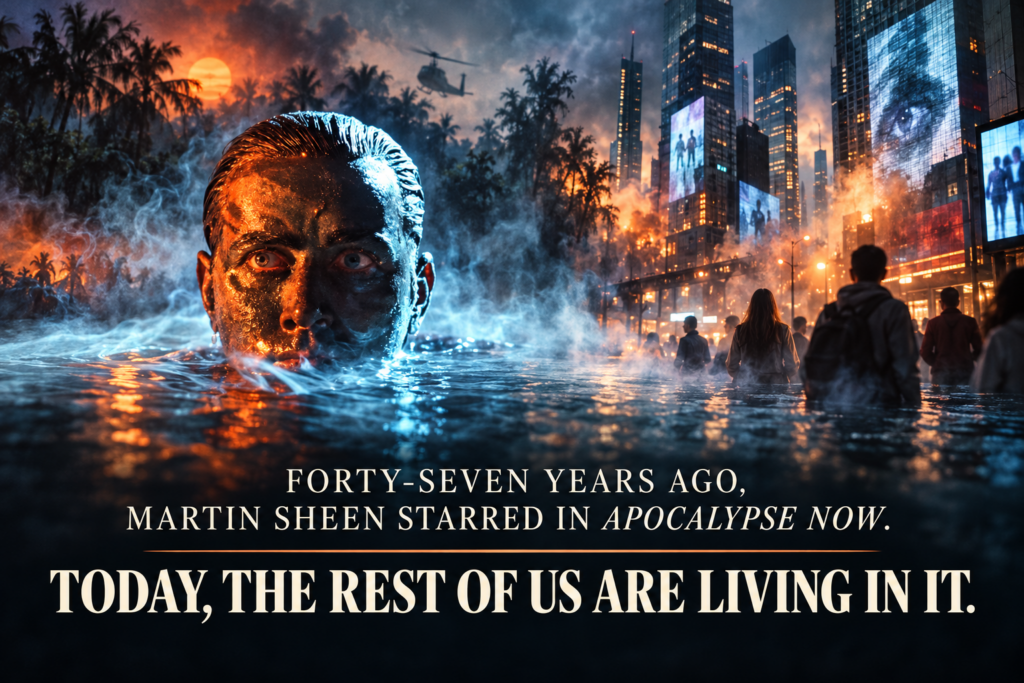
Forty-seven years ago, Martin Sheen starred in Apocalypse Now. Today, the rest of us are living in it. This conflict is not a policy argument between conservatives and leftists. The Last Stand is a struggle over the future of America’s creed, culture, and soul.
Leave a Reply