
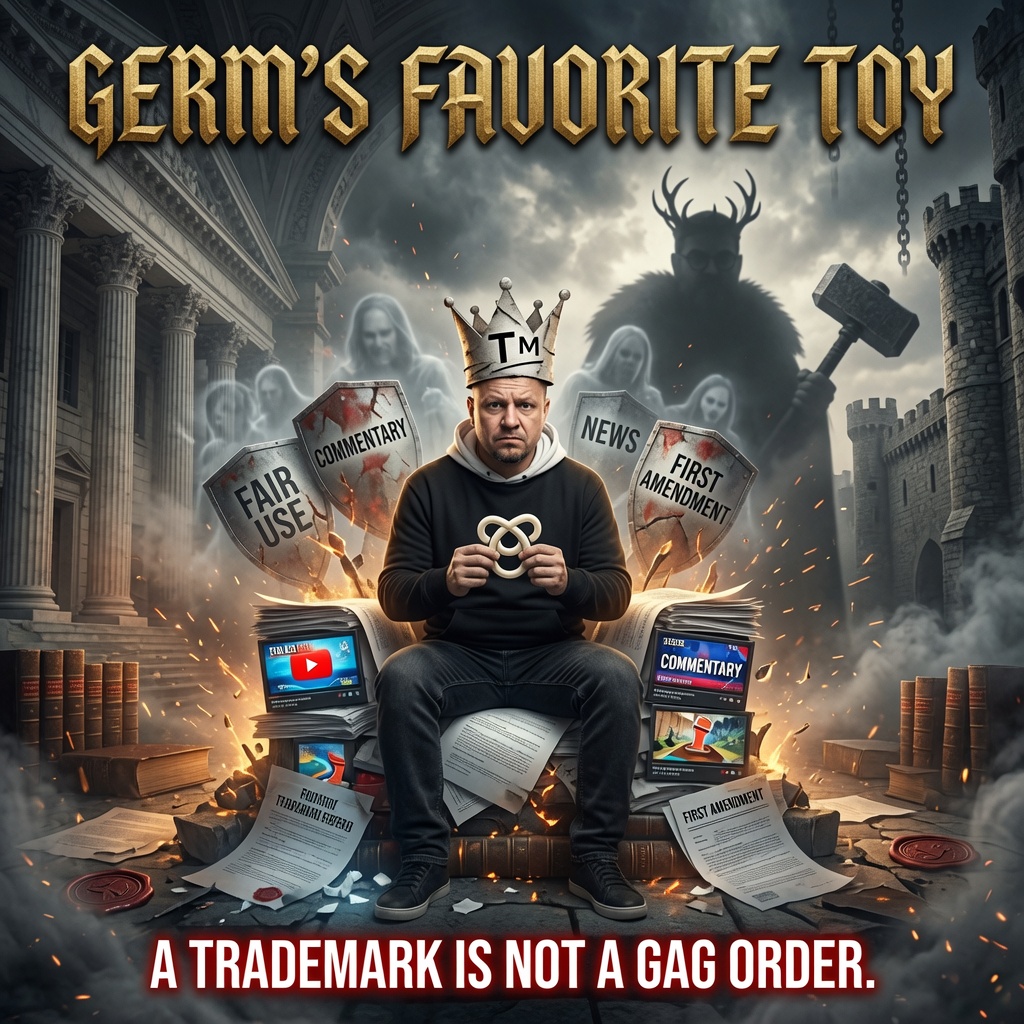
Jeremy Hales Tries Trademark Law But Still Can’t Find Reality
LUTHMANN NOTE: Jeremy “GERM” Hales wants the public to believe a trademark filing makes him king of his own name. That is delusional. Nobody serious disputes that real trademarks can protect real brands against real imposters. But that is not what this fight is about. This is about whether a publicity-seeking litigant can grab a personal-name service mark for commentary and then wave it around against journalists, critics, and defendants who need to identify him by name. Luthmann will never ask permission to say “JEREMY HALES.” He seeks to remove GERM’s favorite new legal toy before he turns it into another lawfare stick. And he’s employing Game of Thrones imagery to illustrate just how it will go down. This piece is “Luthmann is Coming.”


By Frankie Pressman and M. Thomas Nast with Richard Luthmann
GERM, Reek, And The Favorite Toy
(OTTER CREEK, FLORIDA) – Jeremy Hales, known to critics as GERM, has now wandered into trademark law with the same confused swagger Theon Greyjoy brought to Winterfell before Ramsay Bolton turned him into Reek. For readers who skipped Game of Thrones, Theon was the arrogant pretender who talked like a prince, chose the wrong fight, got broken by a sadist, and spent the rest of the story as a cautionary tale in cowardice, delusion, and lost manhood. The comparison writes itself.

Both GERM and Reek became symbols of damaged bravado: noisy, insecure, delusional, and missing important pieces. Reek lost his pride. GERM lost the plot.
And now, like Theon clutching the sad relic of what he thought made him powerful, Hales appears to have found his Favorite Toy: a trademark theory he thinks will terrify critics into silence.
It will not.
GERM already had his clean shot. He agreed to Trial by Combat with Richard Luthmann as Alternative Dispute Resolution. That was the moment. No more docket fog. No more lawfare theater. No more running into court with Randy “Pocket Rocket” Shochet holding the flashlight and billing by the tenth of an hour.
Hales talked big,
Luthmann accepted, and then GERM started looking for paper shields and new legal toys before he tried to jump ship.
In Game of Thrones terms, the visual is irresistible. Ramsay Bolton’s flayed man banner was supposed to frighten cowards into obedience. But in the court of public opinion, Luthmann walking into Trial by Combat with a Robert Baratheon war hammer would make that flayed man look like a polite warning label. (That is metaphor, not choreography. Not yet, anyway.)

The point is simple: Hales prefers the performance of battle to its consequences.
Now comes the trademark pacifier. GERM apparently believes that if he trademarks his name, brand, or whatever leftover scraps of Halesverse identity he can shove into a government form, critics and journalists will suddenly lose the right to say “JEREMY HALES,” “What The Hale$,” “Elephant Shoe LLC,” “Fed 2,” or “GERM.”
GERM believes that, once trademarked, he will finally “own his name” and that “no one else will be able to use it” without him “getting paid.”
That is not law. That is Reek mistaking a broken toy for a royal scepter.
Luthmann is Coming: A Trademark is Not a Substitute for Courage or Intelligence
The point of trademark law is not complicated, unless someone is determined to misunderstand it for litigation content. A trademark protects source identifiers in commerce. It helps prevent consumers from being confused about who made, sponsored, endorsed, or sold a product or service. That is the lane. That is the castle. That is the whole kingdom.
It is not a gag order, restraining order, personal reputation force field, or emergency bunker for an influencer who got called out in public.

The Lanham Act is the federal trademark statute, codified at 15 U.S.C. § 1051 et seq. The false designation, false advertising, and dilution provisions are found at 15 U.S.C. § 1125. Nothing in that statute gives Hales ownership over public discussion about himself. Nothing in it lets him trademark his way out of criticism. Nothing in it turns journalism into infringement because GERM feels wounded.
If someone sells fake What The Hale$ merchandise while pretending to be Hales, that might raise a real trademark issue. If someone creates a counterfeit JEREMY HALES channel to trick consumers into believing they are dealing with Hales, that might raise a real trademark issue.
But if a journalist writes about JEREMY HALES, criticizes JEREMY HALES, mocks JEREMY HALES, covers JEREMY HALES’s lawsuits, or identifies JEREMY HALES as the man who talked up Trial by Combat before ducking the consequences, that is not trademark infringement. That is speech.

GERM’s problem is not that critics are stealing his brand. His problem is that critics are naming him accurately enough for the public to understand the story.
That is fatal to the scheme.
Trademark law protects against consumer confusion. It does not protect JEREMY HALES from being discussed by people who know exactly who he is.
Legal Reality Blows Up GERM’s Magic Trick
This is where the magic trick collapses in GERM’s hands. Critics and journalists can use his name because they are identifying the subject of criticism, reporting, commentary, litigation, and public controversy. The doctrine commonly called nominative fair use exists for exactly this reason.
If the subject of the story is JEREMY HALES, the writer may say JEREMY HALES. If the subject is What The Hale$, Elephant Shoe LLC, Fed 2, Randy Shochet, Trial by Combat, or Hales’s courtroom campaigns against critics, the writer may identify the people, brands, cases, and entities involved. The law does not require journalists to speak in riddles.


Nobody has to refer to GERM as “a certain storage-unit YouTube princeling with a litigation addiction and a less-than-pocket-sized legal cannon.” We can say JEREMY HALES because JEREMY HALES is the subject. That is not infringement. That is basic identification.
The classic nominative fair-use case is New Kids on the Block v. News America Publishing, Inc. The core point is simple: sometimes there is no practical way to discuss the thing without naming the thing. GERM cannot become The Mad King with a trademark filing, lopping the head off anyone with the nerve to utter his “special words.” People are still allowed to say the name.
That is how reporting works. That is how criticism works. That is how language works when it has not been kidnapped by the Halesverse.

Hales’s trademark fantasy collapses even faster when the statute is read instead of used as a prop. Section 1125(c), the federal dilution provision, expressly excludes fair use, including use of a mark to identify, parody, criticize, or comment upon the mark owner or that owner’s goods or services. It also excludes news reporting, news commentary, and noncommercial use.
That means GERM cannot turn trademark law into a private censorship franchise just because he dislikes being criticized. A writer may use his name to identify him. A commentator may use his brand to discuss his channel. A journalist may report on his litigation. A critic may mock his conduct. A defendant may identify the plaintiff suing him.
That is not infringement. That is reality with nouns.
This is the part GERM cannot meme away. The law is not a vibe, a livestream chant, or a chat mob in matching digital helmets. Trademark law protects the marketplace from confusion. It does not protect Jeremy Hales from the consequences of JEREMY HALES being discussed by people who watched the Halesverse try to turn Florida state and federal courts into a content farm.
Luthmann is Coming: Winter is Here — For GERM’s Trademark
NOTE: This section is informational in nature and should not be construed as professional advice of any sort.
Here is the part GERM probably did not explain to the Halesverse: the trademark is not registered yet. It is sitting in the opposition window, which means the drawbridge is still down and the public can still walk into the United States Patent and Trade Office (USPTO) – Trademark Trial and Appeal Board (TTAB) and object.
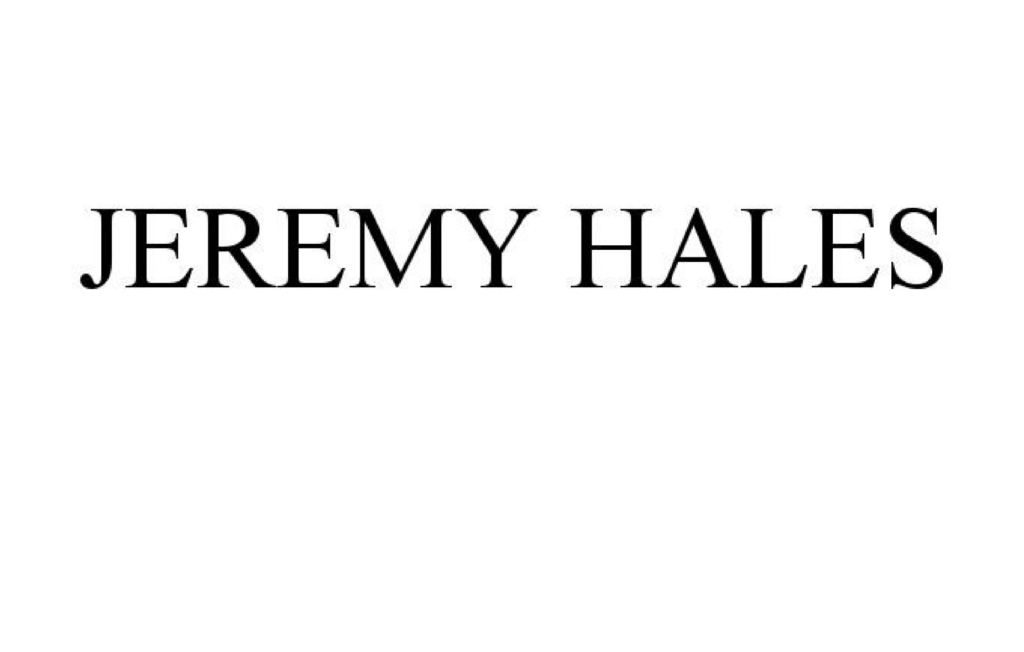
The application is U.S. Serial No. 99597033 for “JEREMY HALES,” published in the Trademark Official Gazette on June 23, 2026, for Class 041 entertainment services — specifically “providing webcasts in the field of commentary.”
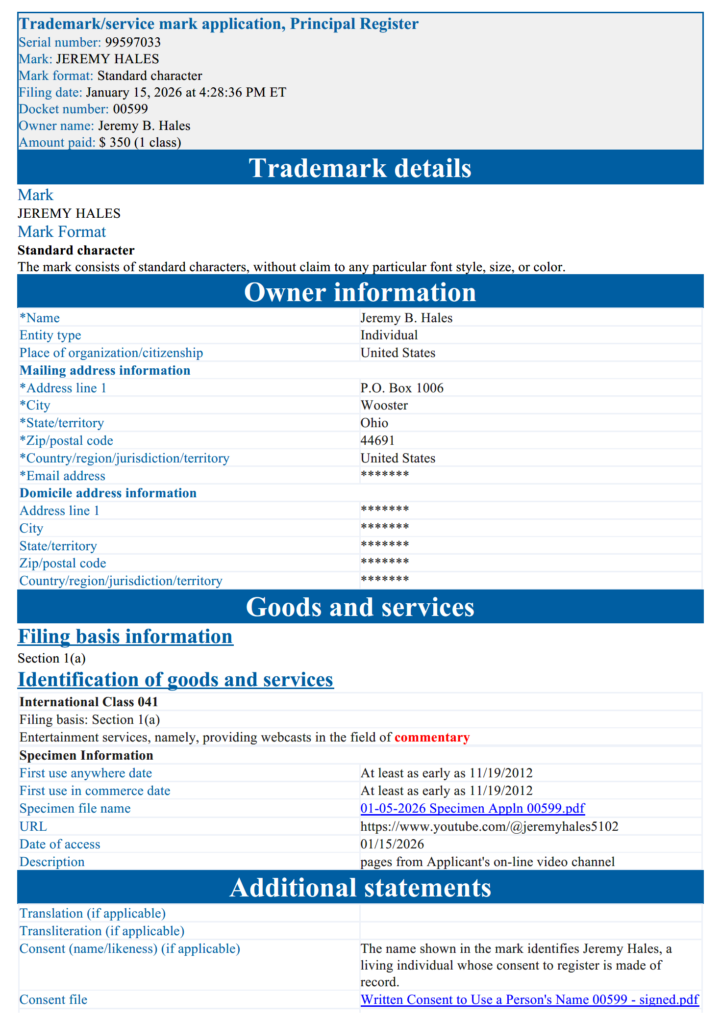
That matters because publication starts the thirty-day clock. The extension is due by July 23, 2026, at 11:59 p.m. Eastern Time.
Anyone who believes they will be “damaged” by registration can go online and file either a Notice of Opposition or, more practically, a Request for Extension of Time to Oppose.
The safe first move is a 30-day extension. It buys time. It is filed electronically. The USPTO says TTAB filings and extension requests must be filed electronically.
- Start here: https://ttabcenter.uspto.gov/new-submission.
- The USPTO’s TTAB filing page is here: https://www.uspto.gov/trademarks/ttab/initiating-new-proceeding.
- The USPTO page on choosing TTAB/ESTTA forms is here: https://www.uspto.gov/trademarks/ttab/index-estta-forms.
- The TTAB technical filing guidance is here: https://www.uspto.gov/trademarks/ttab/estta-help.
Search the serial number: 99597033. Select the form for a request to extend time to oppose, or file the Notice of Opposition itself.
Note that a 30-day extension is FREE. A 90-day extension has a $200 filing fee. The first 30-day extension is typically the cleanest opening shot. Do not wait until the last minute. Do not file garbage. Do not make wild fraud claims without evidence. That’s just general common sense.
A sharp objection is this: GERM cannot use a personal-name service mark for “commentary” as a fear-weapon against critics, journalists, and commentators who must identify him by name to report on him. You can even say something like this:
Potential Opposer Richard A. Luthmann, Jr. requests a 30-day extension of time to oppose Application Serial No. 99597033 for the mark JEREMY HALES.
Potential Opposer is a journalist, publisher, and commentator who reports on Jeremy Hales and related public controversies. Potential Opposer requires additional time to review the application, prosecution history, specimen, claimed use in commerce, and potential grounds for opposition, including whether the applied-for personal name functions as a service mark for the identified Class 041 commentary/webcast services and whether registration may damage Potential Opposer’s lawful reporting, commentary, criticism, and nominative use of the name “Jeremy Hales.”
And that is EXACTLY what Luthmann did:
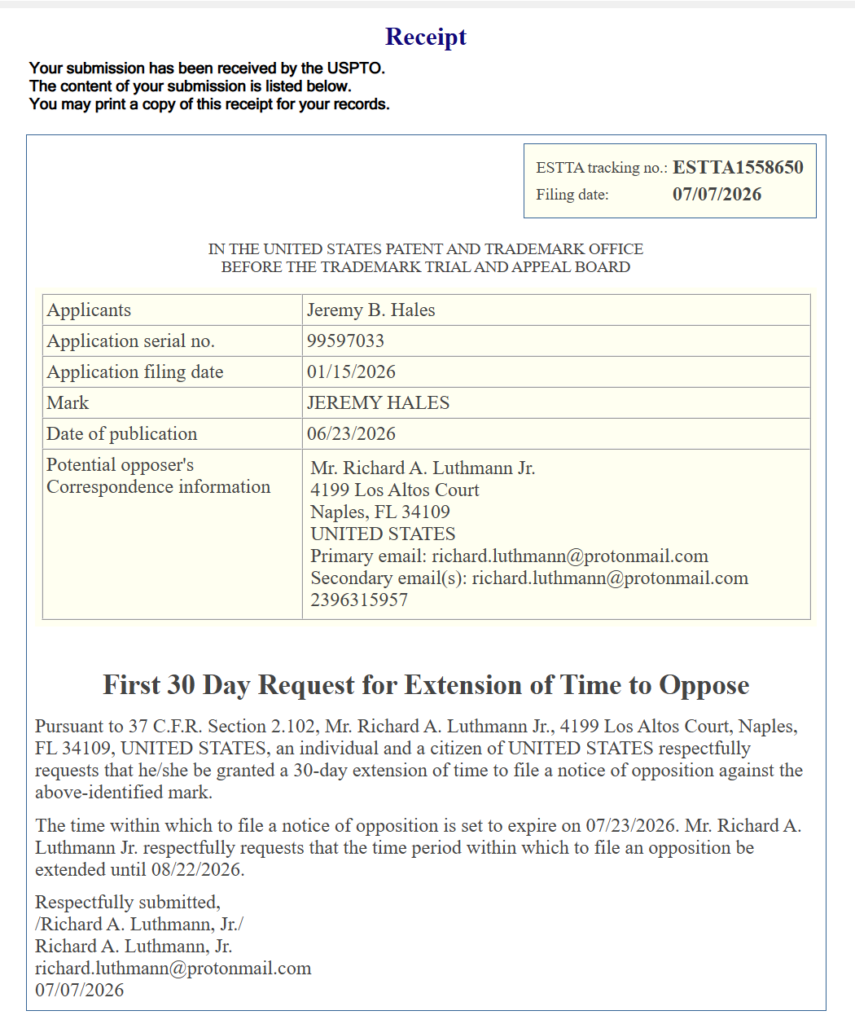
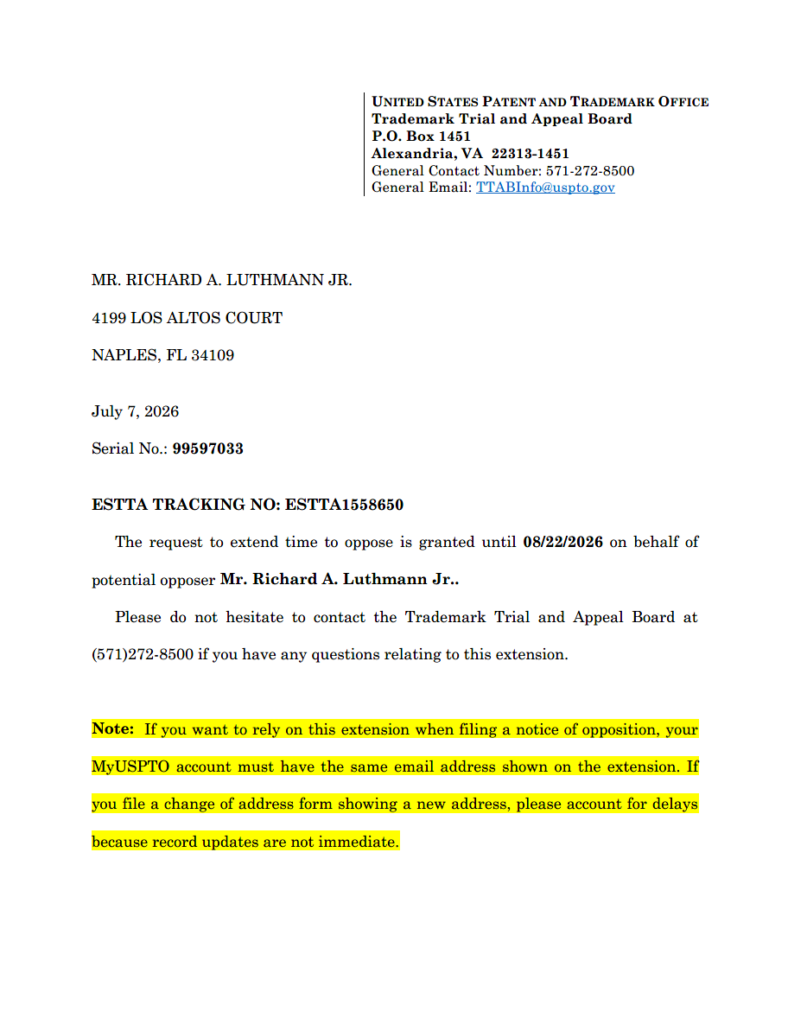
A few hours later, Luthmann received a response from the TTAB.
His request was GRANTED:
Fed 2 Already Showed the Pattern
Fed 2 is not internet folklore. It is Hales et al. v. Preston et al., No. 1:25-cv-00058, in the Northern District of Florida, Gainesville Division. That case matters because it showed the pattern before GERM ever started waving his new trademark toy around.
Hales and his company, Elephant Shoe LLC, dragged critics into federal litigation that looked less like clean legal redress and more like punishment by process. The case began with Hales suing ten people; the amended complaint later added Richard Luthmann as a defendant.
The amended complaint contained sixteen counts, including malicious prosecution, tortious interference, civil conspiracy, Florida statutory claims, deceptive trade practices, and false advertising under the Lanham Act. That is not spin. That is what the federal court’s public record says: Hales and Elephant Shoe put the Lanham Act directly into Fed 2.

That history matters because the Lanham Act did not become GERM’s magic anti-critic sword in Fed 2. The case moved through a pile of dismissal practice, and on April 24, 2026, the Clerk entered judgment pursuant to the Court’s order, dismissing all claims against John Cook, Bruce P. Matzkin, Lisa Lee a/k/a Lisa Weeks, Marla Hughes, Patti Diagostino Plummer, David C. Helm, Robert J. Keszey, David Michael Teschendorf, and Raymond G. Bonebrake, Jr. with prejudice for failure to state a claim on which relief can be granted.
The same docket states that Judge Robert L. Hinkle granted leave for a third amended complaint against two remaining defendants and directed entry of judgment for the other defendants.

In plain English, Hales already tried broad litigation warfare against critics, including Lanham Act theories, and a large part of that machine got thrown out with prejudice.
That is why the pending JEREMY HALES trademark application deserves scrutiny. Hales is not approaching trademark law like an ordinary business owner trying to stop counterfeit merchandise. He is arriving with litigation history where he has already tried to convert online criticism, commentary, and public dispute into federal claims, including a Lanham Act false-advertising theory.
Now Hales seeks registration of his personal name, JEREMY HALES, for Class 041 “Entertainment services, namely, providing webcasts in the field of commentary.”
That is the same battlefield: speech, commentary, public identification, and online criticism. The concern is not theoretical. It is grounded in the record. If Hales gets a registration and then waves it around against journalists, critics, commentators, or defendants who use his name to report on him, Fed 2 already tells the public what the next move may look like.
The legal point is simple: calling criticism “confusion” does not make consumers confused. Calling commentary “unauthorized use” does not turn journalism into counterfeiting. Calling a critic’s accurate reference to Jeremy Hales a trademark problem does not make it one.
Luthmann is Coming: The TTAB Objection is the Firewall
This is why Luthmann’s TTAB objection is not a stunt. It is a substantive response to risk, backed by pattern recognition. Fed 2 already showed how the Hales machine can try to convert criticism, controversy, and commentary into federal litigation. Now the same battlefield reappears in trademark clothing, with JEREMY HALES presented as a service mark for webcasts in the field of commentary.
For a journalist who covers Hales, the danger is obvious: a registration can become a paper weapon in takedown demands, threats, and nuisance claims, even where the law does not support censorship. The TTAB does not exist to bless future misuse. If JEREMY HALES is merely the name of a person appearing in or being discussed in online content, rather than a true source-identifying service mark, registration should fail.
That is not Luthmann bluster. It is basic trademark law. TMEP §1202 requires a mark to function as a trademark or service mark, and TMEP §1202.04 recognizes refusals where wording fails to indicate source. TMEP §904 and USPTO specimen rules require actual use of the mark in commerce with the identified services. A YouTube page bearing a person’s name may show the person is online. It does not automatically show service-mark use.
The Supreme Court also punctures GERM’s fantasy. In KP Permanent Make-Up, Inc. v. Lasting Impression I, Inc., the plaintiff still must prove the trademark claim. Critics do not lose nominative, descriptive, journalistic, critical, and noncommercial protections because GERM waves paper. Luthmann has substantial authority, a concrete journalistic interest, and a fact pattern showing why this application should be treated with suspicion.
Fed 2 already showed the pattern. The dismissed claims already showed the weakness. The pending trademark application now shows the next move. GERM keeps searching for a magic legal object that will make critics disappear.
Trial by Combat did not work because he ducked. Fed 2 did not work because law and facts matter. The Lanham Act did not work because criticism is not confusion. And this trademark application should not work if the TTAB applies the ordinary rules requiring real service-mark function, proper use, and registrability.
Winter is not coming because Luthmann says so. Winter is coming for GERM because the law is already standing at the gate.
Randy “Pocket Rocket” Shochet and the Meter That Never Sleeps
This is where Randy “Pocket Rocket” Shochet should be on notice. A client may be clueless, but a lawyer is supposed to be the adult in the room. From the outside, it looks like GERM keeps wandering into the legal woods with a frying pan on his head while Shochet walks behind him with an invoice pad, nodding solemnly as if this is all very serious.
Maybe Randy does not have the heart to tell him, or maybe he does not want to. Perhaps the “Pocket Rocket” has discovered that GERM’s legal fantasies are a renewable energy source, and every dumb theory can be converted into another round of fees.

That is opinion, but it is a fair question. When a client repeatedly mistakes the courthouse for a personal revenge machine, and counsel keeps fueling the engine, observers are entitled to ask whether the lawyer is offering sober legal judgment or just mining the client’s delusions.
Rule 11 is the line. Federal Rule of Civil Procedure 11 requires legal claims to be warranted by existing law or by a nonfrivolous argument to change the law. It also bars filings presented for improper purposes such as harassment, delay, or needless increase in litigation cost.
A trademark complaint designed to punish journalists or critics for accurately naming Jeremy Hales should trigger immediate Rule 11 scrutiny. Not polite concern. Not judicial patience.
Scrutiny.
If a lawyer signs a pleading pretending that ordinary criticism, commentary, news reporting, or nominative reference is trademark infringement, the court should ask hard questions fast. Lawyers are not supposed to be vending machines for a client’s tantrums. If they are truly officers of the court, that title should mean something.
If not, then they are no different than one of Littlefinger’s brothel whores.
Luthmann is Coming: So Are Sanctions
If GERM uses trademark law for legitimate brand protection against real imposters, fine. Nobody serious cares. Protect the logo. Stop the fake store. Chase the counterfeit merch. That is what trademark law is for.
But if he tries to use a trademark on “JEREMY HALES” or related branding to stop critics, journalists, defendants, commentators, or public watchdogs from naming him, that should be the day the court drops the hammer.
The first courthouse filing that turns this trademark gimmick into a censorship weapon should be sanctions day. It should be met with a motion to dismiss, a Rule 11 safe-harbor letter, fee demands where available, and serious discussion of bar consequences for any attorney who signs off on the theory.
Courts have enough real disputes. They do not need another Halesverse content script dressed in federal-question clothing.
Trial by Combat exposed the truth. GERM likes the performance of battle more than the battle itself. He likes the posture, the noise, the audience, the drama, the little legal props, and the illusion that he is always one filing away from victory.
But when the fight becomes real, he looks to jump ship.
First it was lawfare. Now it is trademark law. Next week, maybe he tries maritime law because somebody said “shipwrecked” in a livestream.
Jeremy Hales can trademark a brand. He cannot trademark public accountability. He cannot trademark criticism. He cannot trademark newsworthiness. He cannot trademark the right of journalists to identify the subject of a story. He cannot trademark his way out of Fed 2, Trial by Combat, or the public record.
GERM’s Favorite Toy is not a sword. It is a pacifier with a ™ sticker.
And if Randy “Pocket Rocket” Shochet carries it into federal court as a weapon against protected speech, the judge should take it away and sanction the grownups who pretended it was real.
Leave a Reply