
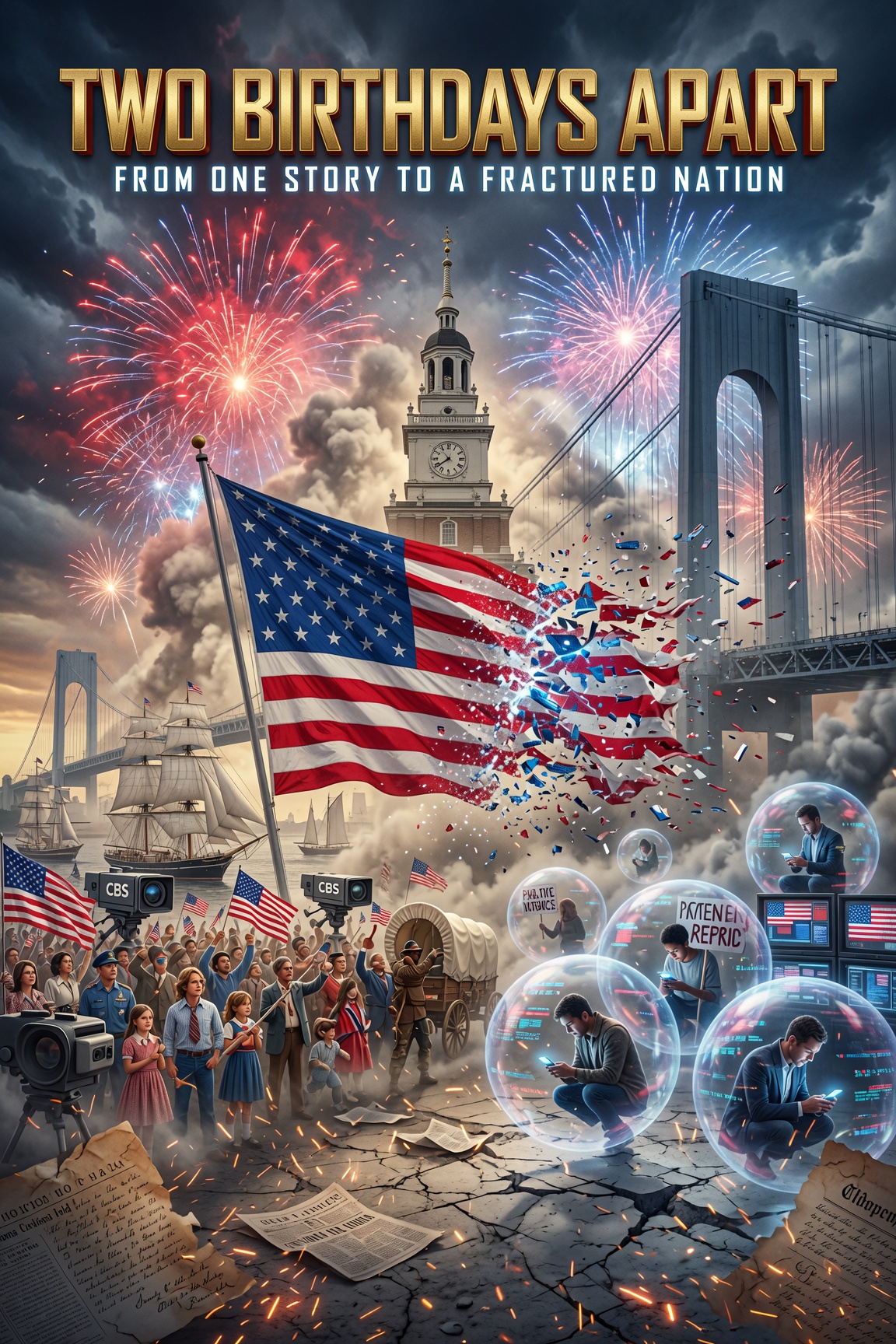
The nation’s 250th birthday arrives with patriotism splintered, politicized, and still worth saving.
LUTHMANN NOTE: The Bicentennial was not perfect because America was not perfect. That was the point. The country had endured assassination, riots, Vietnam, Watergate, inflation, recession, and cultural upheaval, yet still found a way to stand beneath the same flag. Today, the permanent political class has trained Americans to litigate every symbol, fracture every memory, and turn patriotism into a partisan weapon. This division is not accidental. It is cultivated, funded, organized, and amplified by grievance merchants, paid agitators, academic radicals, media arsonists, and political operators who profit from national exhaustion. The old poison of communism has been scrubbed, rebranded, and repackaged by the Red-Green Coalition for a new and dangerously naive generation. But America is not dead. It is waiting for adults to reclaim the story, defend the inheritance, and teach young Americans that liberty is not oppression. America’s 250th birthday should not be a funeral procession. It should be a call to civic arms. This piece is “Two Birthdays Apart.”

By Greg Maresca
In 1976, America threw itself a birthday party unlike anything before or since. The Bicentennial was not just a commemoration of 200 years of independence – it was a coast‑to‑coast block party of red, white and blue.
School children memorized the Declaration of Independence, where Thomas Jefferson blamed King George III, because Trump was still over two centuries later.
But I digress.
As Operation Sail brought a parade of tall ships into New York Harbor, the largest flag ever made was unfurled from the Verrazano-Narrows Bridge to greet them, only to be shredded by the wind in 90 minutes.

The flag unfurled across the harbor like a widescreen epic, a ribbon of red, white, and blue stitching Staten Island to Brooklyn in one long, heroic shot. It pulled the past into the present, greeting every ship that sailed into the world’s greatest city that was rolling out a patriotic red carpet.
It was the kind of moment that made you stop, breathe, and let the scene wash over you.
Photographed in that fleeting moment from the Brooklyn side, the image captured the Bicentennial. That photo was on display in my parents’ home for the rest of their lives. It was a quiet reminder that what endures most isn’t perfection, but something bold enough to try, just like the American Republic it represents.
In 1976, families lined highways to watch wagon trains retrace colonial routes. Even amid a recession, Watergate’s hangover and the long shadow of the Cold War, Americans found a way to feel like one people celebrating one story.

Fast-forward to 2026, and the mood is unmistakably different. The nation observes rather than celebrates its 250th year not with a unified drumbeat, but with a fractured soundtrack of competing narratives, grievances, and uncertainties.
Patriotism has not disappeared, but it has splintered, claimed by factions, questioned by others, and often overshadowed by the clamor of cultural and political division.
The contrast between 1976 and 2026 is not nostalgia talking. It reflects how the country once understood patriotism as a shared civic ritual, even when citizens disagreed. In 1976, Americans could argue about Watergate and Vietnam and still stand shoulder-to-shoulder for a parade.
Patriotism was a common language, not a partisan dialect.
That unity came from proximity. In 1976, people consumed the same news broadcasts, read the same newspapers and magazines. The Bicentennial was a national event because Americans still experienced national life together. When the tall ships sailed into New York Harbor, tens of millions watched the same images at the same time. It created a sense of “us,” however imperfect.
By 2026, the information landscape has Americans living in fragmented realities shaped by algorithms and curated social media feeds.
Patriotism has become contested terrain.

For some, it means honoring tradition and national heritage. For others, it means confronting historical failures. For still others, it is a word they avoid altogether, fearing it has been politicized beyond recognition.
The result is a country where even the flag can spark debate instead of unity.
The Bicentennial benefited from something America has since lost: a cultural instinct to celebrate what we share rather than amplify what divides us.
In 1976, we were still close enough to World War II and the moon landings to remember collective achievement. Citizens believed they were part of a larger story, one worth celebrating even when some chapters were messy.
In 2026, many view history through the lens of dispute rather than continuity, where government, media and education are now battlegrounds for ideological conflict. The sense of belonging to a common denominator has been replaced by a culture that rewards outrage more than understanding.
Division is not the opposite of patriotism – indifference is.
Americans may be divided, but they are not indifferent.
The challenge of the nation’s 250th anniversary is whether we can rekindle the shared sense of purpose that defined the Bicentennial.
Leave a Reply