
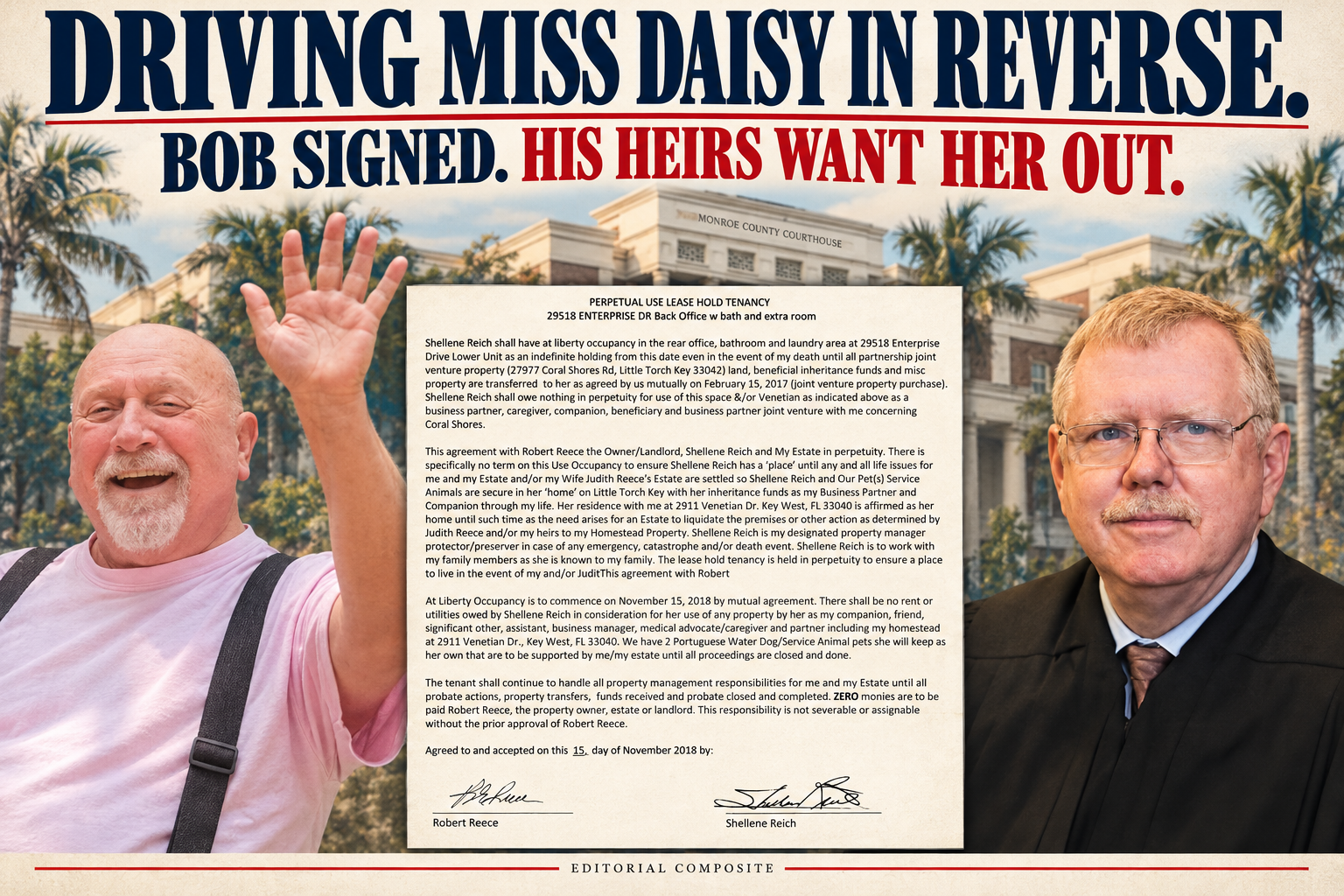
Bob Reece put Shellene Reich’s housing arrangements in writing. His heirs want her gone. Now Key West Judge Koenig controls her chance to defend those promises.
LUTHMANN NOTE: Driving Miss Daisy understood that years of service can become something richer than employment. The Reece family’s destruction campaign presents the ugly reverse. The Key West court should examine the promises and the defense before it orders the employee-companion out. Bob Reece signed an agreement. Shellene objected when people connected to the Key West Police Department illegally entered her home and handled her belongings. Her former lawyer leaked information to the other side. The Reece estate’s lawyers are conflicted. Those facts demand attention. I want Judge Koenig to meaningfully confront the record. Heirs can press their claims, but their parent’s commitments in life deserve respect. We learned that from Boolie Werthan and Hoke. This piece is “Driving Miss Daisy in Reverse.”


By Rick LaRivière and Richard Luthmann
The Companion They Want Gone
Bob Reece knew what Shellene Reich meant to him. He put it on signed paper: companion, friend, assistant, business manager, medical advocate, and caregiver. She had entered his life as a social acquaintance and then an employee. The relationship grew into the kind of companionship that makes a job description hopelessly inadequate.
Now Bob and Judith Reece are dead, and their estate representatives want Shellene out. A disabled woman, 64, is fighting to keep the home Bob affirmed for her while the people pursuing his estate try to defeat the rights she claims under his agreements.

In Driving Miss Daisy, Morgan Freeman’s Hoke Colburn becomes indispensable to Jessica Tandy’s Daisy Werthan through years of service and friendship. Shellene occupies that place in this story: the employee who became a trusted companion, the practical helper whose presence acquired a meaning money alone could never measure. Dan Aykroyd’s Boolie Werthan recognizes Hoke’s value and sustains his employment even after Daisy enters a nursing home. There is decency in that recognition, an understanding that loyalty deserves something better than disposal.
The Reece heirs have chosen the opposite role. Their estate representatives, Angela Reece, Jennifer Bryant, and Lara Caldwell, pursue possession and deny Shellene’s asserted interests. The family’s lawyers threaten financial consequences for maintaining her defenses. Bob’s companion is being treated as a problem to eliminate.

That is the ugly inversion at the heart of this Key West case: family greed replaces Boolie’s decency, the trusted employee becomes the target, the heirs become the villains, and Judge Timothy J. Koenig controls what happens next.
Bob’s Signature Still Speaks
The November 15, 2018 agreement carries a heading the family cannot wish away: “PERPETUAL USE LEASE HOLD TENANCY.” Bob and Shellene signed it. It addresses Enterprise space, Venetian, Coral Shores, continuing management duties, and housing after his death while agreed estate and transfer matters are completed. They waived rent and utilities in consideration of her work and companionship. Bob even addressed continued care for their animals. He was recording obligations arising from a shared life, with practical details extending beyond the day he could personally enforce them.
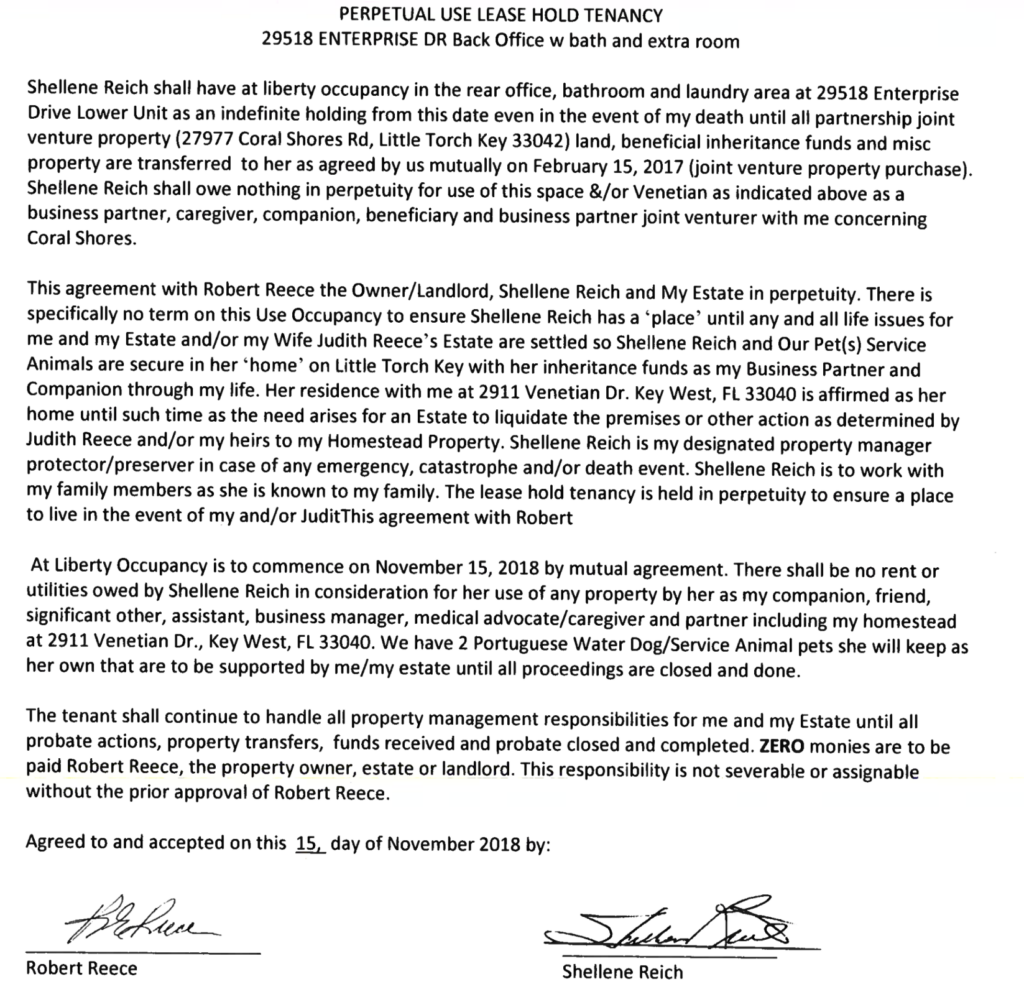
The Venetian provision anticipates estate liquidation or other action determined by Judith or the heirs. That condition must be read with the rest of the agreement, including its housing, service, and transfer provisions. Shellene’s claim deserves the whole document. Reducing her years beside Bob to revocable hospitality would erase the exchange he took the trouble to describe. The heirs inherited a dispute involving their father’s signed commitments. They should have to answer those commitments before obtaining possession of the home he affirmed for her.

Coral Shores supplies another piece of the story. Seller Richard Greer’s notarized 2025 attestation describes Shellene’s purchase contributions, Bob’s financing, and repayment through rental income. His account supports her claim that property transactions intertwined with their personal relationship. The court must examine that evidence alongside the agreement connecting the properties. Shellene is asking to establish rights grounded in services, money, and promises reduced to writing. Bob’s death made those papers more important. It did not make his signature disappear.
Driving Miss Daisy in Reverse: They Knew Exactly How Vulnerable She Was
The family knew Shellene depended on Bob. In January 16, 2025 emails, Angela acknowledged that people had entered the house and removed things, while saying the removal was not her idea. She also said Jennifer and Judith were going through paperwork.
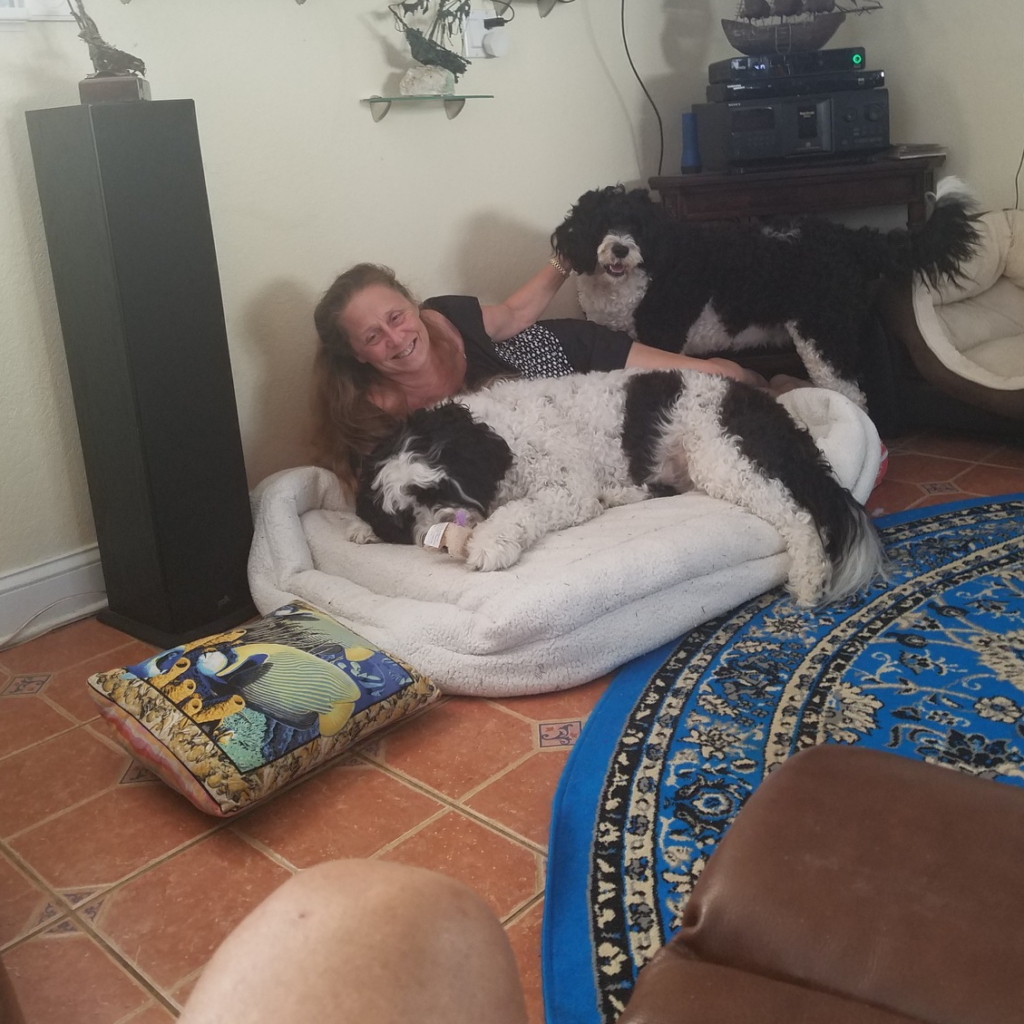
Bob Reece’s death was followed by a fight over the paper trail of Shellene Reich’s life with him. Shellene demanded return of files, including personal records, and described documents being taken away. She says Jay and Kathleen Fisher entered her home while she was away and removed files despite her objections.
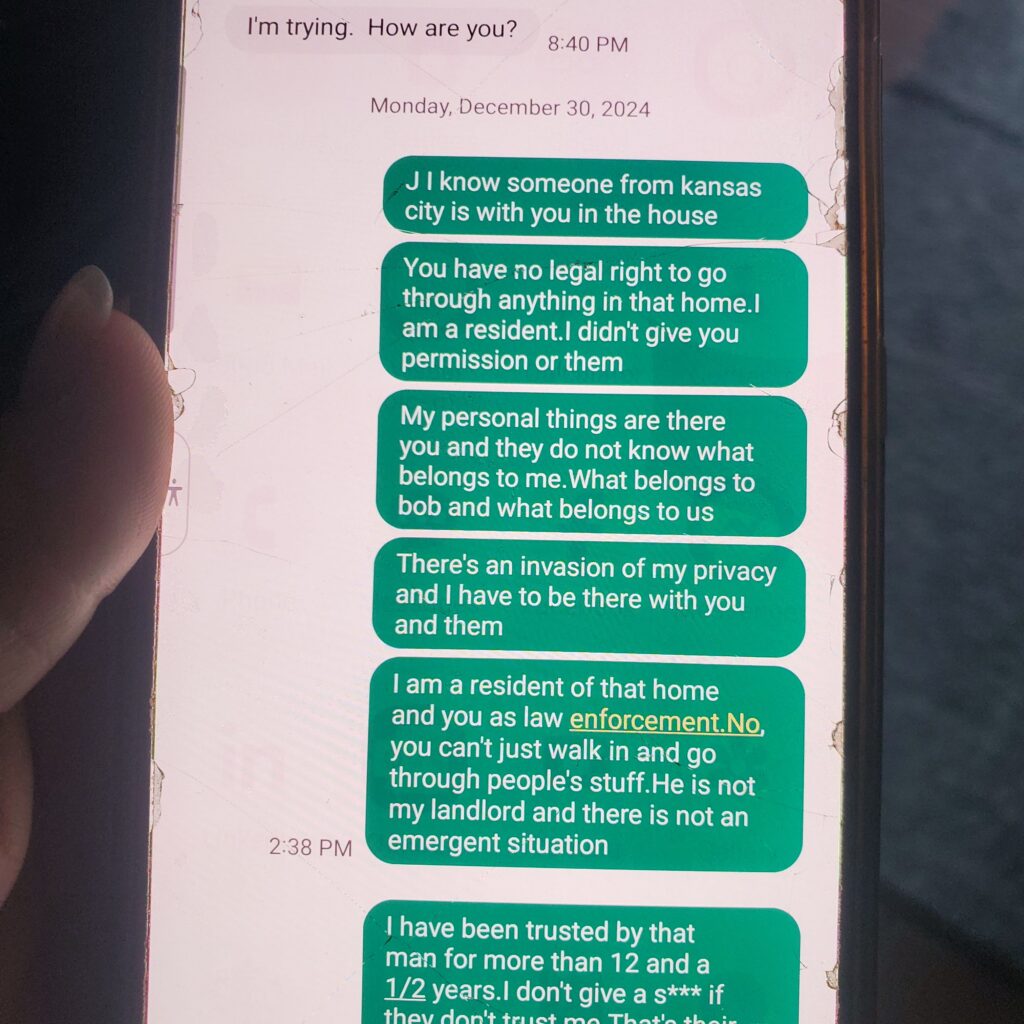
Her text screenshots contain an unmistakable demand: “Leave everything in that house and walk out now.” Another message expressly withholds permission for anyone to be there or do anything before her return. These are the words of a resident demanding control over her home, privacy, and belongings.
The Key West police connection deserves scrutiny. Kathleen Ream Fisher served with the Key West Police Department for 25 years, retiring in 2020 with an honorary promotion from lieutenant to captain. A retirement announcement credited to KWPD identifies her husband, Jay Fisher, as a retired Monroe County Sheriff’s Office sergeant. Reich identifies that couple as the people who removed the records. Their professional backgrounds make a careful accounting imperative. The materials reviewed do not establish that KWPD authorized the entry or removal. keysweekly.com
By January 16, Shellene was demanding the return of personal papers, medical information, and documents concerning her son. Angela Reece’s email offered to ask Jennifer to locate and return paperwork, adding that she thought Jennifer and Judith were reviewing it. “These files need to be returned,” Shellene insisted.
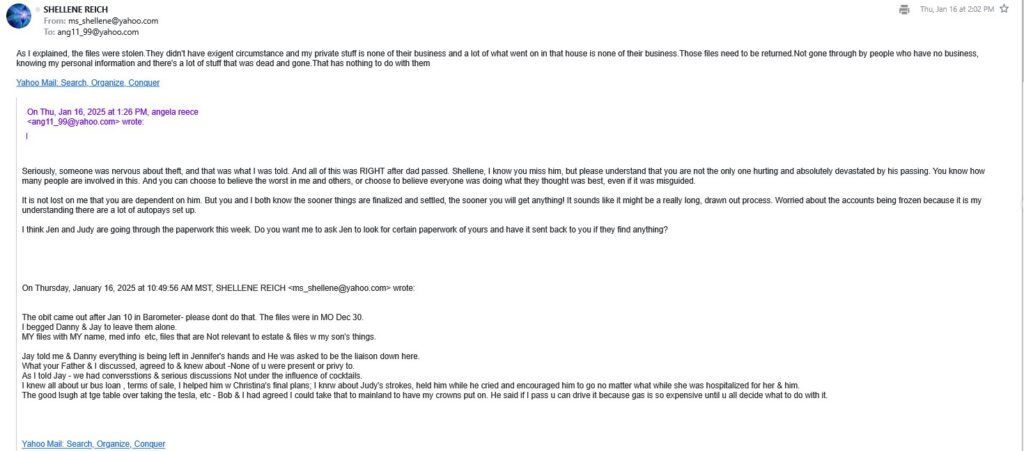
Judge Timothy Koenig should require answers about what was taken, where it went, and what remains withheld. A meaningful hearing must include time to recover and examine those records. Shellene’s defense cannot fairly depend on whatever paperwork others choose to return.
“It is not lost on me that you are dependent on him,” Angela wrote, while invoking her father’s wishes. Those exchanges matter: this family understood both the woman’s vulnerability and the existence of papers bearing on what Bob wanted.

Months later, the Venetian complaint acknowledged Bob had permitted Shellene’s occupancy, then denied the ownership, financial, and leasehold interests she asserted. His written agreement stands against that effort to shrink her place in his life into permission that the survivors could simply revoke. The same complaint describes protected homestead descending outside probate to living descendants, while the plaintiffs sue as estate representatives. The court must require each representative to establish the source of the right to remove her. Family status does not answer that question.
Then came the financial squeeze. Laura Holmes, writing for Yates’s firm, sent a June 19 sanctions warning demanding withdrawal or correction of defenses and threatening a proposed fee claim against Shellene and Garcia. Holmes is married to Key West Police Officer Russell J. Holmes.




The heirs’ September 29 opposition resisted further preparation time and complained about the cost of her continued occupancy. Bob had expressly linked rent-free housing to what she supplied.
The heirs now seek possession while their lawyers and (maybe the Key West Police) threaten to make resisting more expensive. Calling that campaign cruel is a judgment grounded in the choices their own papers disclose.
Manny Garcia Left Her Carrying the Wreckage
Shellene thought Manny Garcia would be her champion. She says he failed to set dispositive issues for hearing and never renewed them after adverse dispositions. An April amendment draft reports that his February 24 dismissal motion was struck March 27.

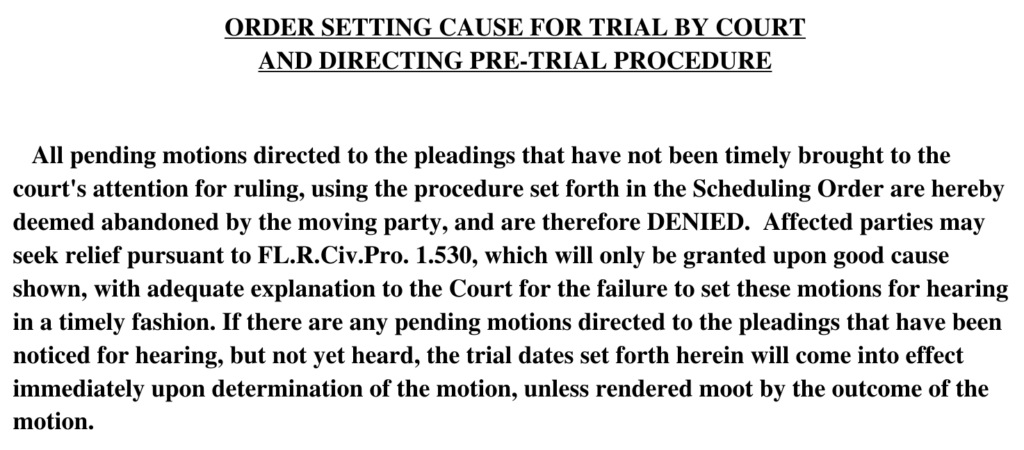
The July 8 trial order then deemed pending pleading motions not timely brought forward for decision abandoned and denied. A filed motion can look like protection to a client. When her lawyer fails to get it decided, the paper becomes an illusion she pays for.
His withdrawal was granted in August. Shellene was left to reconstruct the pleadings, revive permissible issues, and work out what could still be presented. She reports receiving a partial file on October 5, followed by loss of access to the CLIO link on October 9. Her account describes a client forced to rebuild her defense as trial approached. The protection she hired Garcia to provide had collapsed at precisely the point when the cost of failure could be her home.
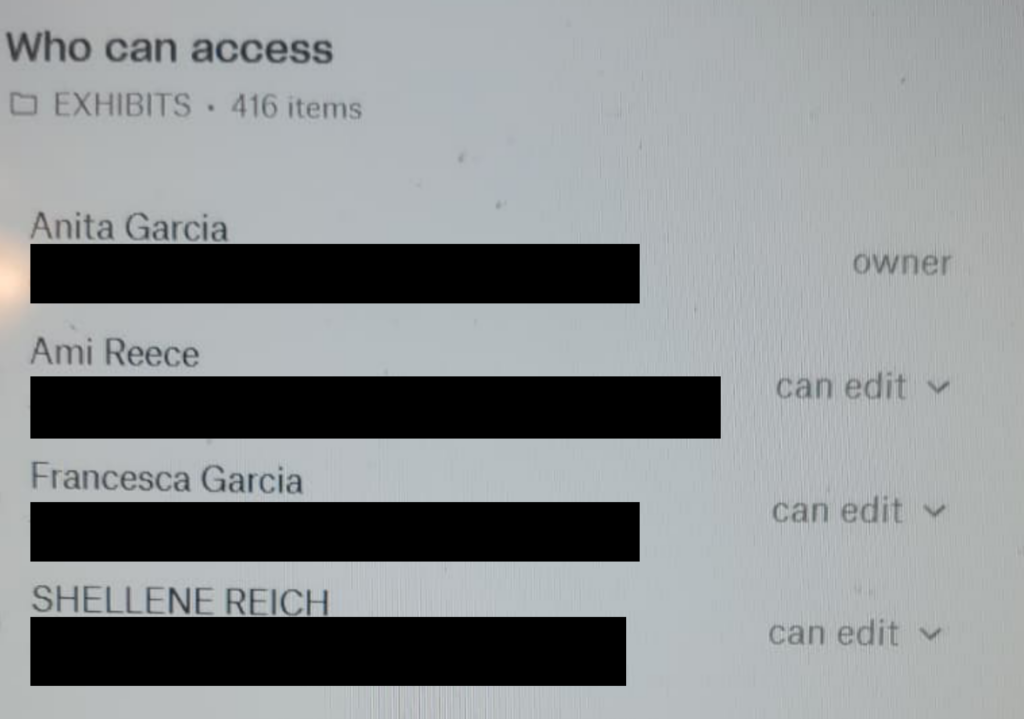
Her exhibit-access photograph makes the abandonment uglier. It shows Anita Garcia as owner of an EXHIBITS folder and lists Ami Reece, Francesca Garcia, and Shellene with editing access. Shellene identifies Ami as Bob’s daughter-in-law and a plaintiffs’ witness. She regards the failures and access arrangement as a betrayal and a sellout.
Garcia has yet to legally answer for the lost hearings and the handling of her files. That explanation belongs under scrutiny, with Shellene given time to obtain the evidence.
Driving Miss Daisy in Reverse: Don Yates, the Family’s Hammer
Donald E. Yates is the hired hammer of this removal campaign. His firm presses possession, challenges Shellene’s defenses, and seeks to exclude defense documents and witnesses over disclosure disputes.
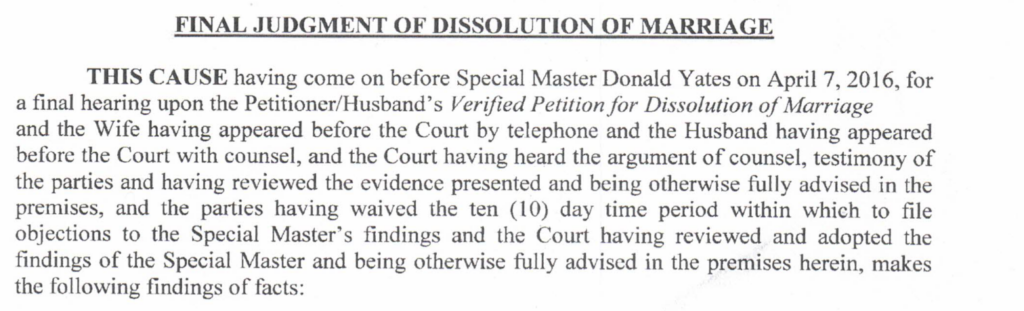
That pressure comes with an attorney-ethical-conflict objection that deserves a real hearing. The Greer divorce judgment identifies Yates as Special Master at an April 7, 2016 hearing. Greer later sold Coral Shores to Bob in the transaction Shellene says financed her purchase. She relies on the 2018 agreement connecting Coral Shores with the housing arrangements now being fought over.
The former-neutral rule addresses a lawyer’s personal and substantial participation in the same matter, with informed written consent required from all parties. Koenig should require the original proceedings, a parcel comparison, and the participation and consent records needed to determine whether that rule bars Yates’s role here. A former judicial neutral should have to confront that history before asking a judge to shut down Shellene’s evidence.
Garcia’s response adds another betrayal to her account. In her declaration draft, Shellene recounts asking him to address Yates’s conflict and being discouraged because the heirs might obtain a better lawyer. Her own protection should have been his concern. Instead, she says, the objection went unpursued.
Yates’s firm now attacks the evidence and defenses she needs to resist removal while the former-neutral issue remains to be resolved. This is a brutal position for a client abandoned by counsel: defend the home, repair the file, and press the conflict her lawyer declined to pursue.
The Court Changed the Script
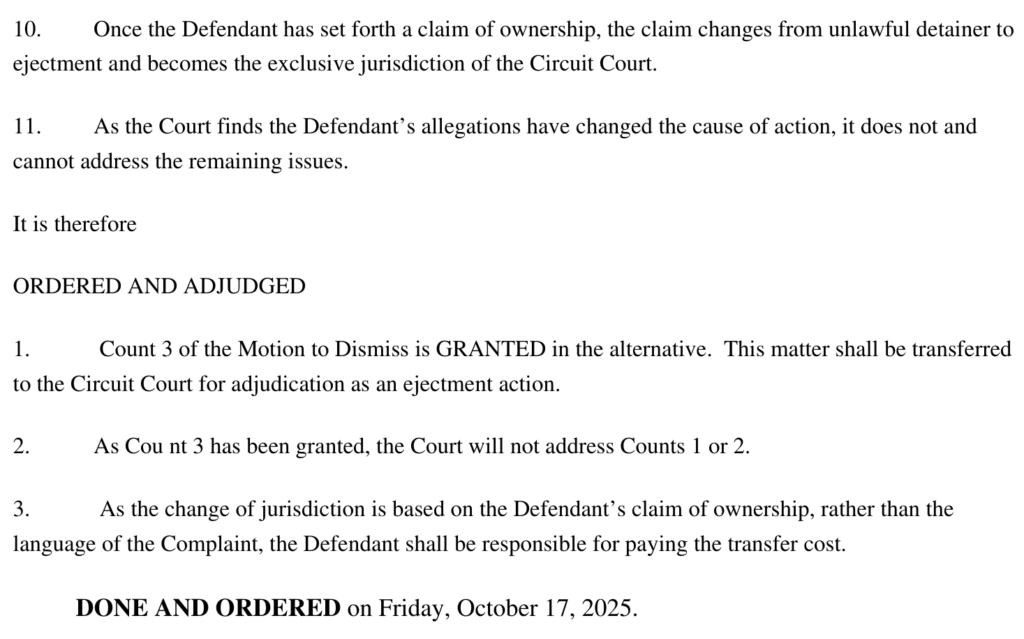
Judge Albert Kelley’s October 17, 2025 transfer order, filed October 20, found Shellene’s equitable-ownership allegations sufficient to require ejectment adjudication. He expressly left the standing and failure-to-state-a-claim grounds undecided.

Her July 30 answers had raised possession and representative-authority issues. Those were defenses demanding decisions, not decorations for a file. The Enterprise transfer order and February stipulation also identified ejectment treatment. Shellene had reason to expect a proceeding in which the rights asserted against her and the rights she asserted in response would receive proper examination.
At the June 12 hearing, Koenig treated the case not as an ejectment, but as an unlawful detainer and struck her jury demand, citing untimeliness and distinguishing an ownership defense from an affirmative counterclaim. Yet Estevill v. Estevill required ejectment adjudication when equitable ownership was sufficiently alleged in an answer and affirmative defenses.
“A separate counterclaim was not indispensable to that procedural result. [Judge Koenig] should reinstate her jury demand, address the demand’s timing, and explain in writing how the transfer orders, operative pleadings, and controlling appellate authority fit the proceeding he intends to conduct,” said a seasoned Florida Keys litigation and appellate attorney who did not wish to be named.
The ejectment statute also requires disposition before trial of properly presented objections to identified title instruments or court proceedings. The plaintiffs’ representative authority and asserted superior possession need distinct rulings. Shellene’s objections must be presented through the proper procedure, with an opportunity to renew what remains available and develop issues requiring evidence.
Attorney Garcia’s failure to obtain hearings cannot fairly become a shortcut around those questions. Before the court takes her home, it should identify what case is being tried and hear the defenses that could decide it.
Driving Miss Daisy in Reverse: Judge Koenig’s Choice
An August 26 order placed this case on Koenig’s October 13 trial calendar. Shellene needs a meaningful hearing AND time to repair the damage Garcia left behind. Previous extensions to obtain counsel do not answer the partial file and lost access she reports in October. Nor do they supply the preparation a disabled litigant needs to locate documents, secure witnesses, and respond effectively.
Reich has made accommodation requests under the Americans with Disabilities Act, seeking breaks, accessible materials, assistance locating records, and practical participation despite pain and mobility restrictions. A hearing she cannot prepare for is a “performance of fairness” and not a meaningful opportunity to be heard.
Her proposed plan targets readiness in mid-November, with earlier progress reports. Judge Koenig should give her sufficient time to seek the missing papers and access logs, subpoena witnesses, present the conflict record, and bring properly renewed issues on for rulings. She must have a real chance to establish the misconduct she attributes to Garcia, Yates, and the Reece heirs.

The judge controls whether those accusations are tested through documents and testimony or buried beneath the consequences of her former lawyer’s failures.
This case is a mess. The robe carries responsibility. Judge Koenig can insist that Bob’s agreements, the transfer orders, the access record, and Shellene’s ability to defend herself receive serious attention. Or he can let the accumulated damage propel her out the door.
Boolie Werthan’s decency protected a cherished employee. These heirs have pursued Bob’s companion with demands for possession and mounting financial pressure. The court should refuse to make that cruelty efficient.

A just arbiter confronting injustice, or a go-along-to-get-along judicial villain? Judge Koenig’s next decisions will supply the answer.
Leave a Reply