
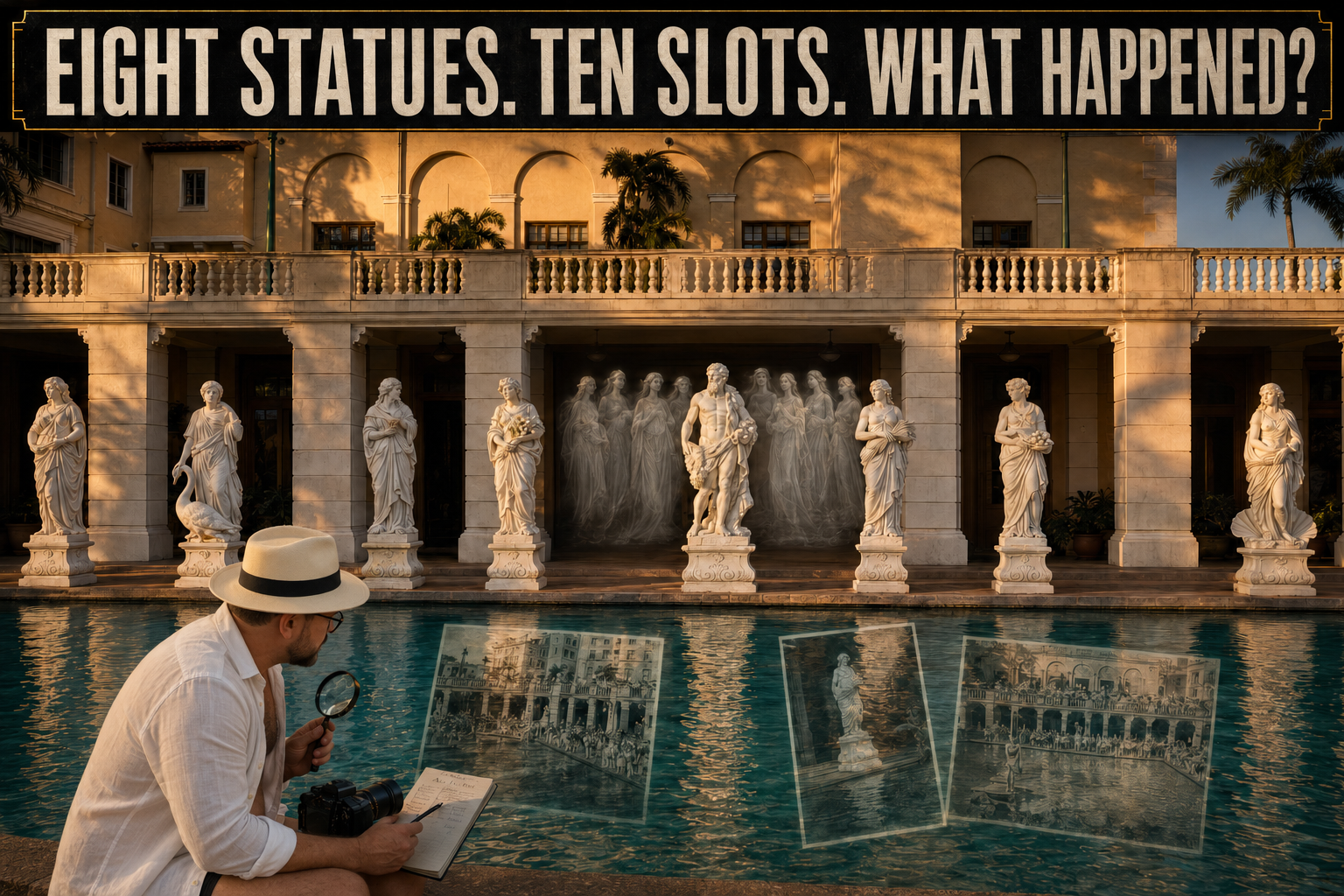
Eight statues, ten apparent openings, and one suspicious reporter turned a quiet afternoon at the Biltmore pool into a hunt for missing Greek gods.
LUTHMANN NOTE: The great investigations do not always begin with leaked documents, courthouse filings, or a nervous source in a parking garage. Sometimes they begin while sitting beside a magnificent pool and asking why the numbers do not add up. This one was harmless, playful, and unexpectedly revealing. The Biltmore’s statues demonstrate how architecture can create a mystery—and how photographs can dismantle one. We may have solved the missing-marble question, but the installation date remains open. If a reader, preservationist, or Biltmore historian has original plans, restoration records, or old photographs showing when these eight figures arrived, I want to see them. The marble witnesses are still holding something back. This piece is “The Case of the Missing Marble.”

By Richard Luthmann
Ten Openings, Eight Statues and One Dangerous Question
I was sitting beside the pool at the Biltmore Hotel in Coral Gables recently, doing what any responsible investigative journalist does at a luxury resort: staring suspiciously at the architecture. Across the water stood a long white arcade. Within it, classical statues watched the swimmers with the solemn patience of witnesses who had lawyered up sometime during the Coolidge administration.
I counted the apparent statue positions. Ten.
Then I counted the statues. Eight.
That was enough. The investigation was open.
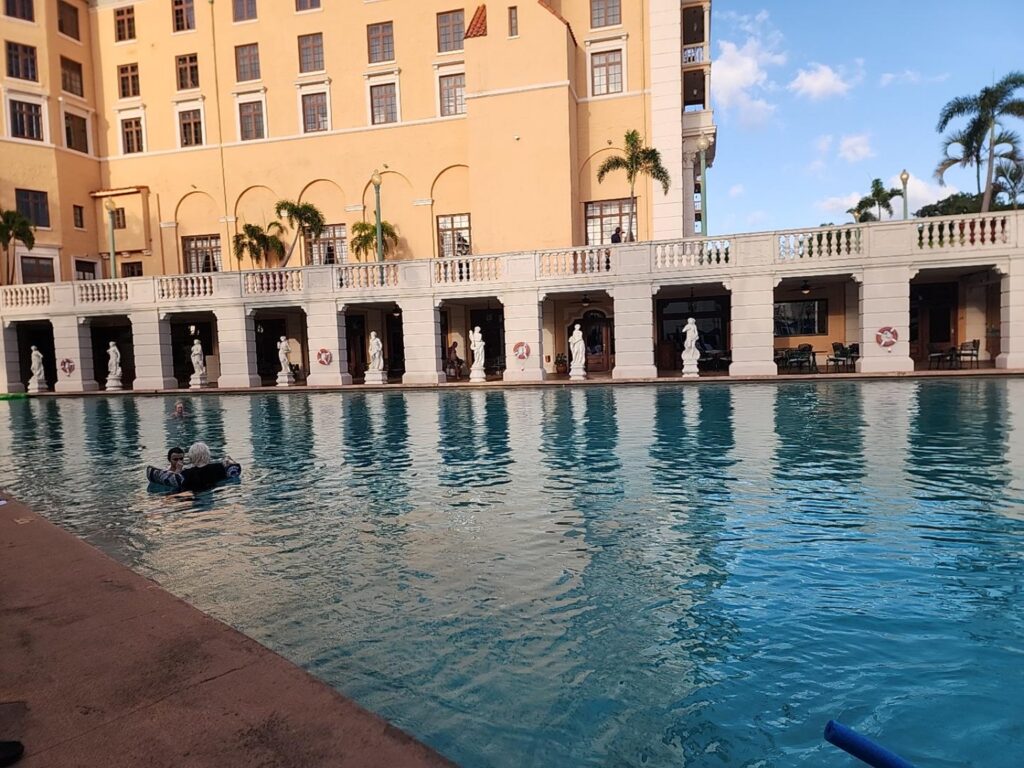
The Biltmore’s pool is no ordinary backyard watering hole. Built with the hotel in 1926, it covers approximately 23,000 square feet and holds about 600,000 gallons. It once hosted aquatic spectacles, diving exhibitions, fashion shows, and celebrity parties. The Biltmore says Esther Williams performed there; Johnny Weissmuller, before becoming Hollywood’s Tarzan, was associated with its swimming program. Thousands once packed the grounds for aquatic galas. Today, it remains among the largest hotel pools in the continental United States.
But none of that answered my question. Why did the marble lineup appear two statues short?
My first theory arrived with all the restraint of a caffeinated prosecutor: the Nine Muses. There are nine of them, after all—Calliope, Clio, Erato, Euterpe, Melpomene, Polyhymnia, Terpsichore, Thalia and Urania. Eight statues. One missing Muse. Clean, elegant, and suspiciously convenient.
Then one of the “Muses” grew a beard.
The Case of the Missing Marble: Hercules Walks In and Wrecks the Muse Theory
The fifth statue from the left was unmistakably male: muscular, bearded, and carrying what appeared to be an animal skin beside a heavy support. This was no Muse. This was Hercules—or Heracles, if we wanted the Greek indictment instead of the Roman one.
For about five glorious minutes, I upgraded the theory. Perhaps this was Apollo presiding over eight surviving Muses. Apollo and the Nine Muses would make ten figures—exactly the number of apparent positions. Two missing women. We had motive, opportunity, and mythological arithmetic.
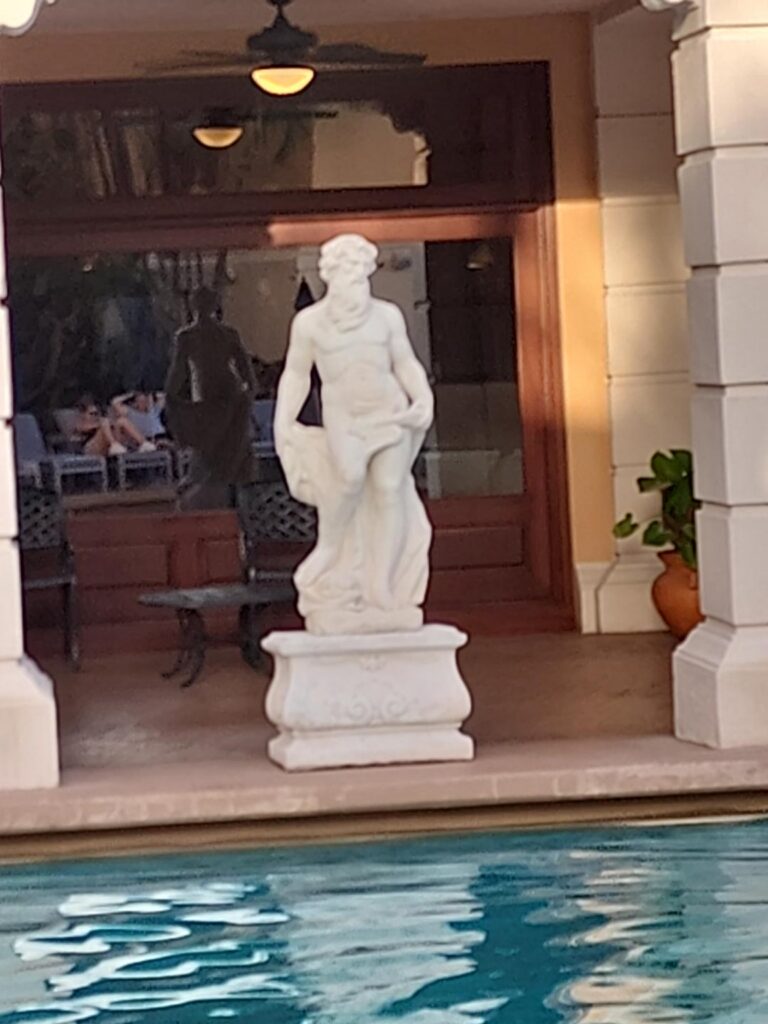
Unfortunately, Apollo is generally represented as youthful and beardless. Our suspect looked as though he had just completed the Twelve Labors, fought three zoning boards, and discovered that valet parking was not included. The club and Nemean lion’s skin pointed squarely to Hercules — his signature attributes.
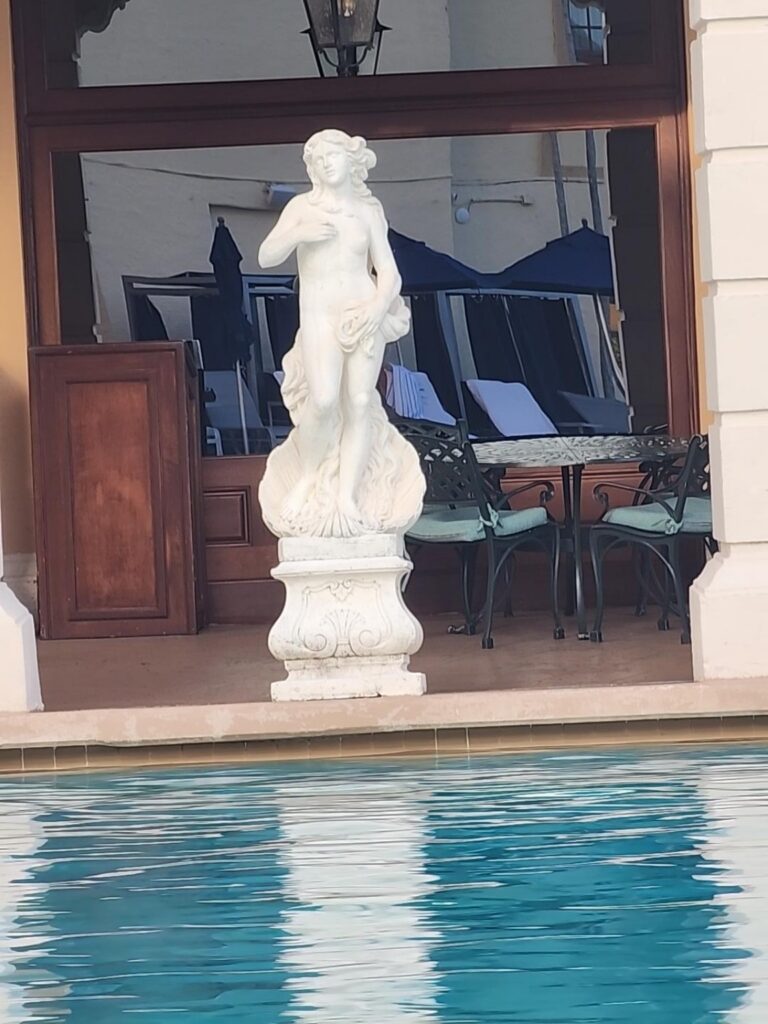
The Muse conspiracy quickly collapsed. The other statues began giving up their identities. Statue Two showed a woman with a swan curling toward her shoulder: Leda with Zeus in avian disguise. Statue Eight stood nude upon a scallop shell—the Birth of Venus, with all the subtlety of Botticelli arriving at a pool party. Statue One remained coy: a fully draped classical woman without a decisive surviving attribute.
Then came Statues Three, Four, Six and Seven—and the real breakthrough. One bundled herself in heavy garments. Another carried flowers. A third held what appeared to be harvested grain. The fourth presented fruit or a cornucopia.
Winter. Spring. Summer. Autumn.
The “missing Muses” were not missing. They had never been Muses. Half the collection appeared to be a complete Four Seasons ensemble.
The Case of the Missing Marble: Witnesses Finally Talk
Once each statue was photographed separately, the lineup began to make sense. Statue Four was Spring in the guise of Flora, holding a basket overflowing with flowers and lifting one blossom toward her face. Statue Six appeared to personify Summer, carrying a bound sheaf of grain. Statue Seven became Autumn or Plenty, presenting the season’s harvested fruit. Statue Three, heavily wrapped and withdrawn, completed the cycle as Winter.
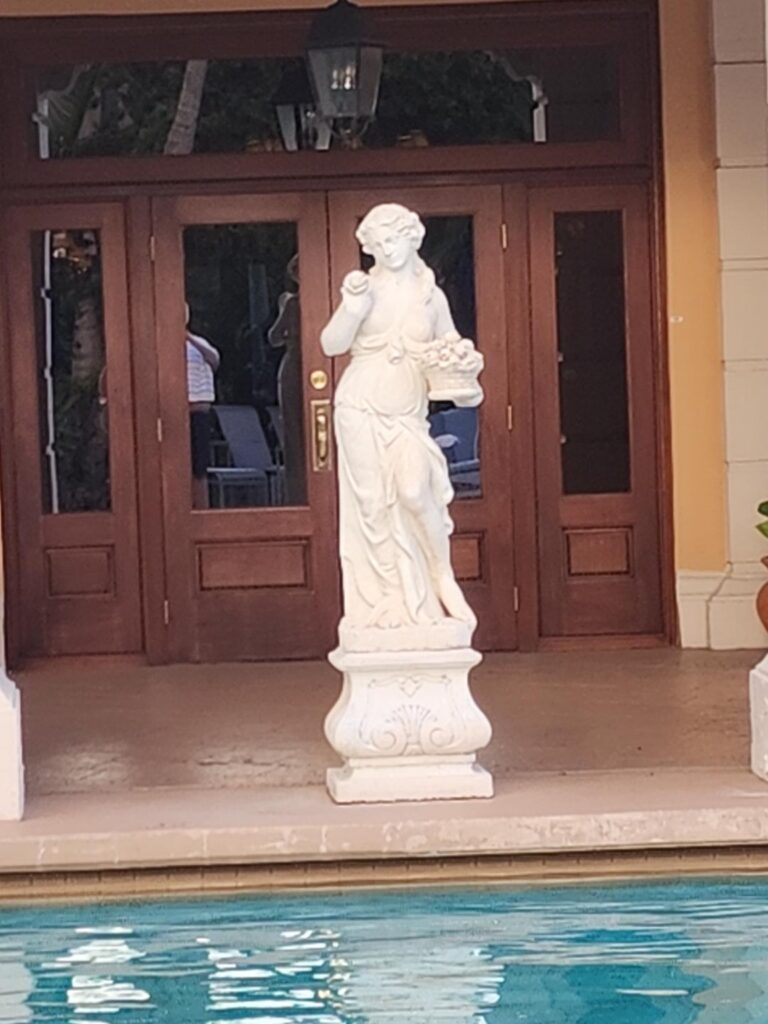
The identifications are interpretive—not inscriptions chiseled into the pedestals—but together they form a coherent conventional program. Spring brings flowers. Summer brings grain. Autumn brings fruit. Winter brings enough clothing to survive a Miami restaurant’s air conditioning.
The resulting working inventory is: an unidentified draped goddess; Leda and the Swan; Winter; Spring or Flora; Hercules; Summer; Autumn or Plenty; and Venus rising from the sea.
That lineup also fits the setting. The Biltmore’s Mediterranean Revival fantasy was never a museum catalog governed by strict archaeological discipline. It was theatrical architecture—Spanish, Italian, Moorish and classical elements assembled to transport wealthy visitors into an Old World dream. Hercules supplied heroic strength. Leda and Venus brought mythology, beauty and water. The Seasons marked nature’s eternal cycle.
Then the panoramic photograph delivered the architectural verdict. The apparent “ten slots” were not ten matching statue stations. The arcade’s columns, doorways, lifesaving equipment,t and circulation paths created an optical rhythm that suggested vacancies. But there were no two empty matching pedestals, no exposed mounting scars, and no obvious gaps in a continuous sequence.
I had mistaken architectural punctuation for missing witnesses.
The Case of the Missing Marble: Mystery Solved—Except for the Part That Isn’t
The best present conclusion is that eight statues constitute the intended display. The Nine Muses theory is dead. Apollo and his missing attendants have been released without charges. The two supposed vacancies appear to be functional breaks in the arcade, not the chalk outlines of stolen goddesses.
But one legitimate mystery remains: When did these particular eight statues arrive?
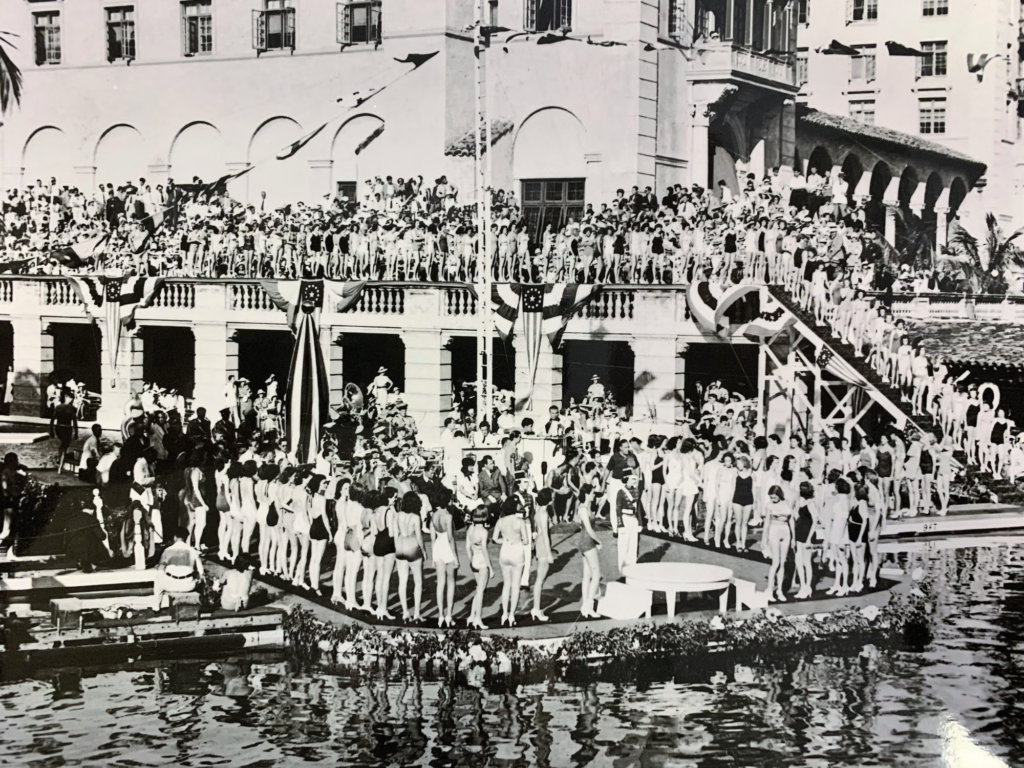
The pool dates to 1926, but the Biltmore endured extraordinary changes. The War Department converted the hotel into a military hospital in 1942. It later served the Veterans Administration and the University of Miami’s medical school before being vacated in 1968.
Coral Gables acquired it in 1973, and a four-year, approximately $55 million restoration began in 1983. Seaway Hotels undertook another extensive renovation after 1992, refurbishing the pool, adding cabanas, and converting the old diving structure into a waterfall. Biltmore history, The Cultural Landscape Foundation.
A 1999 restoration account describes the pool as surrounded by “Moorish arcades and classical statuary,” proving the figures—or classical figures generally—were present by then. It does not establish that these exact eight occupied these exact positions in 1926. And they probably did not,ot based on photographic evidence from the 1930s.
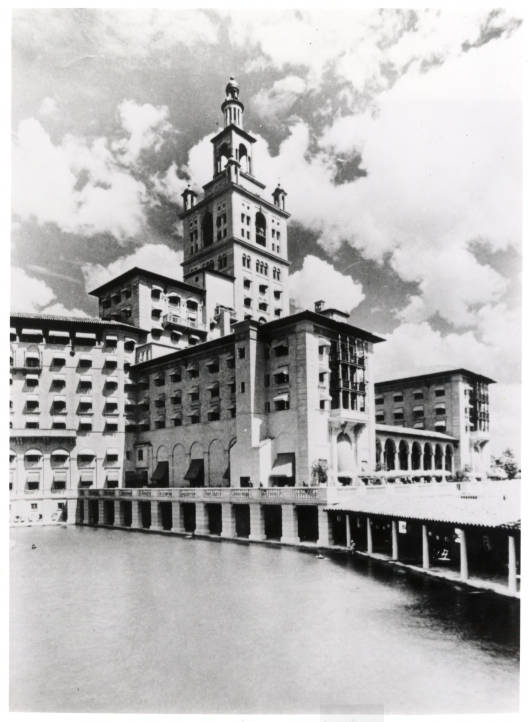
The answer likely lies in Schultze & Weaver’s original elevations, early pool photographs, city restoration drawings, and purchase records from the 1980s and 1990s. The State Archives of Florida preserves an early Biltmore pool image, and additional photographs are held by the Coral Gables Museum and other repositories, but the published views do not yet provide a definitive statue-by-statue installation history.
So the marble case is mostly solved. Eight statues. A complete seasonal cycle. No missing Muse.
Probably.
And “probably,” as every reporter knows, is where the next investigation begins.
Leave a Reply