
DOJ Watchdog Says BOP Blew Through First Step Act Cash While Prisoners Waited For Real Programs
LUTHMANN NOTE: I know the Bureau of Prisons from the inside, and this DOJ Inspector General report rings true because the federal prison machine has always loved appearances more than accountability. They can produce a guide, a dashboard, a policy memo, and a press-ready explanation faster than they can produce a real classroom with a real instructor and a real program that changes a life. The First Step Act was supposed to be earned rehabilitation, not waitlist theater. Congress funded reform. BOP bureaucrats turned it into accounting fog, program mirages, and institutional excuses. That is not corrections. That is captivity with public relations. This piece is “BOP Quality Learing Center Fails the Test.”

By Richard Luthmann
(WASHINGTON, D.C.) – The Federal Bureau of Prisons loves slogans, acronyms, mission statements, glossy program guides, and bureaucratic self-congratulation. It sells itself as a correctional system that prepares inmates for successful reentry, reduces recidivism, teaches life skills, expands education, and turns prison time into productive time.
But the latest Department of Justice Inspector General report asks a simpler, uglier question: Is the BOP actually a Quality Learning Center, or is it a billion-dollar federal warehouse with paperwork pretending to be reform?
The answer, according to the watchdog’s own findings, is brutal. Congress handed the BOP $1.23 billion between fiscal years 2022 and 2024 to implement First Step Act programs. These were supposed to be real reentry programs: substance abuse treatment, education classes, vocational training, cognitive skills, parenting, finance, health management, work readiness, and the kinds of tools that help inmates leave federal custody less likely to return.
Instead, the OIG found a sprawling federal mess: questionable telephone spending, weak financial controls, slow-moving grant money, unavailable classes, years-long waitlists, understaffed departments, empty training spaces, lockdowns, unreliable data, and inmates receiving early release credits without completing a single First Step Act program.
That is not reform. That is Potemkin rehabilitation.
The First Step Act was sold as a rare bipartisan win: conservatives wanted earned accountability, liberals wanted humane reentry, families wanted inmates prepared to come home, and taxpayers wanted fewer repeat offenders. But inside the federal prison machine, Congress’s money hit the concrete wall of BOP culture.
The report shows an agency capable of spending money, shifting money, categorizing money, and defending money — but far less capable of delivering the programs the money was meant to buy.
BOP Quality Learing Center: The $258 Million Phone-Call Shuffle
The headline number is staggering: the BOP used $258.7 million in First Step Act funds to reimburse itself for free inmate telephone calls. Phone access matters. Families matter. Reentry support matters. Nobody seriously disputes that prisoners who maintain healthy family ties have a better shot at lawful reintegration.
But that is not the scandal. The scandal is that the First Step Act allowed telephone minutes as an incentive for participation in programming, while the BOP gave the benefit broadly to all inmates for years without clearly tying it to First Step Act participation.
Worse, the watchdog found the BOP reimbursed itself about $106 million more than the cost it calculated it had incurred to provide the telephone service. That is where the story stops looking like sloppy kindness and starts looking like federal accounting magic.
The OIG said the reimbursement process moved First Step Act money — annual appropriations tied to specific fiscal years — into the BOP Trust Fund, a revolving account with no set time limit on spending. Translation: money Congress appropriated for one purpose, and one timeframe may have been washed into a more flexible pot where the trail becomes harder to follow.
The OIG did not mince words. It said these actions potentially raise appropriations law issues. That is inspector-general language for “someone better call the budget cops before this turns into a bigger problem.”
The BOP reportedly could not identify an official with direct knowledge of the original decision-making rationale, and its Office of General Counsel did not issue a legal opinion on the matter. That is classic federal fog: the money moved, the policy happened, the benefit went out, and when the watchdog asked who made the call, the room got quiet.
A quality learning center teaches accountability. This looks more like institutional amnesia with a ledger.
BOP Quality Learing Center: The Department of Labor Detour
Then comes the nearly $120 million handoff to the Department of Labor. The idea sounded good on paper: a joint grant program called Partners for Reentry Opportunities and Workforce Development, or PROWD, designed to help inmates transition from prison to work through vocational training, skills building, and support services.
But paper is where too much federal reform goes to die. According to the OIG, the BOP transferred the money, assigned most administrative responsibility to Labor, and then maintained limited oversight of how grant funds were spent and what programming was actually being offered inside BOP institutions.
By December 2025, less than $40 million had been drawn down by state grantees, far below the expected pace. Five states receiving grant money reportedly had no inmates actively participating in grant-funded programs at BOP institutions as of March 2026, while three more had fewer than ten active participants each. Nationally, only 355 inmates in BOP institutions were actively participating in the grant-funded programs as of that point, according to BOP-provided data cited by the report.
That is not a pipeline. That is a clogged drain.
The BOP also had limited visibility into whether the grant-funded instruction duplicated existing BOP programming. Some local education officials liked pieces of the program, especially where outside instructors brought value. Others questioned whether the programs offered anything the BOP could not have done internally with proper resources.
Most damning of all, the grant programs were not recognized as official First Step Act programs because they were not standardized, and the BOP could not easily assess their efficacy. So the BOP used First Step Act money on programs that did not count as First Step Act programs for time-credit purposes.
Only Washington could call that reform.
BOP Quality Learing Center: Classes That Exist On Paper, Not In Prison
The real cruelty is not only the money. It is a fake promise. The BOP’s public First Step Act Approved Programs Guide listed programs as available at institutions where they often were not actually being delivered. The OIG found that only nine of the BOP’s 118 First Step Act programs were offered everywhere the guide said they were available.
Programs supposedly designed to help inmates regulate emotions, understand victim impact, and address alcohol dependency were delivered at fewer than half of BOP institutions during fiscal year 2024.
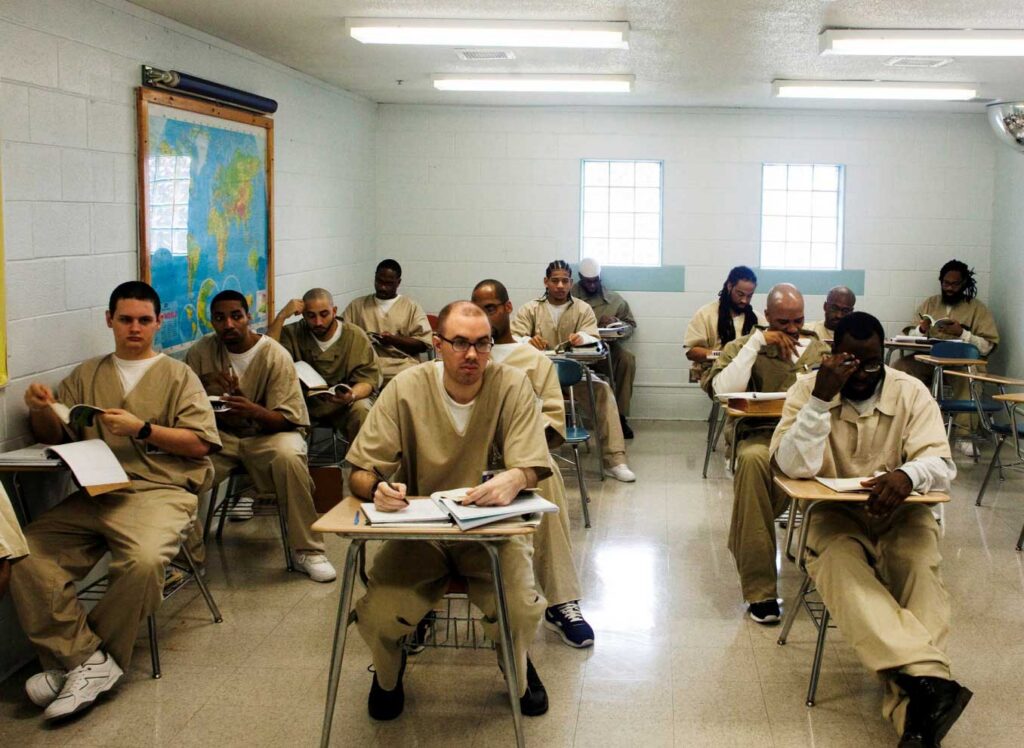
Meanwhile, inmates waited. The report found average waitlists of 354 inmates per institution for Anger Management, with an average wait time of 24 months. The Bureau Literacy Program had an average wait time of 40 months. Money Smart averaged 159 inmates per institution, waiting 18 months. Managing Your Diabetes averaged 22 months. K2 Awareness averaged 17 months.
These are not minor scheduling delays. These are prison sentences inside prison sentences — months and years spent waiting for the very programs Congress funded to reduce recidivism.
The reasons are familiar to anyone who has watched federal prison from the inside: not enough staff, not enough instructional space, and too many lockdowns. The BOP had filled only 54 percent of institution-based First Step Act positions as of July 2024, later improving to 74 percent by January 2026. Psychology, Health Services, and Education — the departments responsible for most programming — were the very areas hit hardest.
Program staff were also pulled into correctional officer posts through augmentation, draining more than 800,000 hours from program-delivery departments between fiscal years 2022 and 2024.
A classroom without a teacher is not rehabilitation. It is furniture.
BOP Quality Learing Center: Early Release Without One Completed Program
Here is the killer fact: between fiscal years 2022 and 2024, 41,548 inmates received First Step Act time credits, resulting in early release from BOP custody. Of those, 9,819 — about 24 percent — had not completed a single First Step Act program. Not one. Zero.
That does not mean those inmates were bad candidates for release. It means the system did not deliver what Congress paid for. The First Step Act was supposed to incentivize participation in evidence-based recidivism reduction programs and productive activities. But because the BOP could not provide enough programs, it allowed inmates to earn credits by showing willingness to participate or by sitting on waitlists.
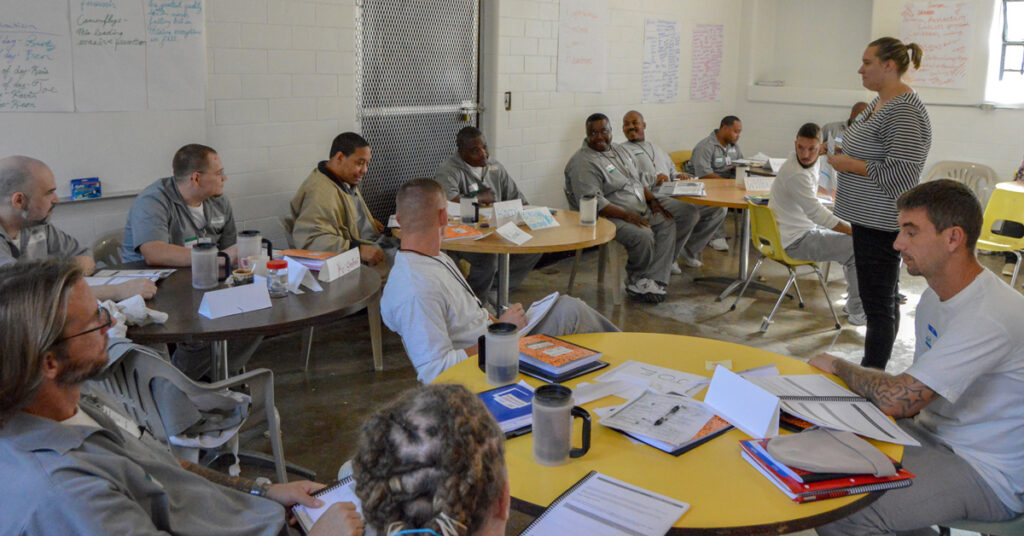
In other words, the BOP transformed earned programming credits into waitlist credits.
That is the bureaucratic genius of the federal prison system: when it cannot meet the standard, it changes the meaning of compliance.
The OIG also found that the BOP’s data was unreliable. The agency could track inmate-level participation in certain ways, but it could not reliably determine how often programs were actually offered at each institution. Some inmates appeared on rosters for programs in which they were not actually enrolled.
At FCI Talladega, four inmates appeared to be actively participating in Anger Management even though the institution had not offered the program since January 2024. At FCI Phoenix, OIG observers saw a program with six inmates present while SENTRY showed zero active participants.
If the data is fake, the dashboard is a theater. If the guide is overstated, the public is misled. If judges, families, Congress, and inmates rely on these representations, the consequences are real.
BOP Quality Learing Center: The Empty Kitchen, The Miniature Roof, And The Prison Reform Mirage
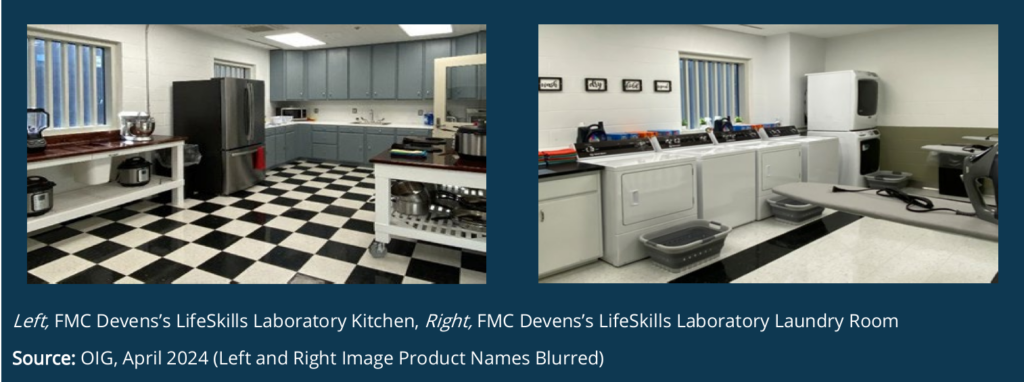
The report’s photographs tell the story better than any bureaucrat could. At FCI Phoenix, inmates learning roofing and framing had to work on scaled-down structures because the vocational workshop had a low ceiling. At FCI Talladega, carpentry classes had to cut lumber outdoors because of low ceilings and poor ventilation, meaning rainy days pushed practical instruction back into bookwork. At FMC Devens, the BOP spent $150,000 in fiscal year 2021 First Step Act funding to build practical LifeSkills spaces — a mock store, bank, kitchen, and laundry room — but as of December 2024, no inmates had been enrolled in the program because no BOP employee was available to teach it.
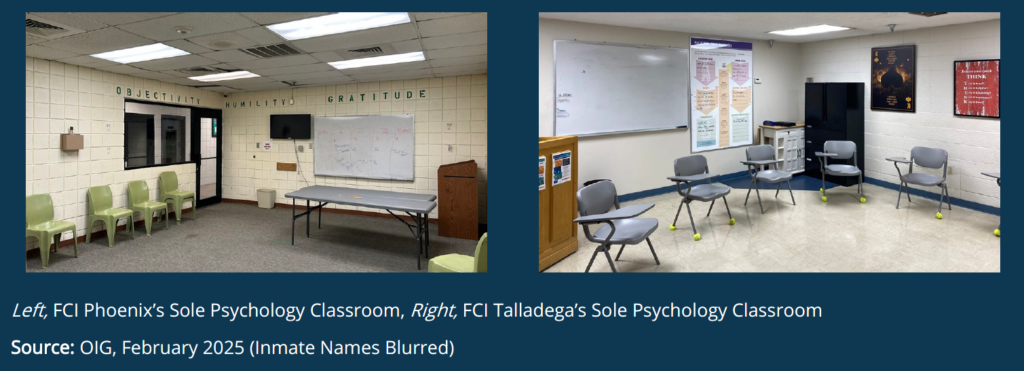
That is the entire scandal in one image: a shiny training kitchen with nobody learning in it.
The BOP’s response is predictable. It concurred with all seven OIG recommendations. It says it created a formal First Step Act branch, issued a new policy, developed staff training, deployed a dashboard, reviewed fiscal year 2026 expenditures, and plans to improve oversight. Good. It should. But nobody should confuse a promised dashboard with a functioning classroom, or a new branch with a changed culture.
The First Step Act was supposed to turn prison time into productive preparation. Instead, the watchdog found a system that struggled to align $1.23 billion with actual inmate needs. The BOP can call itself a reentry agency, a corrections agency, or a quality learning center. But quality learning requires teachers, classrooms, honest data, lawful spending, real oversight, and programs that actually exist beyond the brochure.
Until then, the Federal Bureau of Prisons is not a quality learning center.
It is a federal holding pen with a branding department.
Leave a Reply