
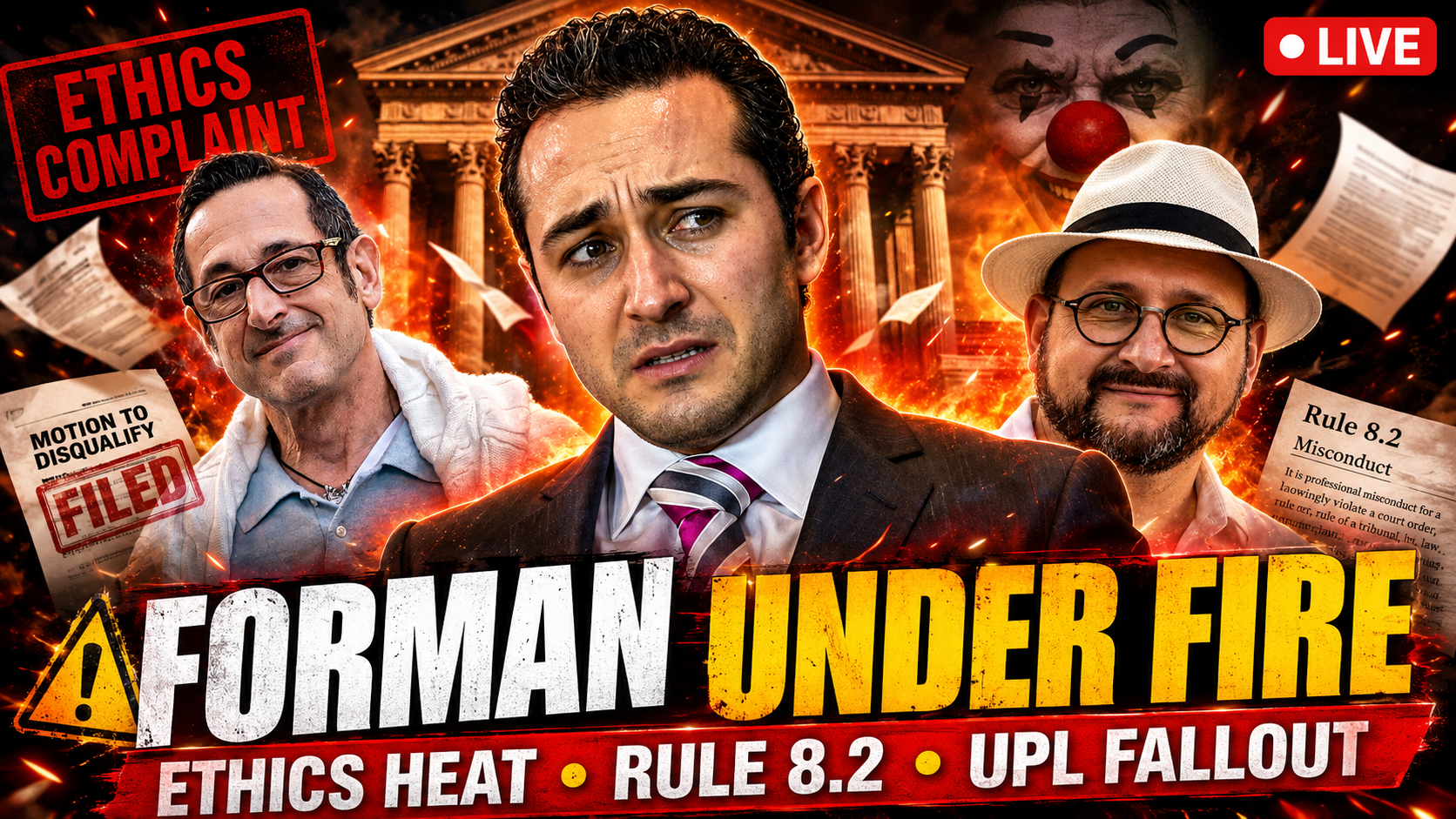
Larry Forman traded on attorney credibility, then used YouTube to attack a Florida judge, boost Halesverse narratives, and flirt with ethics trouble.
LUTHMANN NOTE: Larry Forman wanted the fun part of being a YouTube lawyer: the title, the clout, the audience trust, and the ability to make Halesverse enemies look legally guilty before a court ever got there. But the law license is not a costume, and the Kentucky Rules do not disappear when the camera turns on. Forman’s Judge DeThomasis attacks, his alliance with Jeremy Hales and Randall Shochet, and his role in multiple Florida litigation controversies all raise the same question: did the YouTuber forget he was still a lawyer? This is not merely content anymore. This is the ethics file. This piece is “Larry Forman Under Fire.”

By Dick LaFontaine and Richard Luthmann
The Law License Is Not A Costume
(FRANKFORT, KENTUCKY) – Larry Forman’s problem is not that he talks on YouTube. It is not that he comments on court cases, criticizes judges, defends friends, attacks enemies, or plays to an audience that wants courtroom drama served with outrage sauce. America still has a First Amendment, and lawyers do not surrender all of their speech rights when they get sworn into the bar.
The problem is that Forman did not enter the Halesverse as some anonymous basement heckler with a webcam and a grudge. He entered as “Attorney Larry Forman,” and that title was the whole point. It gave his commentary weight, gave his opinions legal flavor, and gave the Halesverse something more powerful than noise. It gave the machine legal oxygen.
That is where the analysis starts. Forman cannot use the attorney brand for credibility and then claim he is just another YouTuber when the Kentucky Rules of Professional Conduct come knocking. A lawyer carries the license into public life, especially when the lawyer intentionally trades on that license in public commentary. The moment Forman used legal status to shape public perception of judges, litigants, court rulings, and pending disputes, he stepped into professional-responsibility territory.
This was not a private citizen muttering at the courthouse steps. This was a licensed Kentucky attorney using a public platform to attack judicial integrity while wrapped in the authority of the bar.
That is why this story matters. The Halesverse has always had loudmouths, clout chasers, phone-call tough guys, lawsuit hobbyists, and content grifters. What it needed was a lawyer with a microphone. Forman became that lawyer. Now the same law license that gave him authority may become the instrument of accountability.
Larry Forman Under Fire: Judge DeThomasis Was Turned Into A Target
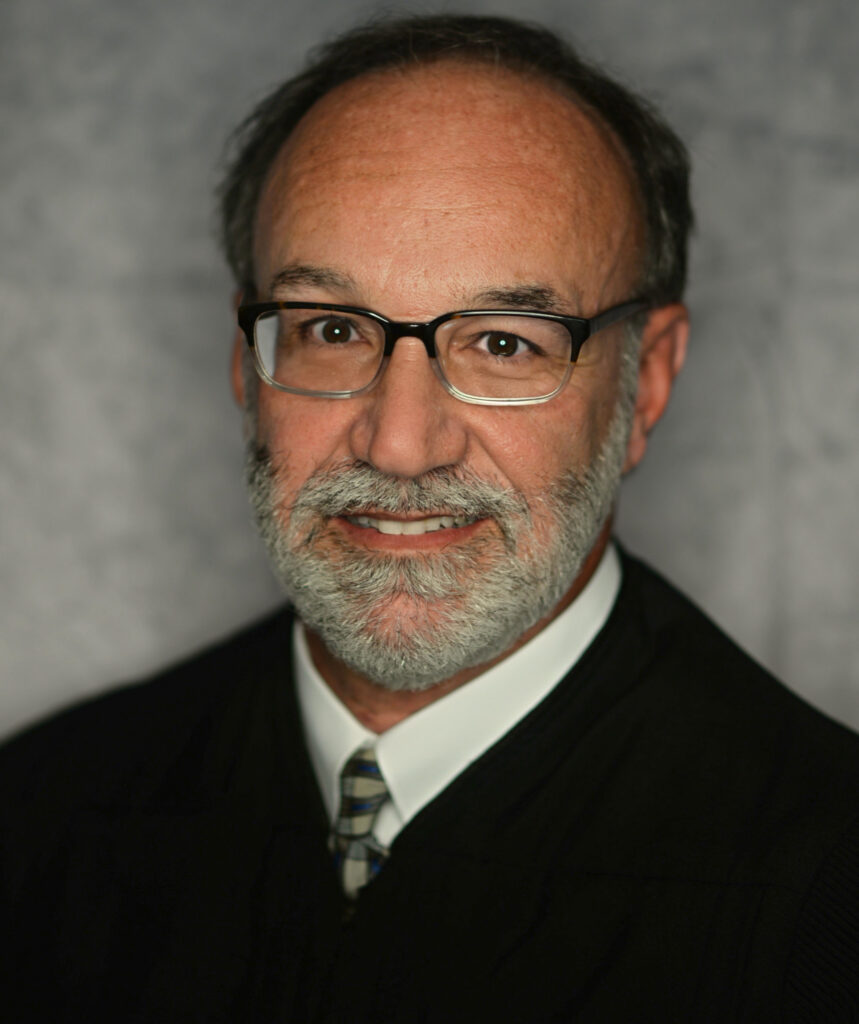
The centerpiece of the Forman problem is Florida Judge Craig DeThomasis.
Judicial criticism is fair game. Judges are not kings. Their rulings can be criticized, appealed, reversed, dissected, mocked, and challenged. A journalist can call out a bad ruling. A lawyer can explain why he thinks a judge got the law wrong. A citizen can be furious about a court decision and say so loudly. None of that is the issue.
The issue is what happens when a licensed lawyer goes beyond criticizing a ruling and starts attacking the integrity, honesty, and qualifications of the judge himself.
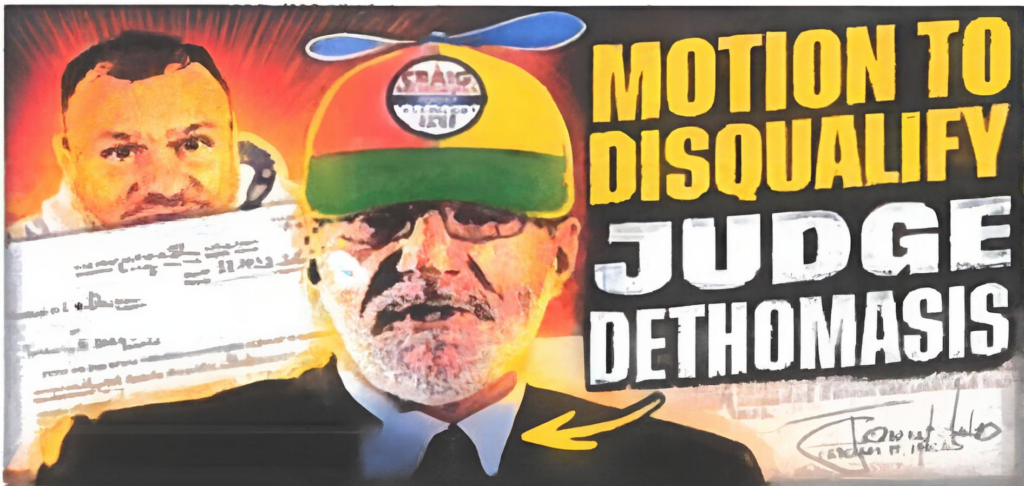
Forman crossed that line repeatedly. He did not merely say Judge DeThomasis made an error. He did not merely argue that the judge misunderstood the record, misapplied the law, or reached a conclusion that should be reversed. Forman called the judge a liar. He participated in or promoted content describing the judge as unhinged, the worst judge in Florida, and someone who defended perverts.
The clown-nose imagery was not the whole offense, but it showed the character of the campaign. The judge was not being analyzed. He was being converted into a Halesverse target.
That distinction matters because calling a judge wrong is legal commentary, while calling a judge a liar is an accusation of dishonesty. A lie is not a mistake. A lie is intentional falsehood. A lawyer who says a judge lied is not simply challenging reasoning; he is attacking judicial integrity.
Under Kentucky Rule 8.2, that is dangerous ground. The rule exists because lawyer speech about judges carries special public force. When a lawyer uses that force recklessly, the damage is not just personal. It is institutional.
Larry Forman Under Fire: He Forgot Kentucky Rule 8.2
Kentucky Rule of Professional Conduct 8.2 is not hard to understand. It says a lawyer shall not make a statement the lawyer knows is false, or makes with reckless disregard for truth or falsity, concerning the qualifications or integrity of a judge. That language matters because the rule does not merely cover formal court filings. It covers statements.
A YouTube livestream is still a statement. A thumbnail is still part of a public presentation.
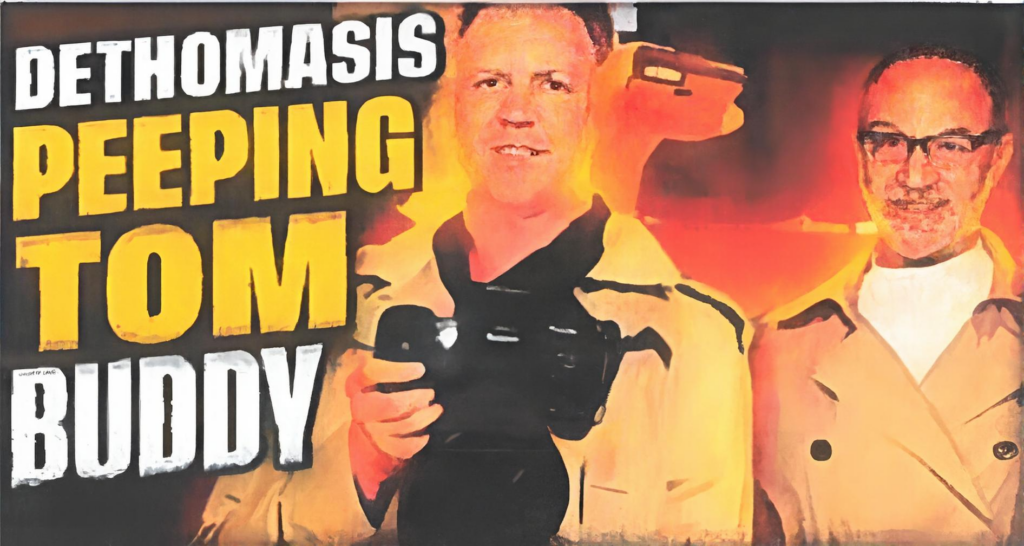
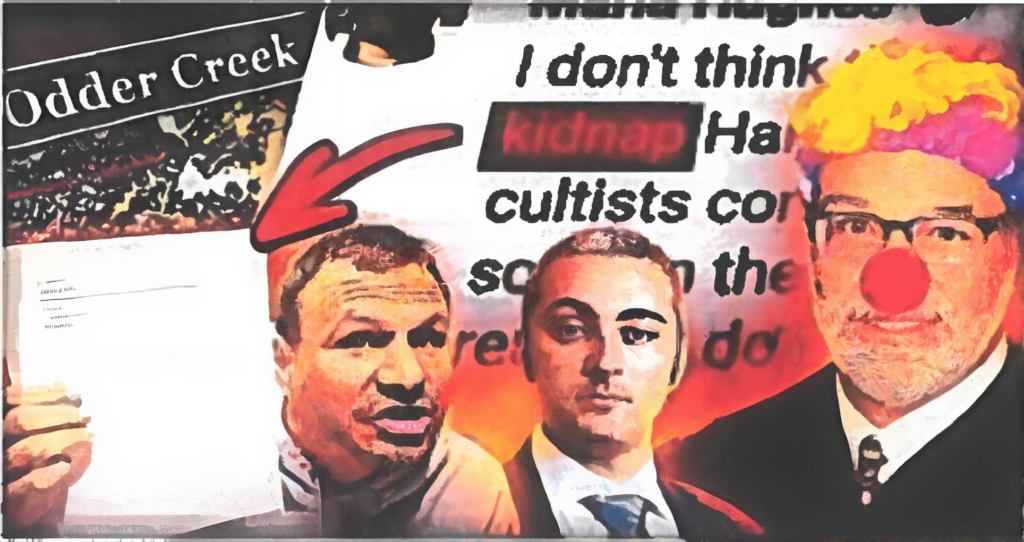
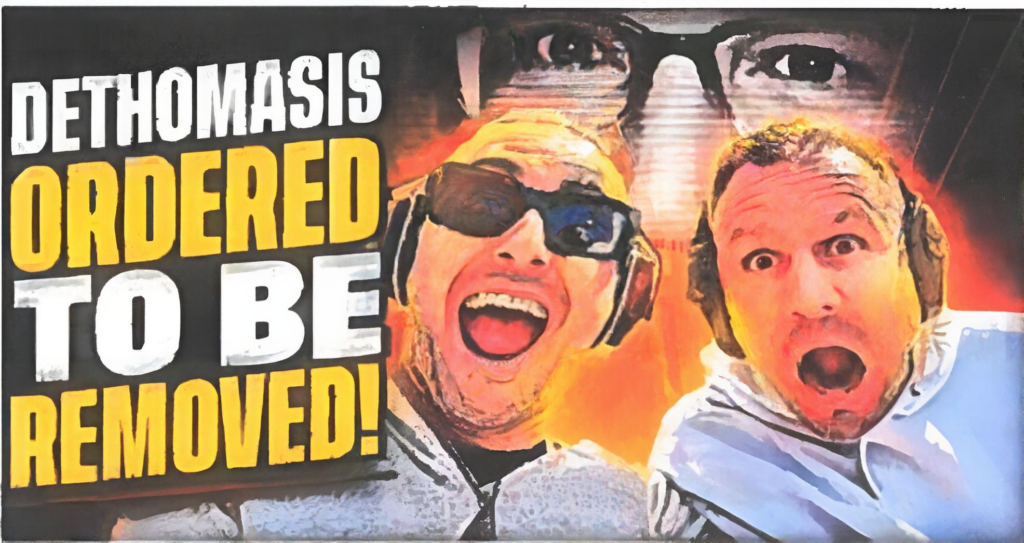
A monetized commentary stream does not become ethics-proof because it comes with graphics, chat comments, and applause from a friendly audience.
Forman’s “that is a lie” problem goes directly to the heart of Rule 8.2. If he had evidence that Judge DeThomasis knowingly made a false statement, then he should produce it, explain it, and ground the accusation in facts. If he did not have that evidence, then the statement looks like exactly the sort of reckless judicial-integrity attack the rule was designed to stop.
Lawyers can say a judge was mistaken. Lawyers can say a ruling was unsupported. Lawyers can say a court got the law backwards. But a lawyer who accuses a judge of lying is making a much more serious charge, and the bar is entitled to ask what factual basis existed before that charge was broadcast to an online audience.
This is where Forman’s YouTube act becomes an ethics exhibit. The issue is not one spicy sentence in isolation. It is the pattern: attorney branding, Halesverse alignment, judge attacks, clown imagery, “defended perverts” language, and public legal commentary presented with the authority of a licensed lawyer. Forman wanted the megaphone that came with the law license. Rule 8.2 is the bill that comes due.
Larry Forman Under Fire: The Matzkin UPL Fight Adds A Second Ethics Front
The Judge DeThomasis issue is not Forman’s only problem. The Bruce Matzkin unauthorized-practice-of-law fight opens a second ethics front, and it may be even more dangerous because it connects YouTube commentary to litigation leverage. Matzkin’s position is that a Florida UPL finding was entered against him even though he was not a party, not counsel of record, not served with process, not subpoenaed, not ordered to show cause, and not given a meaningful adversarial hearing before a finding with professional consequences was entered.
If that order is vacated or narrowed, the Halesverse loses more than a talking point. It loses a weapon.
That is where Kentucky Rule 3.4(f) comes into view. The rule bars a lawyer from presenting, participating in presenting, or threatening to present criminal or disciplinary charges solely to obtain advantage in a civil or criminal matter. A disciplinary process is supposed to protect the public. It is not supposed to become a crowbar in a civil fight.
If the UPL finding was pushed, promoted, cited, or threatened as leverage against Matzkin, then the scrutiny does not stop with the order itself. It moves upstream to the people who used it, benefited from it, and folded it into the Halesverse pressure machine.
This is not a side issue. It is the structural issue. The Halesverse pattern has always been grievance, content, pressure, filing, and more content. Forman’s role matters because his lawyer status helped make that pattern look legally serious. If he used that status to amplify a defective UPL narrative or help convert a disciplinary cloud into civil leverage, then Rule 3.4(f) becomes part of the same misconduct conversation.
Larry Forman Under Fire: Questions For the Kentucky Bar
We contacted the Kentucky Bar for general information about clear ethical lines for lawyers appearing on YouTube. Here is what we asked:
From: Richard Luthmann <ri**************@********il.com>
Date: On Thursday, June 11th, 2026 at 12:54 PM
Subject: Press Inquiry: Kentucky DUI Lawyer YouTube Content, Judge Attacks, and Larry Forman, Esq.
To: sr******@***ar.org <sr******@***ar.org>, uk***@*ky.edu <uk***@*ky.edu>, jc****@***ar.org <jc****@***ar.org>, ky***@***ar.org <ky***@***ar.org>, lc***@***ar.org <lc***@***ar.org>, sd*****@***ar.org <sd*****@***ar.org>, ck******@***ar.org <ck******@***ar.org>, in**@***ar.org <in**@***ar.org>, jh******@***ar.org <jh******@***ar.org>, rc*******@***ar.org <rc*******@***ar.org>, ab*******@***ar.org <ab*******@***ar.org>, ld*****@***ar.org <ld*****@***ar.org>, ag********@***ar.org <ag********@***ar.org>, hm*****@***ar.org <hm*****@***ar.org>, sr*******@***ar.org <sr*******@***ar.org>, ms****@***ar.org <ms****@***ar.org>
CC: Michael Volpe <mv*******@***il.com>, Dick LaFontaine <RA**********@********il.com>, Rick LaRivière <Ri***********@****on.me>, Frankie Pressman <fr*************@********il.com>, Modern Thomas Nast <mt*********@********il.com>, Sully <ms********@***il.com>, Two Lee’s In A Pod <tw********@***il.com>, Anna <la**********@***il.com>, ro****@************rs.com <ro****@************rs.com>, Bruce Matzkin <br***********@***il.com>, John Cook <jm*******@***il.com>, Marla Hughes <Ma*********@**ve.com>, Ray Bonecrusher <rb**********@***il.com>, Supa Dave <mi********************@***il.com>
Kentucky Bar Association / Office of Bar Counsel:
We are independent journalists preparing a news report concerning Kentucky attorney Larry Forman and his public YouTube commentary involving Florida litigation, Judge Craig DeThomasis, Jeremy Hales, and related Halesverse controversies.
https://michaelvolpe.substack.com/p/the-youtuber-who-forgot-hes-a-lawyer
We are not asking the KBA to give legal advice or prejudge any disciplinary matter. We are requesting general guidance and any public comment the KBA can provide about the ethical line for Kentucky lawyers who use YouTube or other social media platforms to discuss judges, pending litigation, and litigation opponents.
The central question is blunt:
When a Kentucky lawyer publicly calls a sitting judge a “liar,” portrays or describes a judge as defending “pedophiles” or “perverts,” labels a judge the “worst judge” in a state, or uses clown-nose imagery and other ridicule aimed at a judge, does that type of public content potentially implicate SCR 3.130(8.2), SCR 3.130(8.4), or other Kentucky lawyer-conduct rules?
Our reporting concerns public statements and thumbnails attributed to Attorney Larry Forman, a Kentucky lawyer and YouTube creator, including commentary about Judge Craig DeThomasis and Florida litigation connected to Jeremy Hales, Randall Shochet, Bruce Matzkin, and related parties. The issue is not ordinary criticism of a judicial ruling. The issue is whether a lawyer may use the authority of a bar card and the reach of a monetized YouTube platform to attack a judge’s honesty, integrity, and fitness in personal and inflammatory terms.
We would appreciate guidance on the following:
1. Does SCR 3.130(8.2) apply to a Kentucky lawyer’s public YouTube or social media statements about judges outside Kentucky?
2. Does the rule apply when the lawyer is not counsel of record in the case being discussed but publicly comments as an attorney?
3. Does monetization, subscriber reach, or use of the “attorney” brand affect the analysis?
4. Does calling a judge a “liar” constitute a statement concerning judicial integrity for purposes of Rule 8.2?
5. Does accusing or implying that a judge protects, favors, or defends pedophiles or perverts potentially trigger Rule 8.2 or Rule 8.4 review?
6. If the public has video clips, thumbnails, transcripts, and links, what is the proper procedure for submitting those materials for review?
7. Since the KBA website states that formal complaints cannot be submitted by email, should a media inquiry like this be treated separately from a sworn disciplinary complaint?
8. Is the KBA able to confirm whether public YouTube content by lawyers is reviewed under the same professional-conduct standards as public speeches, writings, interviews, or other statements?
We intend to publish that the Kentucky Bar Association was contacted for guidance and comment. Please let us know whether the KBA has a statement, whether this should be directed to another person or department, and whether the KBA can explain the proper public process for reporting lawyer YouTube conduct that appears to attack the judiciary.
This is a press inquiry concerning general rules and public-facing lawyer conduct. It is not intended as a substitute for a sworn disciplinary complaint.
We intend to go to press shortly. If you respond after press time, we will incorporate your statements into a follow-up.
Thank you for your attention to this matter!
Regards,
Richard Luthmann
Writer, Journalist, and Commentator
Tips or Story Ideas:
(239) 631-5957
ri**************@********il.com
LINKTREE
Muck Rack Profile
Substack: This is For Real.
Editor-In-Chief: FLGulf.news
Editor-In-Chief: NYNewsPress.com
Editor-In-Chief: TheFamilyCourtCircus.com
Contributor: Frank Report
Contributor: Sun Bay Paper
Follow Me on Facebook X Instagram LinkedIn TRUTH Rumble Newsbreak SPOTIFY YouTube
Sent with Proton Mail secure email.
We received no response as of press time. If we receive relevant communications from the Kentucky Bar, we will update the readership.
The Halesverse Lawyer Problem Is Now The Story
The Halesverse has always depended on confusion. It confuses accusations with evidence, filings with facts, livestreams with litigation, and mob excitement with legal merit.
That is why Forman’s role is so important. He was not just another character in the circus. He was one of the people who gave the circus a legal costume. He helped make internet grievance sound like courtroom analysis, and he helped make Halesverse targets look legally guilty before a court ever made a valid finding against them.
That is also why the next phase will be boring, methodical, and devastating. Build the binder. Preserve the clips. Save the thumbnails. Archive the URLs. Record the timestamps. Capture the exact quotes. Identify every time Forman invoked his lawyer status, attacked Judge DeThomasis, discussed Matzkin, referenced discipline, mentioned UPL, spoke about disbarment, or commented on litigation where he had a personal stake.
Do not rely on vibes. Do not rely on outrage. Let Forman’s own words do the work.
The bottom line is simple. Larry Forman did not forget how YouTube works. He forgot how lawyering works. He wanted the benefits of the attorney identity without the burdens of attorney discipline. He wanted the trust of the audience without the restraint required by the rulebook. He wanted to swing the law license like a flamethrower and call it commentary.
But the Kentucky Rules do not disappear when the livestream starts.
The law license is not a costume, YouTube is not an ethics-free zone, and the Halesverse lawyer problem has now become the story.
Leave a Reply