
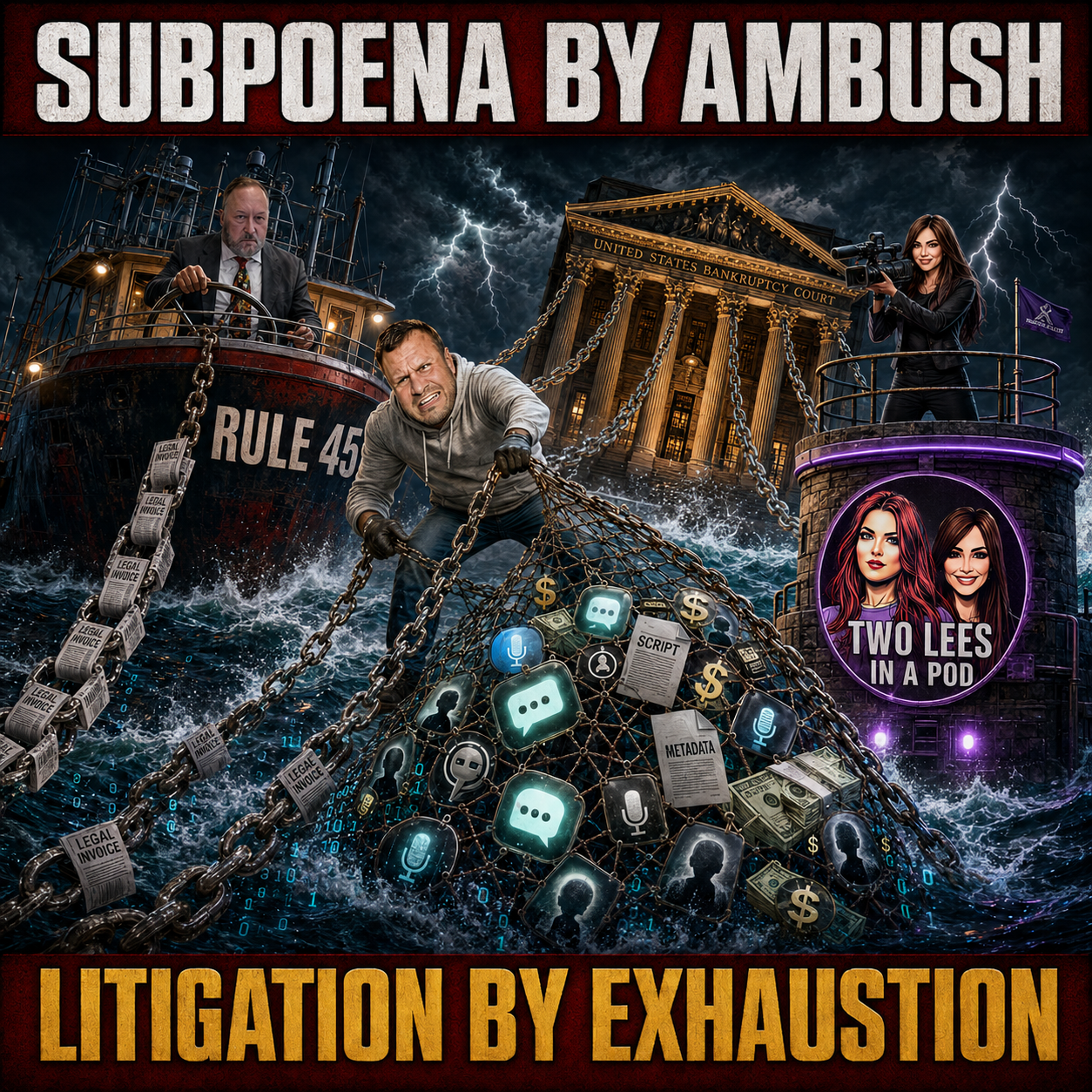
Jeremy Hales and Randy Shochet pursue Lisa Lee’s communications, finances, editorial materials, metadata, and audience identities.
LUTHMANN NOTE: This is not about whether Lisa Lee knows a subpoena exists. It is about whether Jeremy Hales and Randy Shochet may transform somebody else’s bankruptcy into a private intelligence operation against a YouTube content creator, her guests, and her audience. They want the public broadcast, private messages, financial records, editorial preparation, metadata, and the identities of viewers. That is not a request. It is a raid. Rule 45 protects nonparties from undue burden; it does not hand vexatious litigants a crowbar. If Hales wants to know whether Preston was paid, ask Preston. The rest looks like retaliation, intimidation, and another invoice-producing fishing expedition. This piece is “Litigation By Exhaustion.”

By Richard Luthmann
The Process Server’s Fairy Tale
(GAINESVILLE, FLORIDA) – Jeremy Hales and his attorney, Randall “Randy” Shochet, have opened another front in their expanding campaign of litigation-by-exhaustion.

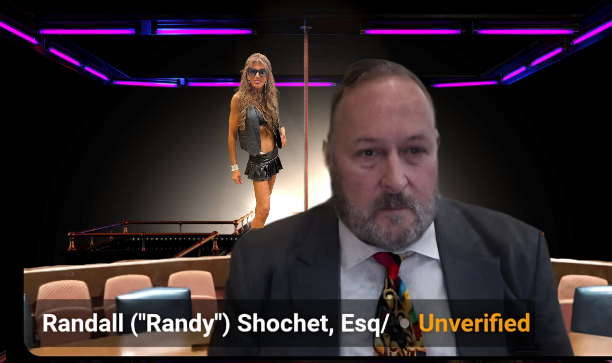
This time, the target is Lisa Lee, host of “Two Lees in a Pod,” a nonparty YouTube content creator and commentator who provided a public forum for discussion of the Lynette Preston bankruptcy controversy. Rather than narrowly seek a copy of a public broadcast, Hales and Shochet unleashed a sprawling subpoena demanding private communications, financial records, editorial materials, metadata, promotional files, and the identities of viewers and subscribers. It is not discovery in any ordinary sense. It is a dragnet aimed at the newsroom, the audience, and the critic simultaneously.

The service attempt was equally troubling. Lee says process server Mark Newby first contacted her by telephone and admitted the subpoena had to be delivered directly to her. She says she told him she was away from home. The next morning, Newby allegedly approached her husband, Gabriel Weeks, without asking his name or whether Lee was present.

According to Lee and Weeks, Newby announced that “Lisa told me I could leave this with you.” Lee says that was false. She never authorized substitute delivery and never appointed Weeks to accept federal process.
Lee also says her security cameras captured the encounters. During the podcast, she described Newby approaching neighbors, misidentifying another woman as Lee, entering the enclosed patio area, and ultimately leaving the papers after Weeks walked away. Those allegations turn a disputed service attempt into a credibility contest with video evidence potentially waiting in the wings.
When federal contempt power may ultimately be invoked, the service record must be clean. This one appears contaminated from the start.
Litigation By Exhaustion: The Fishing Expedition Comes Into Focus
The subpoena’s scope reveals why Lee views the maneuver as retaliation disguised as discovery. Hales and Shochet did not stop at requesting the July 11 broadcast. They demanded months of communications between Lee, Preston, John Cook, and anyone supposedly acting on Preston’s behalf. They sought revenue records, payment logs, scripts, promotional material, metadata, and the identities of viewers and subscribers. In practical terms, they asked for the operating system of Lee’s reporting platform: her sources, internal discussions, business data, and audience.
During the podcast, Lee called the subpoena a fishing expedition designed to obtain through the bankruptcy court what Hales failed to secure in earlier litigation. She pointed to prior federal claims involving Hales, Shochet, Lee, and other critics that were dismissed with prejudice. Her argument was simple: Hales already tried to build claims around criticism and online commentary. Now he is attempting to mine a separate bankruptcy case for private information that might support another lawsuit, another accusation, or another content cycle.
Luthmann agreed with the central characterization. He advised Lee that the subpoena should be met with written objections and a motion to quash, arguing that the demands sweep far beyond any legitimate question concerning whether Preston was compensated for appearing on the program. If that is the real issue, the narrow solution is obvious: ask Preston, examine her financial records, or accept a declaration stating whether Lee paid her.
Viewer identities prove nothing about an estate asset. Private editorial communications do not establish compensation. Full platform revenues do not show money paid to Preston. The subpoena is not calibrated to answer a bankruptcy question. It appears calibrated to identify people, map relationships, and create leverage.
That is why the conduct looks vexatious.
Litigation By Exhaustion: Cameras, Enclosures, and the Paper Trail
The podcast discussion also supplied details that may become important if Shochet or Newby submits a contested affidavit of service. Lee said she had multiple security-camera recordings covering the process server’s visits. She described Newby entering the front patio enclosure after being unable to gain access through one entrance and then approaching through the side. Luthmann reacted that the alleged entry made the situation more serious because Newby was no longer simply standing at a public-facing threshold.
The legal significance should not be overstated before the footage is reviewed. But the evidentiary significance is considerable. Video may establish where Newby stood, whether Weeks accepted the papers, whether Newby retained them as he walked away, whether anyone asked for Lee, and whether the account eventually placed in an affidavit matches the physical events.
That is the difference between rhetoric and evidence. Hales may post a triumphant video claiming Lee was served. Shochet may rely upon a process server’s return. But a timestamped camera does not care about anyone’s litigation narrative. If the footage shows Weeks walking away without accepting the papers, or Newby departing with them still in hand, any contrary affidavit would face immediate impeachment.
Lee said she filed a complaint concerning Newby’s conduct and intended to challenge any claim of valid service. She also emphasized that she is a nonparty. She was not commanded to attend a deposition under this subpoena; she was ordered to produce documents. Yet the rhetoric surrounding the dispute quickly escalated online into suggestions of warrants, federal agents, and dramatic enforcement.
That theater became a joke on the podcast.
The humor lands because the underlying intimidation strategy is so obvious: inflate ordinary discovery into a federal manhunt and hope the target panics.
Litigation By Exhaustion: The Vexatious-Litigation Machine
There is now a recognizable pattern. Hales and Shochet repeatedly transform criticism into litigation, reporting into discovery, and public commentary into alleged misconduct. Every disagreement becomes another docket entry. Every critic becomes a potential defendant, subpoena target, copyright respondent, or object of public denunciation. The apparent objective is not merely to obtain discrete evidence. It is to impose cost, fear, distraction, and attrition.
That is the essence of vexatious behavior.
Vexatious litigation does not always arrive as a frivolous complaint with a scarlet label across the caption. Sometimes it comes dressed in procedural clothing: a subpoena broader than the proceeding, a demand for irrelevant audience identities, a threat of sanctions before any court has found wrongdoing, or a disputed service account built around consent the target denies ever giving. Each maneuver is presented as routine. Together, they form a machinery of harassment.
Lee’s proposed response exposes that machinery. She intends to contest service, challenge the subpoena’s procedural foundation, invoke the protections owed to nonparties and journalists, and resist the effort to identify viewers and subscribers. She has also offered a practical alternative: if Hales truly lacks the public broadcast, provide it; if he genuinely wants to know whether Preston was paid, answer that narrow question by declaration.
That should satisfy any legitimate bankruptcy purpose.
If Hales wants to know what Preston said publicly, he can watch the program. If he wants to know whether she received money, he can ask her. What he should not receive is Lisa Lee’s newsroom, audience list, private correspondence, and commercial records merely because he dislikes her coverage.
The bankruptcy court is not Hales’s private intelligence bureau. Rule 45 is not Randy Shochet’s fishing license. And federal process should never become a prop in an online retaliation campaign. At some point, vexatious tactics must meet firm judicial resistance.
This is that point.
Leave a Reply