
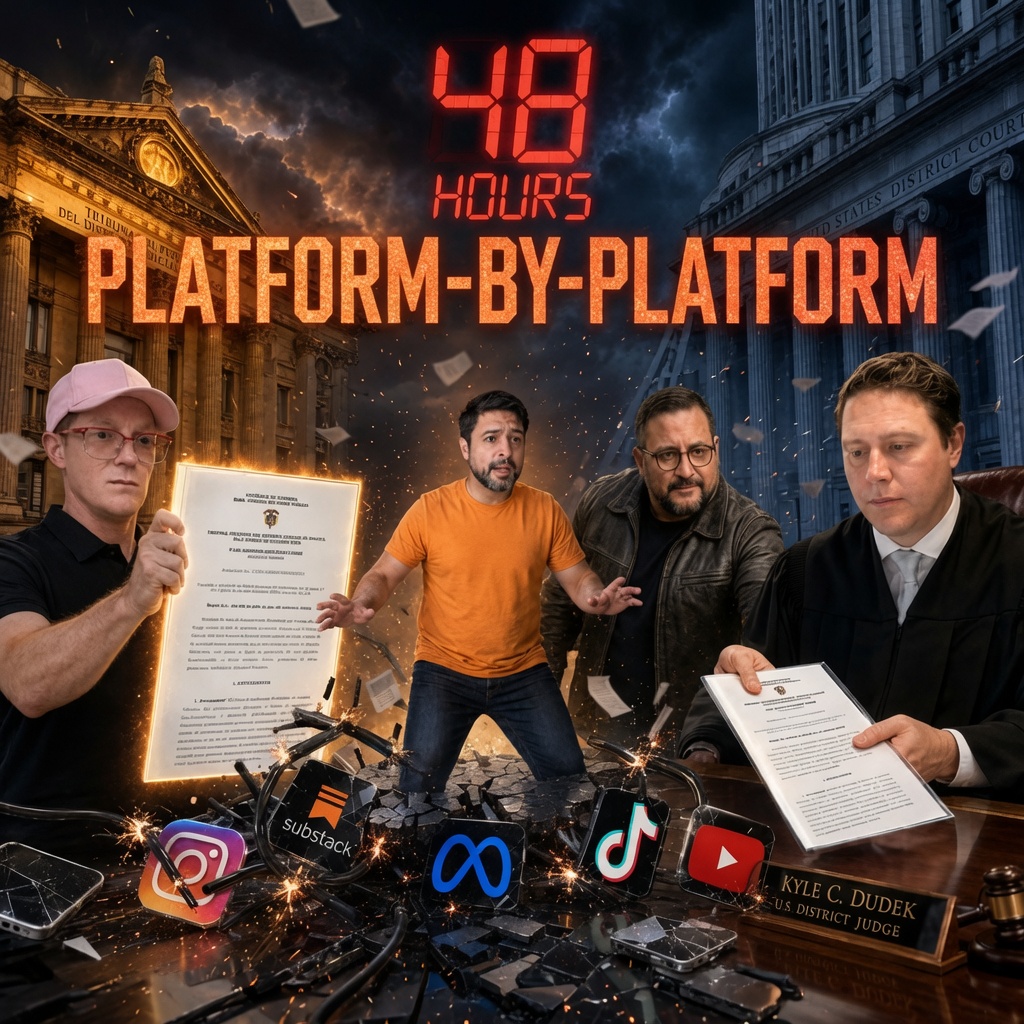
Bogotá appellate judges put Meta and Substack under orders while Antifa-linked doxxer Danesh Noshirvan faces a growing international compliance crisis.
LUTHMANN NOTE: Danesh Noshirvan made accusation a business model: pick a target, borrow an allegation, sharpen it into a criminal label, and unleash the audience. Colombia put that machinery squarely under examination. The ruling is not automatically enforceable in Florida, and its future-speech restrictions face First Amendment barriers. But defamation is not protected simply because an influencer calls it commentary. The Colombian findings now sit in Fort Myers Federal Court Judge Kyle Dudek’s docket as evidence of pattern, notice, intent, and absence of mistake. Danesh demanded accountability from everyone else. Now Joey Camp, Richard Luthmann, and the American courts are demanding receipts from Danesh for his behind-the-camera work. This piece is “Danesh Faces Digital Exile.”
By Richard A. Luthmann
(FORT MYERS, FLORIDA) – Danesh Noshirvan, the Antifa-linked “accountability influencer,” built an internet brand by placing other people on trial without a courthouse, a jury, or rules of evidence. He selected the target, framed the accusation, delivered the verdict and dispatched the audience.
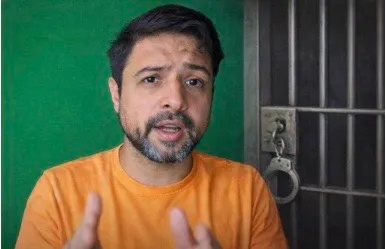
Now an actual appellate court has judged the judge.
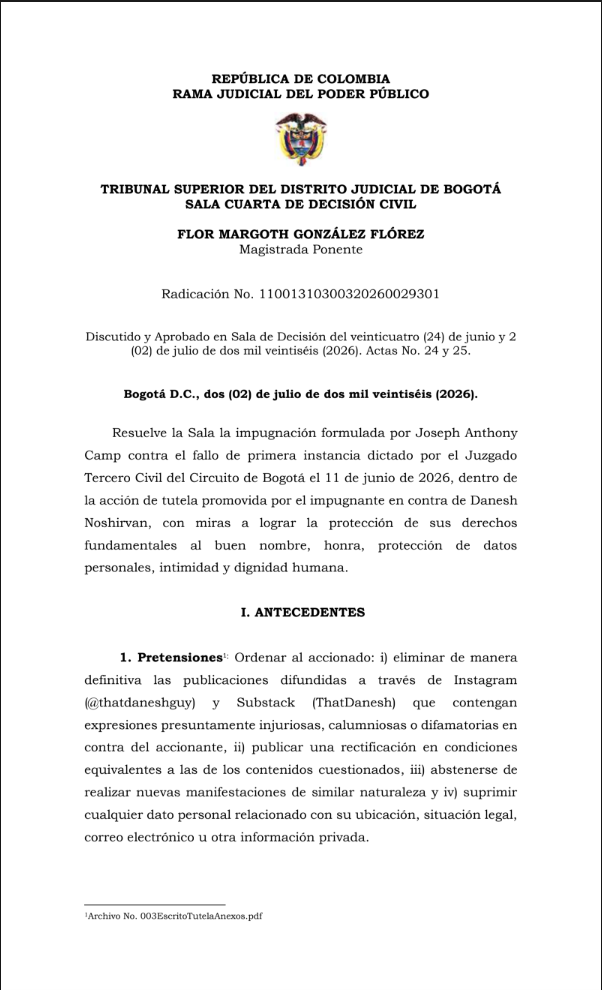
On July 2, 2026, the Fourth Civil Decision Chamber of the Superior Court of the Judicial District of Bogotá reversed a lower-court ruling and granted constitutional protection to Joseph Anthony “Joey” Camp. The three-judge panel found that Noshirvan’s publications violated Camp’s fundamental rights to honor, good name, and human dignity.
The tribunal did not merely criticize Danesh. It issued commands.
Meta Platforms, as operator of Instagram, and Substack Inc. were ordered to remove identified publications within 48 hours of notification. Noshirvan was separately ordered to stop publishing future digital content accusing Camp of criminal conduct without support in a judicial decision.
That is not yet a global account ban. It is something potentially more dangerous: a judicial blueprint for stripping Danesh’s accusation machine apart, platform by platform and post by post.
The critical question is no longer whether Danesh likes the Colombian ruling. The question is whether he, Meta, Substack and the other companies distributing his content intend to obey it—and what happens if they do not.
Danesh Faces Digital Exile: The Verdict He Cannot Edit
The case is Joseph Anthony Camp v. Danesh Noshirvan, Colombian filing No. 11001310300320260029301. Camp, an American legally residing in Colombia, brought an acción de tutela seeking immediate protection of constitutional rights he said were being violated through Noshirvan’s online publications.
A lower court rejected the petition on June 11. Camp appealed. The Bogotá Superior Court reversed.
The appellate tribunal reviewed Noshirvan’s publications describing Camp as a “Child Stalker,” an apparent “registered sex offender,” a “white supremacist who targets women and children with sexual assault for a fee,” and a “Real Rapist.”
Those phrases are reproduced because they appear in the judicial decision. This publication does not adopt them as true.
The court found that the statements were not merely harsh opinions, name-calling, or subjective commentary. They were factual imputations of criminal conduct presented to a massive audience without a supporting judicial decision.
The judges also examined a geographically targeted call for Noshirvan’s followers to spread his podcast throughout Bogotá so the city would know Camp’s identity. The ruling discussed the publication of Camp’s location, email address, immigration status and other personal information. According to the tribunal, Noshirvan acknowledged that the disputed material relied upon allegations, reports or publications produced by third parties—not judicial findings.
Danesh’s defense was effectively that he was reporting what other people had alleged. The Colombian court’s answer was that repackaging somebody else’s accusation does not transform it into an adjudicated fact.
The tribunal expressly preserved Noshirvan’s right to criticize Camp. It did not order the removal of every opinion, insult, or negative statement. It drew the line at presenting unsupported accusations of criminal conduct as fact.
Then came the remedy.
Meta and Substack were ordered to remove the specified statements and “any other content” that imputes criminal conduct to Camp without support from a judicial decision. Noshirvan was ordered to refrain from publishing such content in the future. The proceeding was transmitted to Colombia’s Constitutional Court for possible discretionary review, but tutela judgments are structured for immediate compliance.
This was not Camp issuing a press release about what he hoped a court might do. It was an electronically signed appellate judgment issued in the name of the Republic of Colombia.
Danesh did not merely lose an argument. The court rejected the architecture of his defense.
Danesh Faces Digital Exile: The Platforms are Now on the Dock
The ruling does not expressly terminate Noshirvan’s Instagram or Substack accounts. As of August 4, his Substack profile remained publicly accessible and advertised more than 3,200 subscribers. So no—the Colombian court has not yet deplatformed Danesh.
But the order places Meta and Substack in a legally uncomfortable position. They were notified of the Colombian proceeding and, according to the appellate decision, did not participate. They now have an order directing them to remove specified publications within 48 hours. As of the time of publication, they have not complied.
The platforms can seek clarification and contest jurisdiction or enforcement. They can restrict the material inside Colombia, and they can remove it globally. What they cannot credibly do is pretend the judgment does not exist.
Colombian tutela courts retain authority to supervise compliance. Articles 27 and 52 of Decree 2591 of 1991 provide mechanisms for enforcing tutela judgments and pursuing contempt against those responsible for disobedience. The practical reach of contempt sanctions against an American creator who remains outside Colombia is uncertain. Colombia cannot simply email an order to Florida and expect American marshals to enforce it.
The platforms are different. Meta operates worldwide. Substack distributes content globally. Both possess the technical ability to remove posts, restrict visibility, or suspend an account. A company may resist a foreign judgment in an American courtroom while independently deciding that a repeat violator is no longer worth the regulatory risk.
That is how “effective deplatforming” could happen. One Colombian order does not erase Danesh. But repeated violations can produce repeated compliance demands. Additional tutela petitions could target TikTok, YouTube, Facebook, Threads, podcast hosts, and payment processors.
Camp says he intends to pursue further proceedings, though that remains his stated litigation position—not a completed judicial result.
If multiple platforms receive orders involving the same creator, the calculation changes. Danesh stops looking like an isolated moderation complaint and starts looking like an international compliance problem.
The digital executioner could find himself slowly disconnected from the machinery he used against everyone else.
America Will Not Rubber-Stamp Bogatá
Camp can ask an American court to recognize the Colombian judgment. That does not mean an American judge must enforce it. The casual term is “domestication.” Florida’s streamlined statute applies to foreign judgments that grant or deny a sum of money. The Colombian judgment is primarily injunctive. It orders content removed and restricts future publications. It does not award Camp a fixed monetary judgment that can simply be recorded with a Florida clerk.
To obtain American enforcement, Camp would likely need an independent recognition or enforcement action based on international comity.
Noshirvan and the platforms could then raise jurisdictional, statutory, and constitutional defenses.
The biggest barrier is the federal SPEECH Act. Under 28 U.S.C. § 4102, an American court may not recognize a foreign defamation judgment unless the party seeking enforcement proves that the foreign proceeding provided at least as much protection for speech as the First Amendment and applicable state law—or that the defendant would have been liable even under American constitutional standards.
The statute also requires the foreign court’s exercise of personal jurisdiction to satisfy American due-process requirements. Noshirvan’s participation in Colombia is relevant, but the SPEECH Act expressly says that appearing in the foreign proceeding does not waive the right to contest recognition in America.
The burden becomes even steeper against platforms. A foreign defamation judgment against an interactive computer service cannot be recognized unless enforcement would be consistent with Section 230.
Florida law erects its own barricade. Section 55.605 allows courts to reject a foreign defamation judgment that did not provide protections equivalent to the United States and Florida constitutions. Section 55.6055 gives Floridians facing foreign defamation judgments access to declaratory relief concerning whether those judgments are recognizable.
The Colombian decision also collides with a fundamental difference between the two countries’ speech rules. Bogotá treated the absence of a supporting judicial decision as decisive. American law does not require a prior criminal conviction before a person may truthfully report or discuss criminal conduct.
American defamation law instead examines whether a statement is false, whether it is protected opinion, what level of fault applies, and whether the plaintiff is a public figure. Where public figures or public controversies are involved, the actual-malice standard may apply. Even a private plaintiff generally must prove falsity and legally sufficient fault.
The order against future statements presents an additional First Amendment problem. American courts treat judicial commands restricting future speech as prior restraints carrying a heavy presumption of unconstitutionality. A narrowly tailored injunction removing specific statements after a full American adjudication of falsity might survive.
What makes the Colombian ruling especially significant is that it does not rest on speech the First Amendment would necessarily protect. Defamation is not immunized merely because it is delivered through a podcast, Instagram account, or self-styled “accountability” platform. Although the Colombian judgment cannot be transplanted wholesale into an American courtroom—and its future-speech restrictions face serious constitutional obstacles—the tribunal’s factual analysis remains powerful evidence.
At minimum, it documents Noshirvan’s modus operandi: selecting a target, converting third-party accusations into declarative criminal labels, broadcasting them to a mass audience, directing followers toward the target, and then defending the campaign as commentary.
Danesh Faces Digital Exile: Luthmann Puts the Judgment on the Federal Table
On July 22, Richard Luthmann filed the Colombian decision in Luthmann v. Noshirvan, No. 2:25-cv-00337-KCD-NPM, pending in the Middle District of Florida.
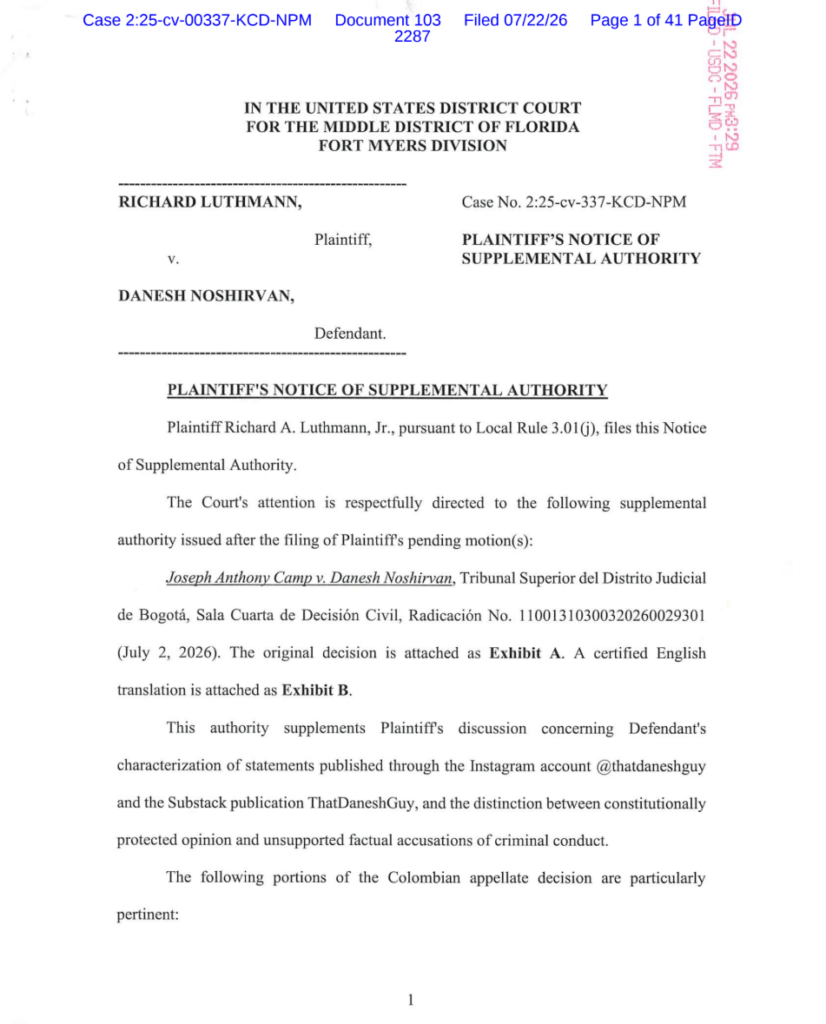
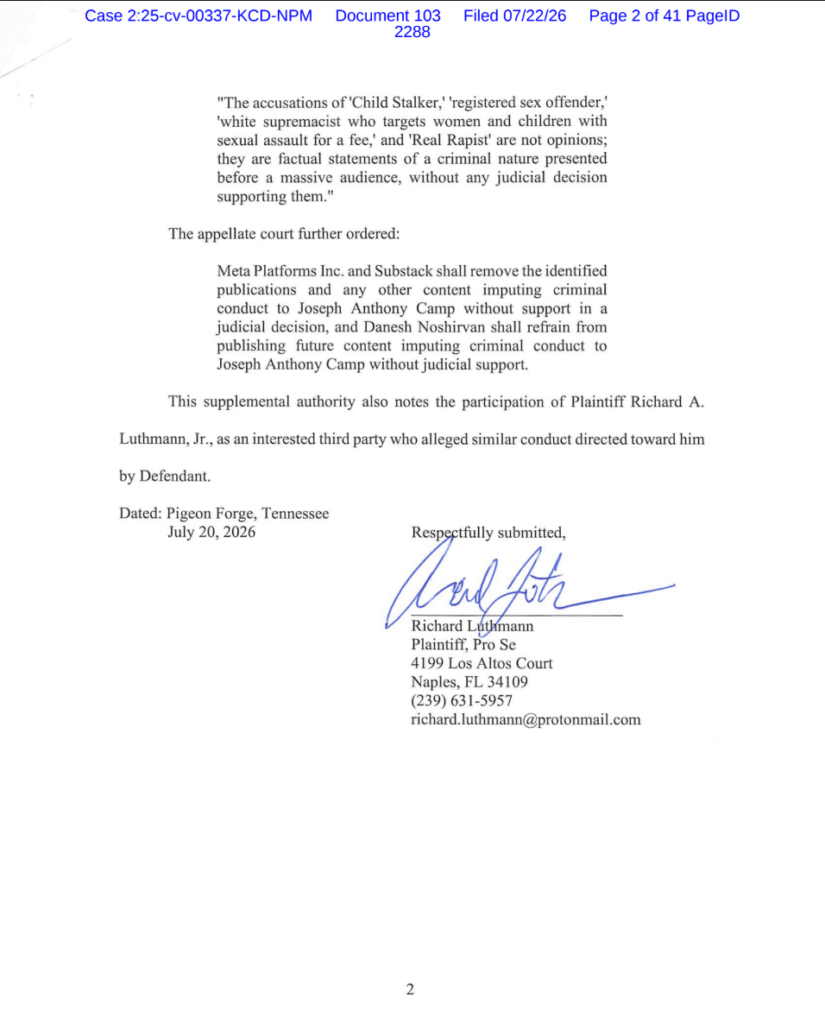
Document 103 is captioned “Plaintiff’s Notice of Supplemental Authority.” It includes the Spanish decision and an English translation and directs the federal court to Bogotá’s distinction between protected opinion and unsupported factual accusations of crime.
The notice also tells the court that Luthmann participated in the Colombian proceeding as an interested third party alleging similar conduct by Noshirvan. The filing does not render the Colombian tribunal’s decision a binding precedent. U.S. District Judge Kyle C. Dudek remains obligated to apply federal constitutional law, Eleventh Circuit precedent, and Florida substantive law.
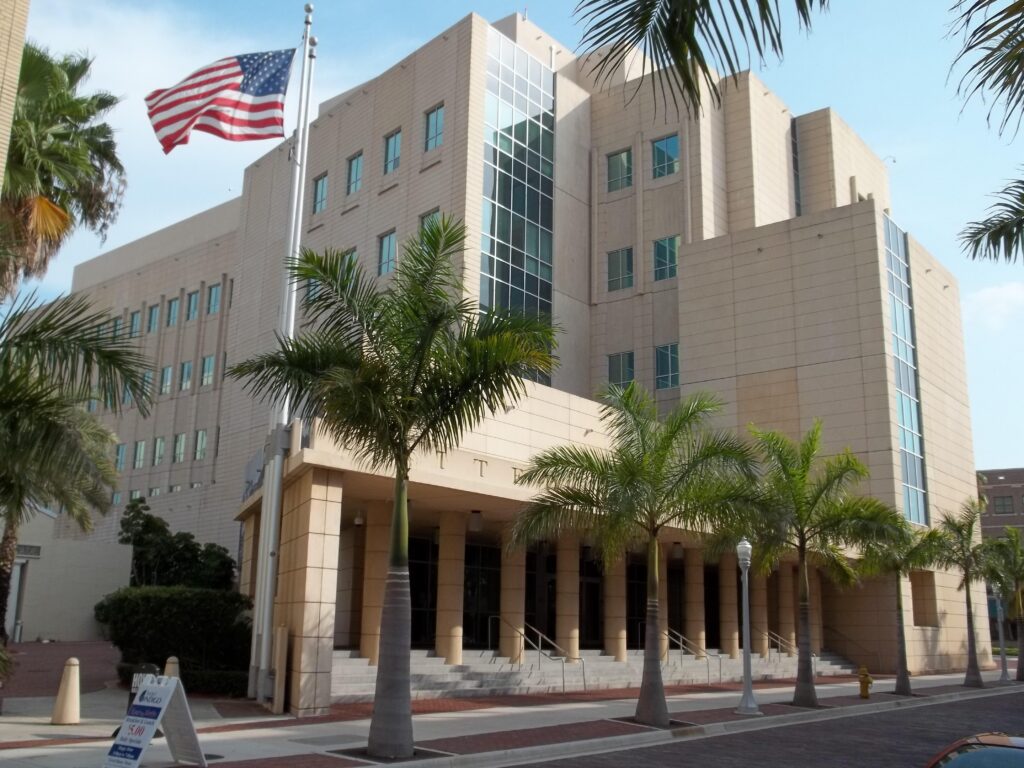
But Luthmann’s filing puts three things in front of Dudek. First, a foreign appellate court examined Noshirvan’s publishing practices and rejected his attempt to classify concrete criminal accusations as protected commentary.
Second, Noshirvan had notice of the proceeding, participated in it, and defended his publications.
Third, the Colombian court’s findings bear directly on disputed questions of characterization, notice, republication, and state of mind now circulating through the Florida litigation.
The judgment may be difficult to enforce as an American injunction. It may still be potent as evidence.
That may be the more immediate threat.
Steele is Gone – Dudek has the Files.
The judicial terrain in Fort Myers has also shifted beneath Noshirvan’s feet. Senior U.S. District Judge John E. Steele, who presided over the sprawling Noshirvan v. Couture litigation, died July 14 at age 77. President Bill Clinton nominated Steele to the federal bench in 2000.
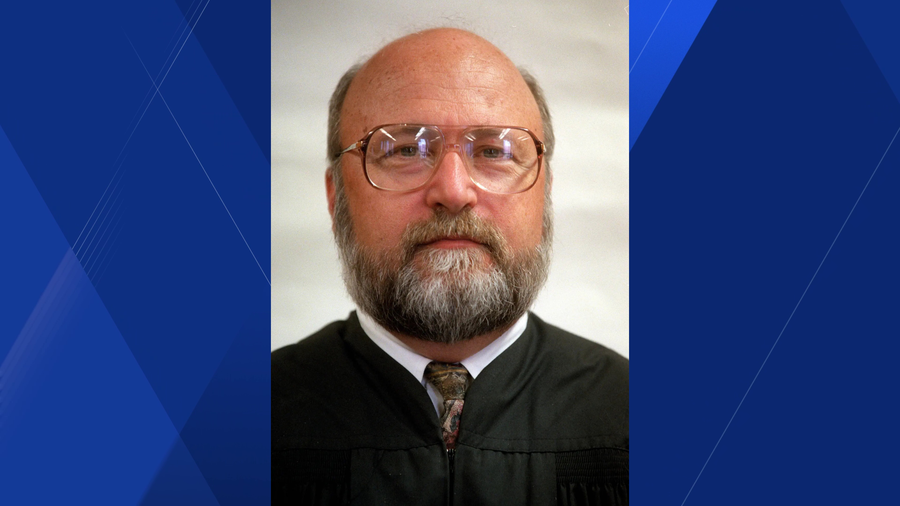
Steele had already issued consequential rulings in the case. He sanctioned Noshirvan and his attorney over litigation misconduct and later awarded Garramone Plastic Surgery $62,320 in attorney fees. He allowed counterclaims brought by Jennifer Couture, Dr. Ralph Garramone and Garramone Plastic Surgery to survive dismissal—meaning the allegations were legally sufficient to proceed.
The Danesh-related Fort Myers docket universe is now concentrated before Judge Kyle C. Dudek.
President Donald Trump nominated Dudek on June 16, 2025. The Senate confirmed him on September 9, and his judicial commission was issued two days later. Dudek previously served as a magistrate judge in the same district.
All things being equal, this change is terrible for Noshirvan. Dudek does not need a guided tour of the battlefield. As a magistrate judge, he handled discovery disputes in Noshirvan v. Couture before his elevation to the district bench. He has already encountered the parties, attorneys, subpoenas, and collateral accusations.
Now the overlapping cases sit before a judge capable of seeing the entire mosaic: Noshirvan’s claims against Couture and Garramone, the counterclaims against him, Luthmann’s separate defamation case, the sanctions record and the Colombian appellate judgment.
Litigants benefit when a dispute is fragmented. One judge sees a discovery fight. Another sees a defamation claim. Another sees an allegedly threatening publication. Nobody sees the machine.
That advantage disappears when one judge holds the files.
Danesh Faces Digital Exile: The Digital Verdict
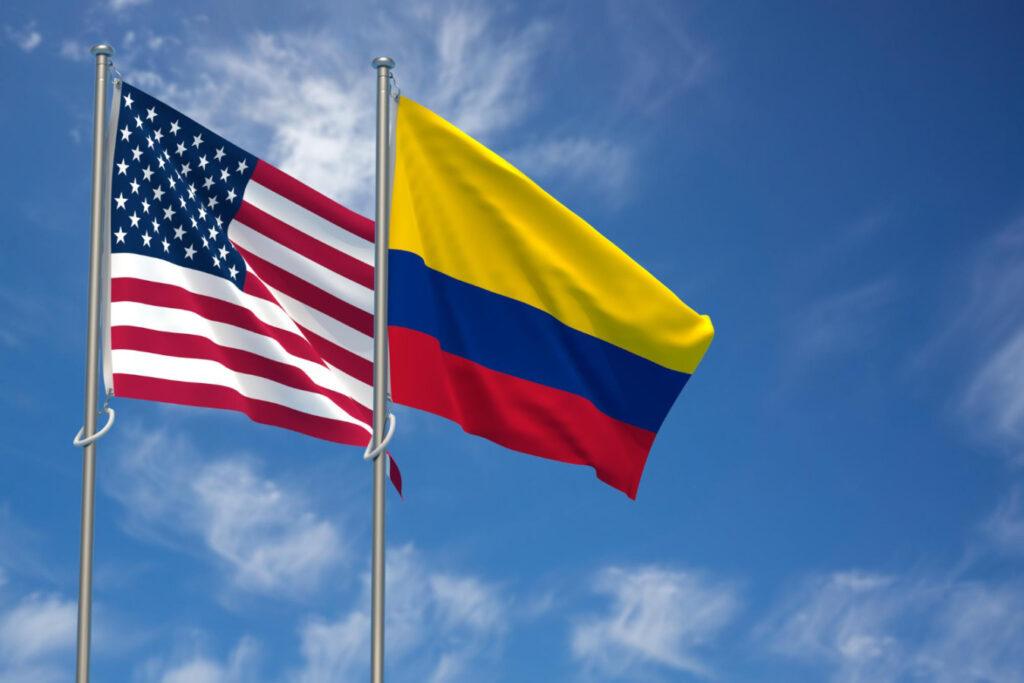
The Colombian court has not shut Danesh down. Not yet. It has done something more important: it converted Camp’s complaints into an appellate judgment, imposed duties on the platforms and created a record that can follow Noshirvan into every future courtroom and moderation proceeding.
American recognition remains an uphill fight. The SPEECH Act, Florida law, Section 23,0 and the First Amendment stand between the Colombian order and any automatic American enforcement.
But Danesh does not need to lose a domestication case to suffer the consequences.
Platforms can act voluntarily. Colombian courts can supervise compliance. Camp can pursue additional proceedings. Luthmann can use the ruling to establish notice and challenge the claim that Noshirvan’s criminal accusations are merely harmless opinion. Dudek can examine the Colombian record alongside the domestic pleadings, publications and sanctions history.
The man who monetized accusation is now surrounded by adjudication.
For Danesh Noshirvan, the danger is no longer one lawsuit, one country or one platform. It is convergence.
And the walls are closing in.
Leave a Reply