
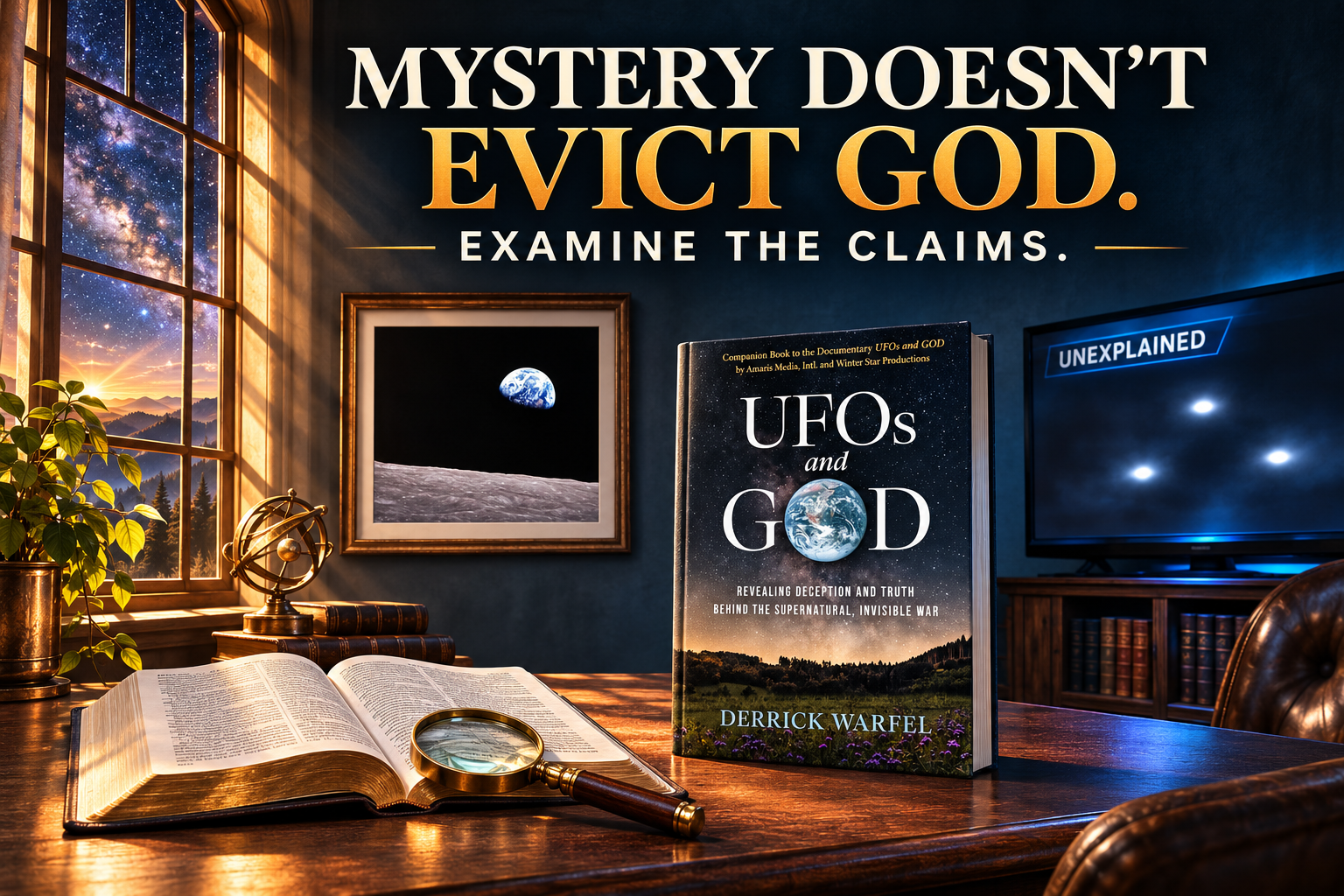
Greg Maresca examines Derrick Warfel’s biblical response to UFO claims, government disclosures, and humanity’s hunger for meaning.
LUTHMANN NOTE: The UFO entertainment business sells suspense by the episode. I’m not handing it authority over my faith. Warfel deserves credit for confronting the spiritual claims attached to these stories instead of accepting every alleged visitor as humanity’s next enlightened teacher. Christians have a duty to exercise discernment, especially when someone dresses an old promise of salvation in futuristic packaging. Government footage can establish that something was recorded without settling what it means. Neither a classified file nor a television narrator gets to rewrite the Creed. I want the records released and the evidence examined. God does not need Washington’s permission to remain God. This piece is “Angels, Aliens and Answers.”

By Greg Maresca
Combine the government disclosures of UFOs/UAPs, conspiracy theories, and Halloween, and you have an eccentric trifecta where the veil between the known and unknown can seem either paper-thin or concrete-thick.
With Uncle Sam releasing declassified UFO records and footage or, in a linguistic twist of bureaucratism, records of “unidentified anomalous phenomena,” because even flying saucers can use a rebrand, enter Derrick Warfel’s 352-page tome UFOs and GOD.

Warfel’s book arrives on cue as a reflective and clarion voice in this wilderness of mystery, offering a perspective that is neither fearful nor dismissive.
In the introduction, he writes, “No one has all the facts on this subject.” Warfel devotes substantial attention to reported sightings, military encounters, alleged abductions, physical effects, crop circles, cattle mutilations, and the government’s own investigations. He also reviews famous cases such as Roswell, Rendlesham Forest, the Phoenix Lights, and military UFO encounters while acknowledging the questions raised by pilots, military personnel, and scientists.
Warfel’s opus is written from an “unapologetic literal biblical worldview.” Readers know what they are being asked to consider. Warfel interprets the phenomenon through the scriptural framework of fallen angels, paranormal phenomena, spiritual warfare, UFO abductions, and the possibility of UFO-related deception in the end times.
Instead of arguing that every unexplained aerial object is demonic, Warfel asks readers to examine the claims surrounding the phenomenon. This distinction matters because he acknowledges that many UFO reports have ordinary explanations.
A veteran author and filmmaker, Warfel neither sensationalizes extraterrestrial phenomena nor pits science against faith. Rather, he echoes Thomas Sowell’s insight that the more we learn, the more we recognize the depth of our own ignorance.

Warfel underscores how the vastness of the universe should inspire humility, wonder, and a deeper awareness of God. In a world that often feels chaotic, the concept that the unexplained can coexist with the divine is a balm to any restless soul.
Warfel examines UFOs through the lens of poltergeist phenomena, arguing that these encounters are variations of the same paranormal phenomenon rather than separate mysteries or evidence of alien life.
Contemporary culture demands instant examination and answers, yet Warfel reminds his readers how faith has always lived comfortably alongside the unknown, explaining how the world is full of visions, signs, and wonders that have always defied explanation.
Drawing from parallels between ancient accounts and contemporary reports, Warfel reveals how humanity has always wrestled with phenomena beyond our understanding and how the search for meaning is inherently a spiritual one.
The vastness of creation has always been a theological point, not a scientific obstacle. If extraterrestrial life exists, it would not somehow disprove God. Rather, it would do just the opposite and magnify Him.

The writing is clear, accessible, and often poetic, inviting both religious and secular readers to consider questions larger than themselves. He writes with the confidence of one who has studied both theology and the modern UFO phenomenon without falling into sensationalism or cynicism.
Humanity’s fascination with UFOs reveals a longing for connection beyond ourselves. Whether that yearning expresses itself through faith, science, or speculation, it recalls St. Augustine’s famous insight in Confessions: “Our hearts are restless until they rest in You.” Warfel likewise suggests that this longing is neither accidental nor aimless but placed within us by God as a reminder that we belong to a creation far larger than our earthly concerns.
UFOs and GOD is a persuasive and timely book about perspective, a welcome addition to the conversation that offers a grounded, thoughtful, and spiritual lens through which to view the unknown. It draws readers to consider that the universe is not a closed system, that human knowledge is certainly nowhere near complete, and that faith in Divine Providence is never threatened by new discoveries. It is where mystery strengthens belief rather than weakens it.
Warfel concludes with the hope that “sound theology from the Bible will give us true peace of mind.” That sentence captures the book’s essence. Beneath all the discussion of flying saucers, alien encounters, government secrecy, abductions, angels, demons, and end-times prophecy, Warfel leads the reader to where we should look for truth when confronted with something we do not understand.
In this season of ghosts, goblins, and the greys, Warfel’s narrative shines through with clarity: the unknown does not diminish God but reveals Him.





Leave a Reply