
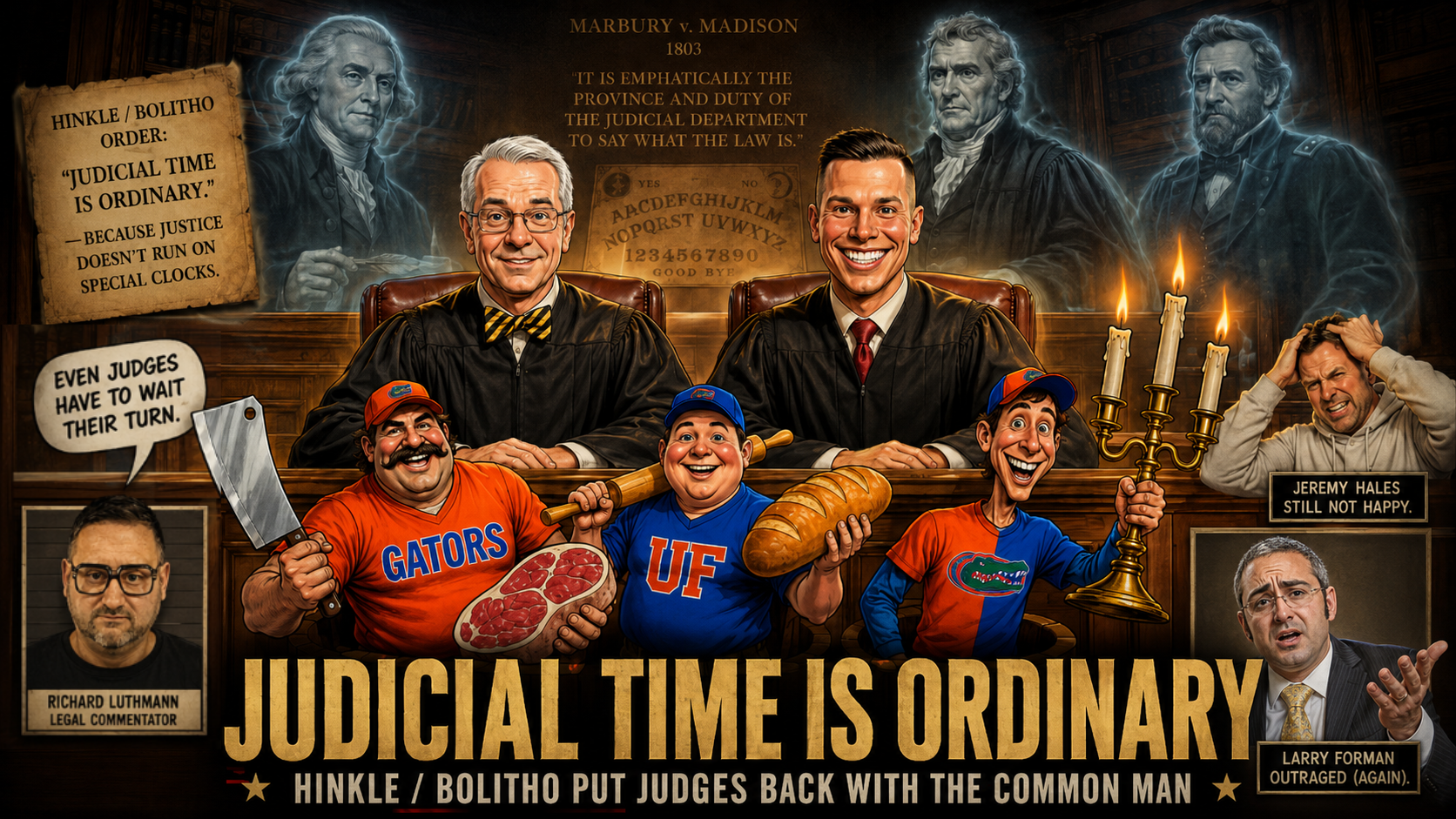
The Butcher, the Baker, the Candlestickmaker, Hinkle, and Bolitho
LUTHMANN NOTE: Some court orders sting because they close a door. Others matter because they open a window. The Bolitho order denied me leave to file a limited reply, but it also said something bigger: judicial time is ordinary, not extraordinary. I can live with that. I do not need judges treated like temple priests, and I do not want litigants treated like peasants outside the castle gate. If court time is real time, then court criticism is real criticism. Sharp. Fair. Sourced. Public. That is not an attack on the judiciary. That is the Republic reminding the judiciary what it is. This piece is “Hinkle Makes Judicial Time Ordinary.”

By Richard Luthmann
(GAINESVILLE, FLORIDA) – There are court orders you lose and hate. There are court orders you win and forget. Then there are court orders you lose and quietly admire because they say something larger than the immediate fight.
That is where I am with the recent Judge Robert Hinkle / Magistrate Zachary Bolitho “no extraordinary circumstances” ruling in the Jeremy Hales / What the Hales federal case now pending in Gainesville federal court.
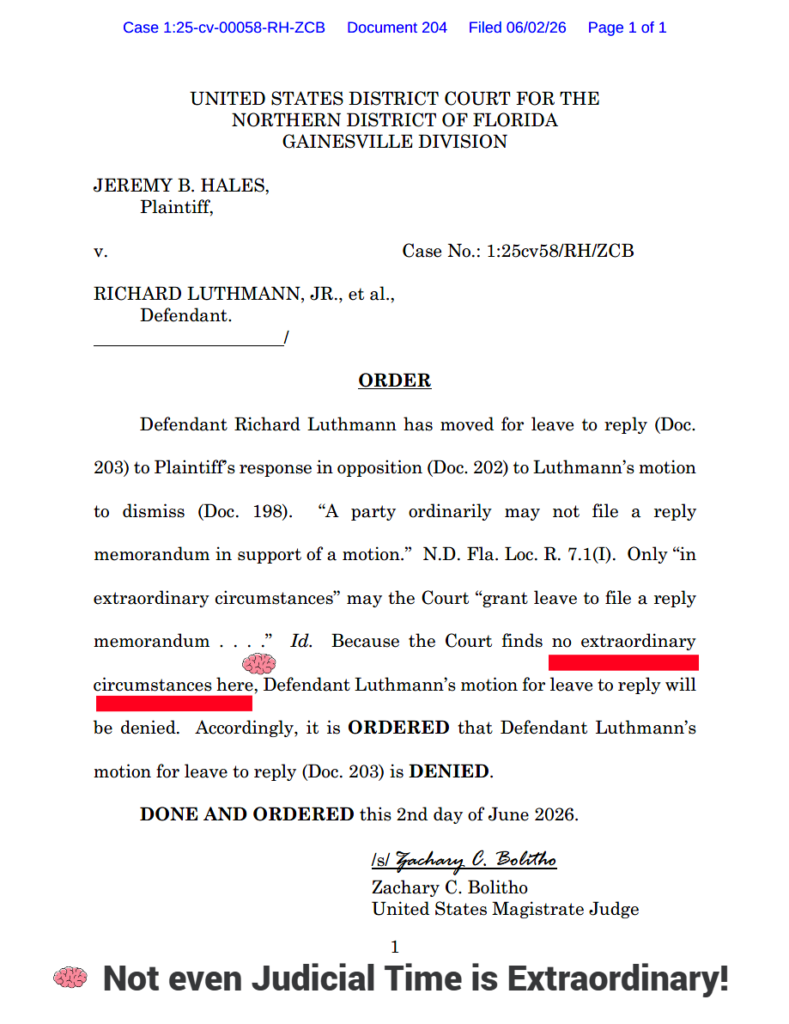
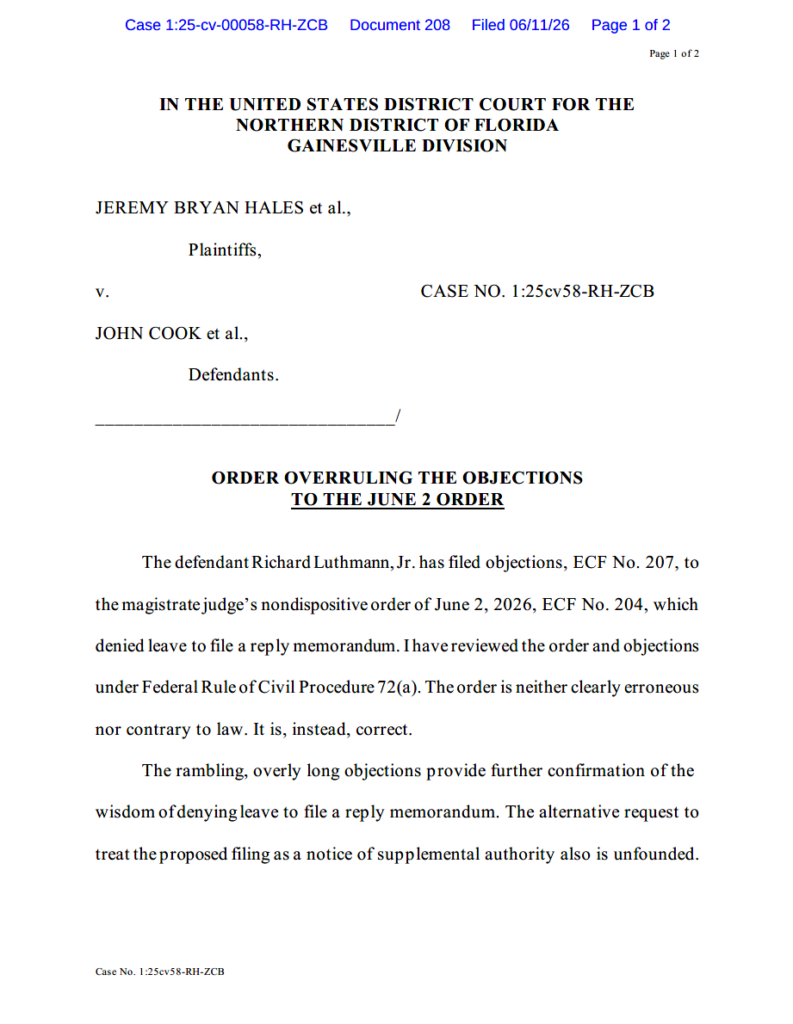
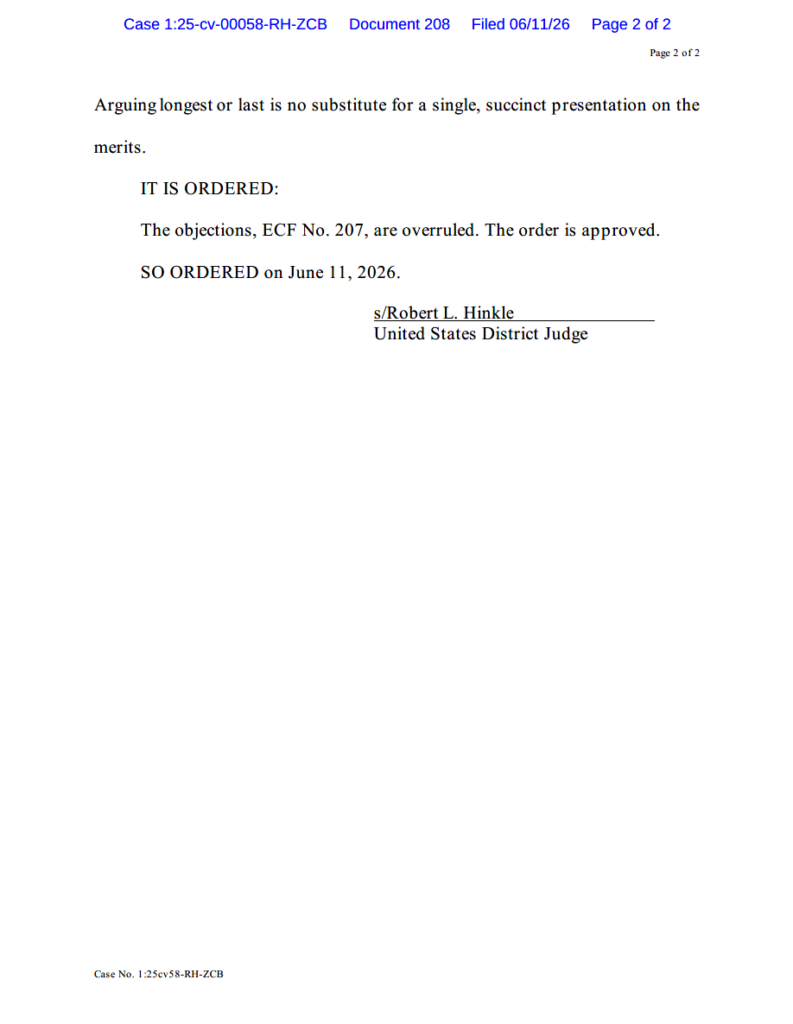
On paper, I lost a small procedural point. Magistrate Judge Zachary C. Bolitho denied me leave to file a limited reply. Judge Robert L. Hinkle did not treat that denial as some grand constitutional drama. The basic message was simple enough: judicial time is ordinary. Replies are not automatic. Local rules mean what they say. A party generally gets one clean shot. Then the court moves on.
Fine. I’ll take the “paper loss.” But time may very well prove me the winner. Ask Michael Volpe’s favorite U.S. President, Thomas Jefferson. (I swear, Mike holds séances with Jefferson and Ulysses S. Grant because he’s always talking about them.)

Jefferson won the immediate fight in Marbury v. Madison. William Marbury did not get his commission, and James Madison did not have to deliver it. The Jefferson administration avoided a direct order from the Supreme Court that it might have ignored, and the disputed scraps of Federalist patronage stayed buried where Jefferson wanted them.
But Chief Justice John Marshall won the war over the Constitution. The case became far more than a quarrel over signed, sealed, and undelivered commissions. It announced judicial review: the power of the federal judiciary to interpret the Constitution and to refuse to enforce laws that violate it.
In the formative years of the Republic, that was no small thing. Jefferson’s Republicans captured the political branches, but Marshall’s Federalist judiciary secured a generational foothold over constitutional meaning. The result was a classic American irony: Jefferson prevailed in the case, while Marshall turned the loss into institutional conquest.
This piece is not a grievance opera, and Judge Hinkle is no villain. In fact, I think the ruling is more useful than the win would have been. It strips away one of the most poisonous myths in American law: that judicial time exists in some holy category separate from everyone else’s time.

The butcher has time constraints. The baker has time constraints. The candlestickmaker has time constraints. So do Judge Hinkle and Magistrate Bolitho.
That is not an insult. It is a compliment. It is also a public-service announcement to the judicial class.
Hinkle Makes Judicial Time Ordinary: The One-And-Done Rule Comes For Everybody
The immediate fight was narrow. I asked to file a limited reply on a statutory-timing issue. The question was not whether I could relitigate the entire motion to dismiss. It was not an effort to sandbag Jeremy Hales or his lawyers. It was not delay dressed up as procedure. It was a short request to determine which version of Florida’s cyberstalking statute governed a January 2025 publication, after later amendments took effect on October 1, 2025.
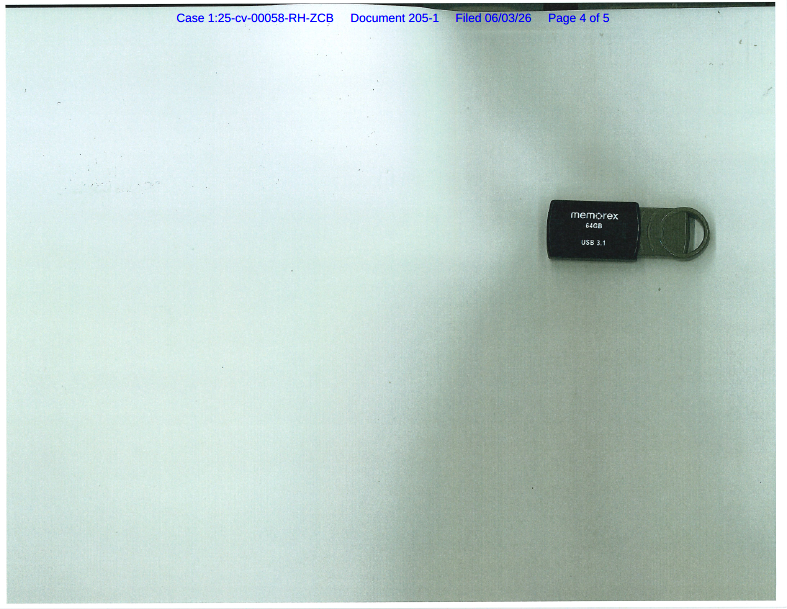
The video at issue is now federal court evidence.
That is a real legal issue. In a diversity case, the timing and substance of state law matters. Statutes generally operate prospectively unless the Legislature clearly says otherwise. A later amendment does not automatically govern an earlier alleged publication simply because it is more convenient for the plaintiff’s theory.
So I asked to reply.
Judge Bolitho said no. Local Rule 7.1(I) says a party ordinarily may not file a reply memorandum. Only extraordinary circumstances justify one. The court found none.
As a litigant, I could complain. As a writer, I see the better story. The court effectively said, “One and done.” Even to me, a pro se defendant not appearing with a lawyer. Even though the late, great Judge Jack Weinstein previously said my mental-health issues, my collapse as a former practicing lawyer, and the danger of ignoring those issues in the legal profession showed that I couldn’t render sound legal advice to anyone, let alone myself.

That is the tension. A federal court can recognize that I am not in any real-world sense operating as a trained, active, competent attorney in my own case, and still hold me to a brisk procedural lane. That sounds harsh until you look at the other side of it.
The court did not create a special protected caste for judges either.
Hinkle Makes Judicial Time Ordinary: Judges Are Pedestrian. Good.
The hidden assumption in too much American legal culture is that judges are different. Not merely different in function, but different in class. Their time is treated as rarefied. Their frustration becomes doctrine. Their convenience becomes policy. Their irritation becomes an order.
That is where Judge Hinkle’s treatment of the issue matters. By refusing to inflate the dispute into a moral emergency, Hinkle did something useful. He made judicial time ordinary, placing the judiciary back into the world with the rest of us. Judges are not temple priests floating above the marketplace. They are government employees with hard jobs, heavy calendars, limited hours, and human constraints.
That is exactly how it should be. I do not need Judge Hinkle to pretend my filing was extraordinary, nor do I need Judge Bolitho to stop the courthouse machinery so Richard Luthmann can get the last word.

The ruling says the court’s time matters, but it does not say judicial time is divine. It says judges must manage cases, but it does not say judges are a superior species. That is the egalitarian part.
The legal establishment may not like where that logic leads. If judges are ordinary, then criticism of judges is ordinary too. Not threats. Not lies. Not unhinged personal abuse. But criticism. Public criticism. Legal criticism. Policy criticism.
The kind of criticism every butcher, baker, cop, mayor, journalist, school-board member, prosecutor, and defendant already lives with.
If a judge’s time is not extraordinary, then a judge’s ego is not extraordinary either.
That is a healthy rule. It is a very American rule. It is also a rule the judicial class should embrace before the public imposes it more rudely.
Hinkle Makes Judicial Time Ordinary: This Is Not The Larry Forman Routine
There is a difference between criticizing judicial power and throwing reckless insults at judges. That distinction matters right now because the Halesverse has been orbiting around Kentucky lawyer Larry Forman, who has made public comments about Florida Judge Craig DeThomasis that raise an entirely different set of issues.
Calling a judge a liar without proof is not legal analysis. It is not reform journalism. It is not First Amendment heroism. It is gasoline in a paper courthouse.
That is not what I am doing here.
I am not saying Judge Hinkle is corrupt. I am not saying Judge Bolitho is dishonest. I am not saying either man acted from bad faith, bias, favoritism, or personal hostility. I am saying their ruling carries a broader public-policy meaning. It rejects judicial exceptionalism by implication. It treats the court’s workload as real, but not sacred. It treats procedure as procedure, not priestcraft.
That is fair commentary.
It is also why lawyers should be careful when they put on clown makeup and call it advocacy. A law license is not a costume. Judicial criticism should be sharp, sourced, disciplined, and aimed at conduct, doctrine, process, and power. It should not be a cheap insult factory for internet applause.

I have spent enough time on both sides of the courtroom to know the difference. I have also spent enough time in the federal system to know that judges have enormous power and are subject to ordinary human limits. Both truths can exist at once.
That is why the Hinkle / Bolitho order is more interesting than a routine denial. It gives the public a clean principle: courts are busy, judges are human, and not every complaint becomes a federal event.
The Breath Of Fresh Air
The old courthouse mythology says the judge enters, everyone rises, and ordinary life stops. The better view is simpler. The judge enters, everyone rises because the office deserves respect, and then ordinary life continues under rules that apply to human beings.
The parties have burdens. The lawyers have burdens. Pro se litigants have burdens. Judges have burdens. Nobody gets magic immunity from time, error, pressure, criticism, or common sense.
That is why I like this ruling.

I lost the procedural point, but the courthouse gained a democratic one. Judge Hinkle did not pamper the bench as some separate and distinct estate. He did not act as if judicial inconvenience were a constitutional injury, nor did he turn a one-page denial into a marble monument. He let the practical rule breathe: court time is real time.
That does not mean pro se parties should be crushed under lawyer standards. They should not. Courts still have to account for the fact that a non-lawyer party is not a trained advocate or may have recognized limitations. The Supreme Court and Eleventh Circuit have long recognized that pro se filings get liberal construction for a reason. A person standing alone in federal court is not standing in the same shoes as a silk-stocking law firm.
But liberal construction is not endless indulgence. That is the hard edge of the lesson. I can live with that edge if the same principle runs both ways. And here, it does.
Judges are pedestrian. That is not an attack. It is the highest civic compliment. Our Republic does not need robed aristocrats. It needs ordinary public servants doing difficult work under public scrutiny.
To paraphrase the words of Judge Hinkle: it “will not end well” for Larry Forman.
And, in the deeper sense, Judge Hinkle’s ruling should not end well for judicial exceptionalism either.
Leave a Reply