
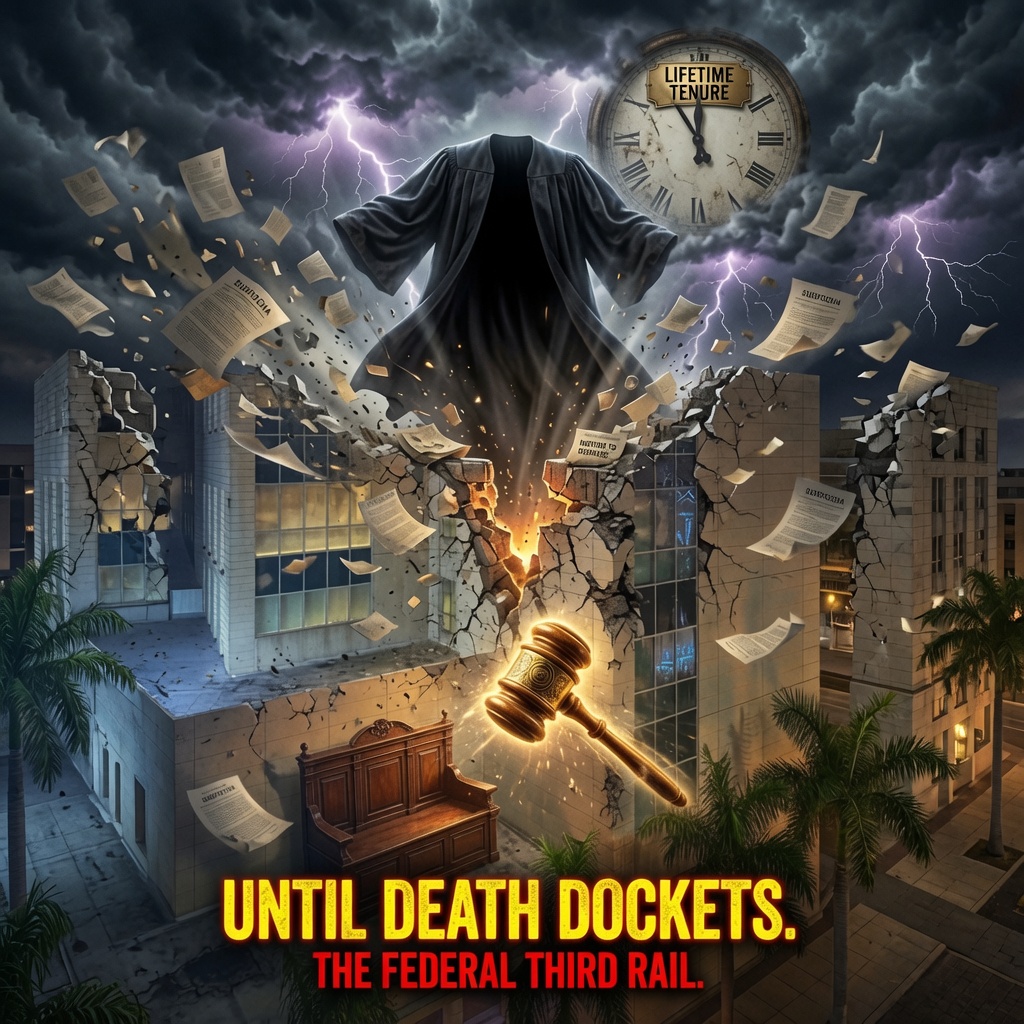
Judge John Steele’s death leaves Fort Myers federal court with an overloaded docket, unresolved cases and a judicial system built without an orderly exit plan.
LUTHMANN NOTE: John Steele’s death is not an invitation for conspiracy theories. It is an invitation for institutional honesty. Steele served the federal judiciary for decades and remained responsible for a vast body of work until the end. That is a tribute to his endurance, but it is also an indictment of a system that depends upon aging judges carrying enormous caseloads until they retire voluntarily, become incapacitated or die. Judicial independence must be protected. Judicial succession must also be planned. The Constitution created life tenure to prevent political retaliation—not to force litigants, lawyers and courthouses into chaos whenever an elderly judge’s robe suddenly becomes empty. This piece is “The Empty Robe.”


By Frankie Pressman and Richard Luthmann
The Judge Who Built the Fort Myers Federal Bench
(FORT MYERS, FLORIDA) – Senior U.S. District Judge John E. Steele is dead at 77, and the federal courthouse in Fort Myers has lost more than a judge. It has lost one of the central load-bearing walls of justice in Southwest Florida.
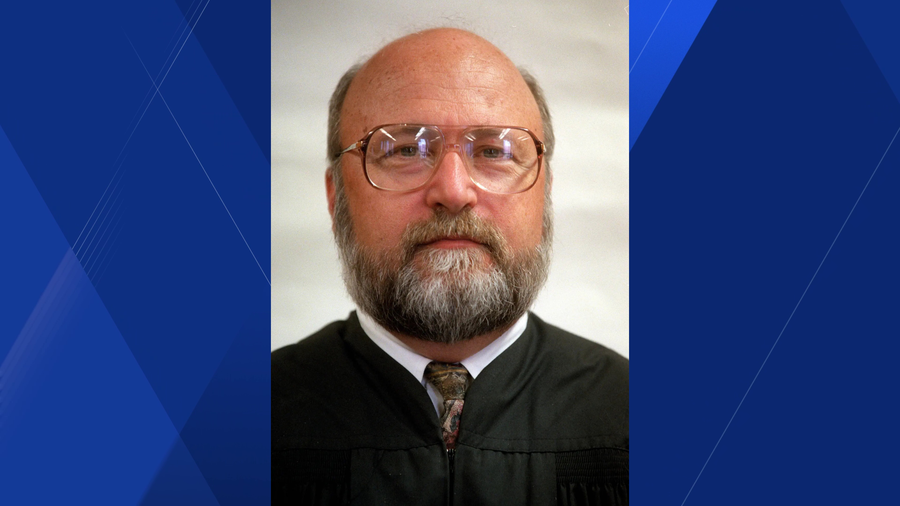
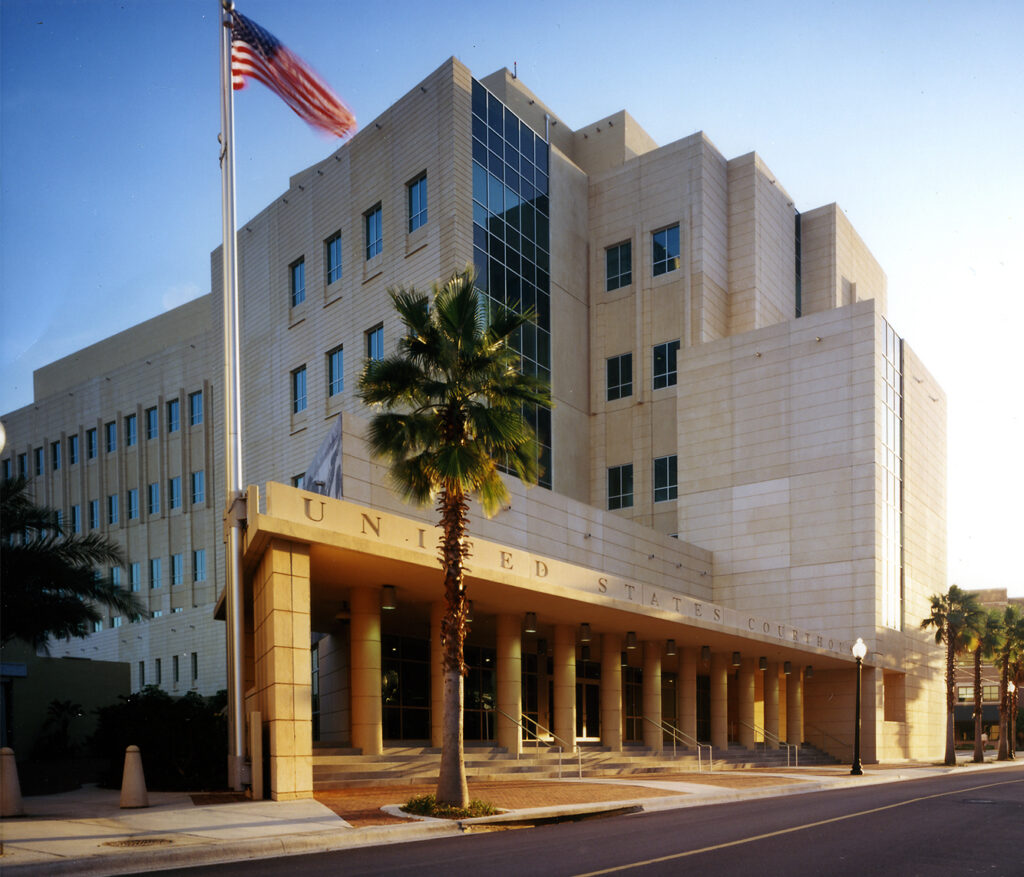
Steele arrived when the Fort Myers Division was still treated like a distant judicial outpost. Before his appointment, visiting district judges routinely traveled from other parts of the sprawling Middle District of Florida to handle the region’s federal docket.
President Bill Clinton nominated Steele on June 6, 2000. The Senate confirmed him on July 21, and he received his commission five days later. He had already served as a federal magistrate judge since 1991. When Steele took the district bench, Fort Myers finally had a permanent Article III judge of its own. He assumed senior status in 2015 but continued carrying a substantial caseload.
That history matters because Steele did not merely occupy chambers. He helped construct the modern Fort Myers federal court.
For more than three decades, his signature appeared beneath orders affecting liberty, property, businesses, families and constitutional rights. He presided over fraud prosecutions born from the housing collapse, early COVID-relief cases and bitter civil disputes.
In 2022, he sentenced contractor Casey Crowther after Crowther was convicted of fraudulently obtaining more than $2 million in Paycheck Protection Program funds.
Steele also handled the long-running Noshirvan v. Couture litigation, sanctioning Danesh Noshirvan, reprimanding attorney Nicholas Chiappetta and eventually setting a $62,320 fee award, an unprecedented sanctions amount for the Fort Myers Division.

Judges leave behind opinions. Steele leaves behind an institution—and an unfinished mountain of work.
The Empty Robe: Death Came with the Gavel Still Falling
Steele did not quietly retreat from the courthouse years ago. He died with active cases, scheduled proceedings, unresolved motions and future trials still attached to his initials.
The Middle District’s own records show Steele issuing orders as late as July 10, 2026. Those included immigration habeas matters requiring immediate decisions about whether federal detainees would remain behind bars. Public dockets also show civil cases assigned to Steele with hearings, deadlines and trial settings extending deep into 2026.
That is where the obituary ends and the institutional emergency begins.
Every matter assigned to Steele must now be examined. Pending motions must be identified. Hearings must be canceled, reassigned, or conducted by another judge. Trial calendars must be reconstructed. Criminal defendants have speedy-trial rights. Immigration detainees may be seeking emergency relief.
Civil litigants may have spent years and fortunes preparing for proceedings before a judge who knew the evidence, the lawyers and the history. Orders awaiting signatures cannot sign themselves.
Across Steele’s assigned cases, the administrative inventory may encompass more than a thousand pending or future-facing docket items—motions, deadlines, hearings, trials, reports and recommendations, compliance obligations and case-management tasks. The exact reassignment count has not yet been publicly released, but the operational burden is undeniable.
Fort Myers has only a limited judicial bench. Its listed district judges now include Judge Sheri Polster Chappell and the newly minted Judge Kyle C. Dudek, supported by magistrate judges handling delegated pretrial work.
Steele’s death does not create a new Article III vacancy because his active seat was filled after he took senior status. It creates something potentially more disruptive: an enormous active workload without the senior judge who accepted responsibility for it.
The robe is empty. The docket is not.
The Empty Robe: The Ruling, The Firestorm, The Facts
Steele’s death came amid political combat surrounding one of his final nationally watched rulings.
On July 8, Steele ordered the supervised release of Maikel Guerra Morales, a Cuban national convicted of hijacking an aircraft and forcing it to land in Key West in 2003. Guerra Morales had served more than 20 years in federal prison before Immigration and Customs Enforcement detained him while attempting to arrange his removal.

Steele ruled that the government could not imprison him indefinitely when there was no significant likelihood of deportation in the reasonably foreseeable future. His decision relied upon existing U.S. Supreme Court precedent limiting prolonged immigration detention.
The ruling did not erase Guerra Morales’ conviction, declare him innocent, or grant him American citizenship. It addressed whether the executive branch could continue holding a man after completion of his criminal sentence when removal remained speculative.
Rep. Greg Steube answered with articles of impeachment, accusing Steele of judicial overreach. The Department of Homeland Security publicly attacked the decision. Then Steele died abruptly.
The timing inevitably produced speculation. It should not produce fiction.
As of July 21, no court official, law-enforcement authority or credible public report has connected Steele’s death to the Guerra Morales ruling, the impeachment resolution or any outside actor. The cause and circumstances have not been publicly explained. Responsible journalism demands that the unanswered question remain unanswered until evidence exists.
Steele’s ruling can still be criticized. His reasoning can be appealed, dissected, and condemned. That is how the American system is supposed to work. Judges are not immune from scrutiny merely because they wear robes, and politicians are not committing sacrilege by challenging judicial power.
But death does not transform speculation into proof. The true immediate scandal is not conspiracy. It is that an overloaded federal courthouse must suddenly absorb the unfinished work of a judge who was still functioning as an indispensable judicial engine at age 77.
The Empty Robe: Lifetime Tenure’s Third Rail
John Steele’s death forces the question Washington usually avoids: Should federal judges be permitted to continue exercising enormous judicial power for life without a mandatory retirement age?
Article III provides that federal judges hold office during “good Behaviour.” In practice, that means life tenure unless a judge retires, resigns, dies, or is removed through impeachment. The design protects judicial independence. A president cannot fire a judge for an unpopular ruling. Congress cannot threaten a judge’s salary to obtain a preferred result. Those protections remain essential.
But independence is not the same thing as immortality.

Federal judges may assume senior status after satisfying age-and-service requirements commonly called the “Rule of 80.” They keep their office and salary and may continue hearing whatever caseload they are willing and authorized to accept. Steele qualified and took senior status in 2015. Eleven years later, Fort Myers still depended heavily upon him.
That dependence reveals the contradiction. Senior status creates a new vacancy that can be filled, but the senior judge may retain hundreds of existing cases and accept more work. The federal judiciary gains capacity, but it also builds court administration around judges whose service can end without notice because of illness, incapacity, or death.
Most state systems do not operate this way. Nearly every state supreme court uses limited terms, mandatory retirement ages, or both. A 2024 Brennan Center analysis found that 339 of 344 state supreme court justices lacked unrestricted federal-style life tenure. New Hampshire requires retirement at 70. Massachusetts does the same. Other states set different limits.
A mandatory retirement age of 75 would not insult experienced judges. It would permit planned transitions, orderly reassignment and institutional continuity. Congress could also require lighter, clearly capped senior-status caseloads after a designated age.
John Steele devoted decades to public service. Honoring that record does not require ignoring the warning left by his empty courtroom. No system of justice should become dependent upon one aging judge carrying a docket until the day he dies.
Leave a Reply