
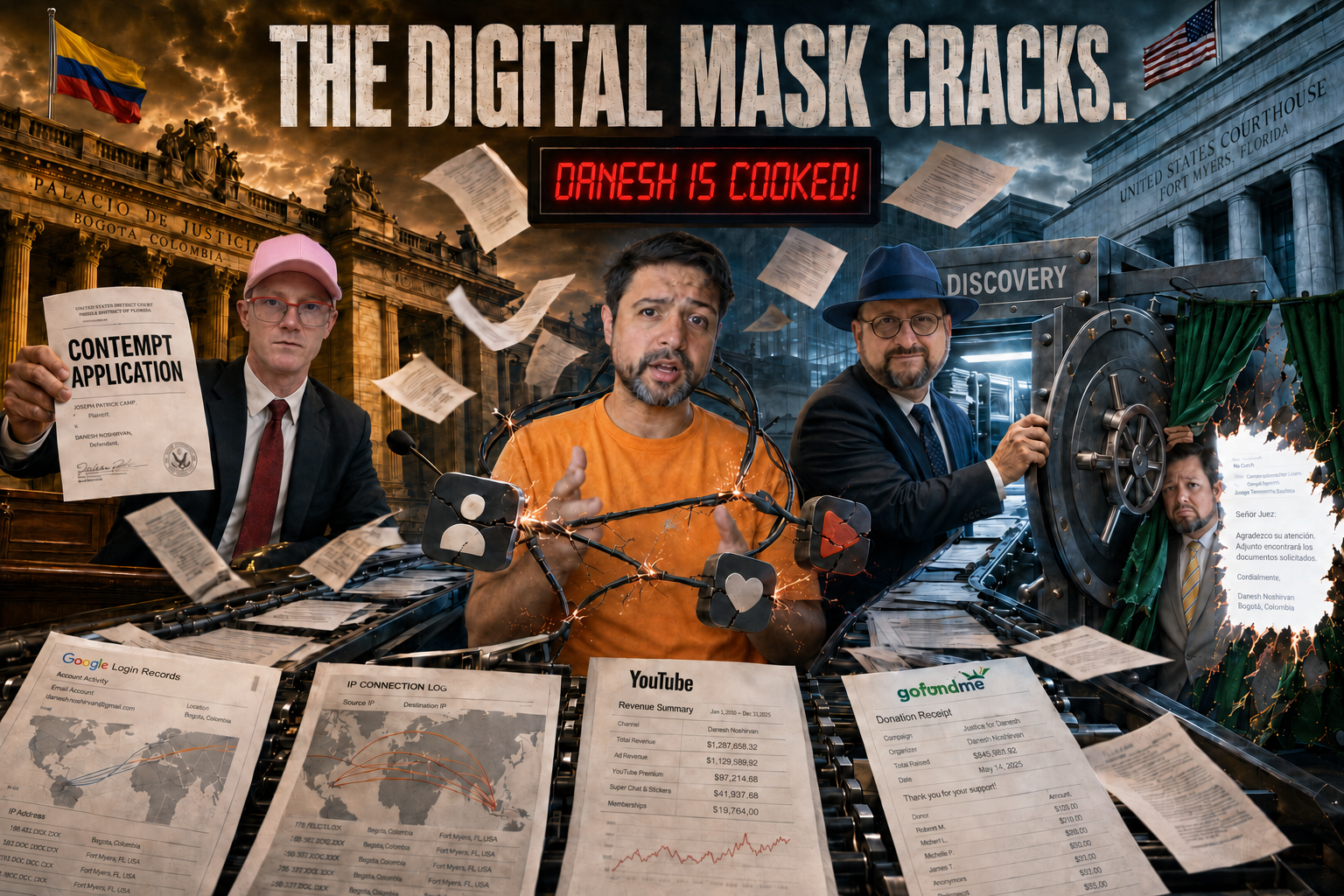
Danesh Noshirvan is ‘Cooked’ as Camp seeks contempt in Colombia while Luthmann demands discovery in Fort Myers.
LUTHMANN NOTE: This is what happens when the target stops arguing with the cancel culture mob and starts subpoenaing the machinery. Google’s records do not rely on Danesh Noshirvan’s branding, excuses, or curated storytelling. They map the accounts, recovery credentials, login activity, and money. Bogotá has already entered judgment, Camp is seeking contempt, and Noshirvan’s own email demolishes the claim that he never participated there. Meanwhile, Florida lawyer Nicholas Chiappetta wants Fort Myers Federal Court to keep the curtains closed while the evidence grows stale. No. Lift the stay. Preserve the records. Open discovery. Let every platform produce its receipts. The Danesh machine demanded accountability. It is about to receive the industrial-strength version. This piece is “Google Receipts Join Bogotá’s Hammer.”
By Dick LaFontaine with Richard Luthmann
Google Opens the Black Box
(FORT MYERS, FLORIDA) – Danesh Noshirvan built the “ThatDaneshGuy” brand on the proposition that he was the investigator, the exposer, the digital executioner who could turn other people’s lives into content while remaining behind the platform curtain. Google has pulled back the curtain, and the implications may be devastating in federal courts in both Bogotá, Colombia, and Fort Myers, Florida.
Subpoena returns produced in the Joseph Anthony Camp matter in Colombia connect the YouTube handle @ThatDaneshGuy to Google Account ID 69807278887 and the confirmed address th***********@***il.com. A second return identifies da*************@***il.com as a separate Google account. The records then join them at the circuitry: reciprocal recovery addresses, the same date of birth, the same recovery telephone number, and extensive overlapping login activity.
The numbers are not decorative. They disclose 631 login or logout entries for the branded account, 818 for the personal account, and 22 IP addresses that appear in both datasets. Multiple logins occurred from the same address within minutes; at least one was recorded from the same IP at the same second.
An IP does not legally “belong” to Noshirvan, and this production does not prove Camp’s separate Facebook-impersonation allegation. That requires the corresponding Meta return, timestamps, device data, and an ISP record.
“Joey Camp tells me the motherload, including the Meta subpoena returns, are on the way,” Richard Luthmann said.
However, the Google evidence does something devastating before that next subpoena ever lands: it establishes that the public persona and the private account were not strangers passing in cyberspace. They were wired together from inside Google’s own system.
Now, the self-appointed, Antifa-linked, internet sleuth has become the subject of platform-grade detection, and the digital fingerprints are no longer coming from an enemy’s screenshot folder. They are coming from the service provider that kept the logs.
“The release of the digital data on Danesh will have a similar effect to what the release of the diary had on Anthony Fauci. In both cases, even staunch allies will not be able to defend the apparent frauds, half-truths, and misrepresentations,” Luthmann said. “And they will both have to answer for death.”
Google Receipts Join Bogotá’s Hammer: The Outrage Factory Has a Cash Register
The records also puncture the fiction that “ThatDaneshGuy” was simply a concerned citizen speaking into the public square. Google’s YouTube revenue data reports approximately $5,818.26 in estimated revenue across 30 weekly periods from September 28, 2025, through April 19, 2026—roughly $193.94 per week.
The components tell the business story: $2,727.84 in estimated partner advertising revenue; $1,834.27 from Shorts Feed advertisements; $559.44 from YouTube Premium; $557.84 in memberships; $111.58 in Super Thanks; and $27.30 in Super Chat payments.
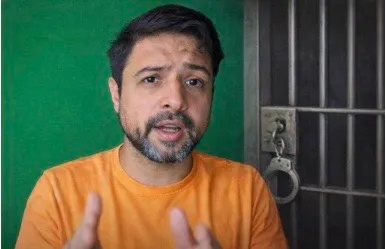
And YouTube was but one spigot. In addition to TikTok revenues, GoFundMe campaign figures show that Noshirvan’s repeated appeals generated approximately $60,000 from roughly 1,600 donations, including a campaign asking followers to help cover a $62,320 federal sanctions award entered against him. Those public counters destroy the image of a penniless truth-teller shouting into the wilderness.
Noshirvan operates a monetized social-media channel while repeatedly converting his litigation troubles into fundraising content: declare persecution, accuse enemies of targeting his family, activate the audience, and pass the digital collection plate. Victimhood was not merely a narrative defense. It became another revenue stream.
The same followers summoned to punish Noshirvan’s targets were then asked to finance the courthouse consequences when a federal judge finally sent the bill back to him.
Those figures also establish the economic architecture surrounding the account. Attention was inventory. Outrage was fuel. The audience was monetized. Every accusation capable of driving clicks, memberships, tips, and platform distribution operated inside a channel with a working cash register.
Noshirvan has sold himself as an accountability influencer while repeatedly turning criminal labels into mass-distribution content. The Colombian appellate judgment found that specified descriptions of Camp—including “registered sex offender” and “Real Rapist”—were factual criminal accusations, not protected opinion, and lacked support in any judicial decision presented there.
Noshirvan may dispute that ruling’s factual weight in America, but he cannot honestly convert the enterprise into a nonprofit seminar on civic virtue.
The emerging picture is uglier and more commercial: a monetized accusation machine whose operator could generate revenue while targets absorbed legal bills, reputational damage, threats, and years of cleanup. Google did not calculate moral culpability. It supplied something colder: the ledger showing that the megaphone was connected to money.
Google Receipts Join Bogotá’s Hammer: Danesh’s Declaration of Defiance
On July 2, 2026, the Fourth Civil Decision Chamber of Bogotá’s Superior Court reversed the trial-level denial of Camp’s tutela petition. The appellate tribunal protected Camp’s rights to honor, good name, and human dignity. It directed Meta and Substack to remove specified publications within 48 hours and ordered Noshirvan to refrain from publishing unsupported accusations that Camp committed crimes.
That judgment is entered. What came next remains the subject of Camp’s pending contempt application.
Camp alleges Noshirvan did not merely fail to comply. According to the motion, Noshirvan responded to notice by writing, “I will not be taking anything down,” calling the decision invalid, and later declaring, “I am not going to delete anything” and “I will continue to refer to Joseph Camp as a child molester.”
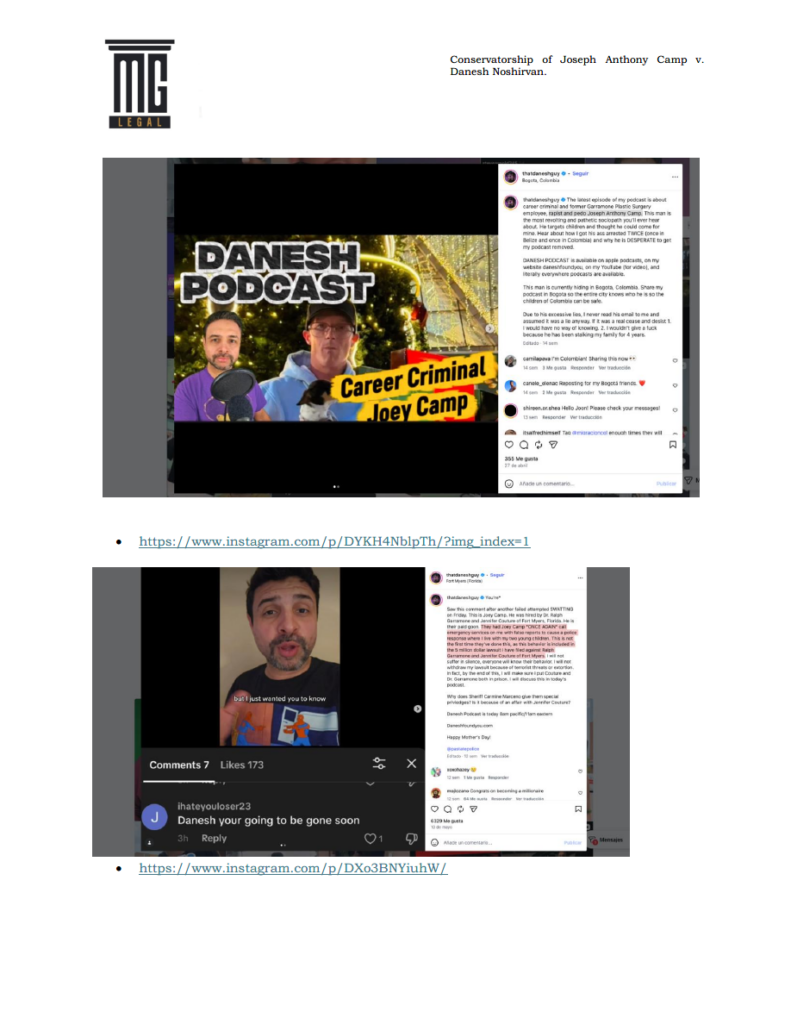
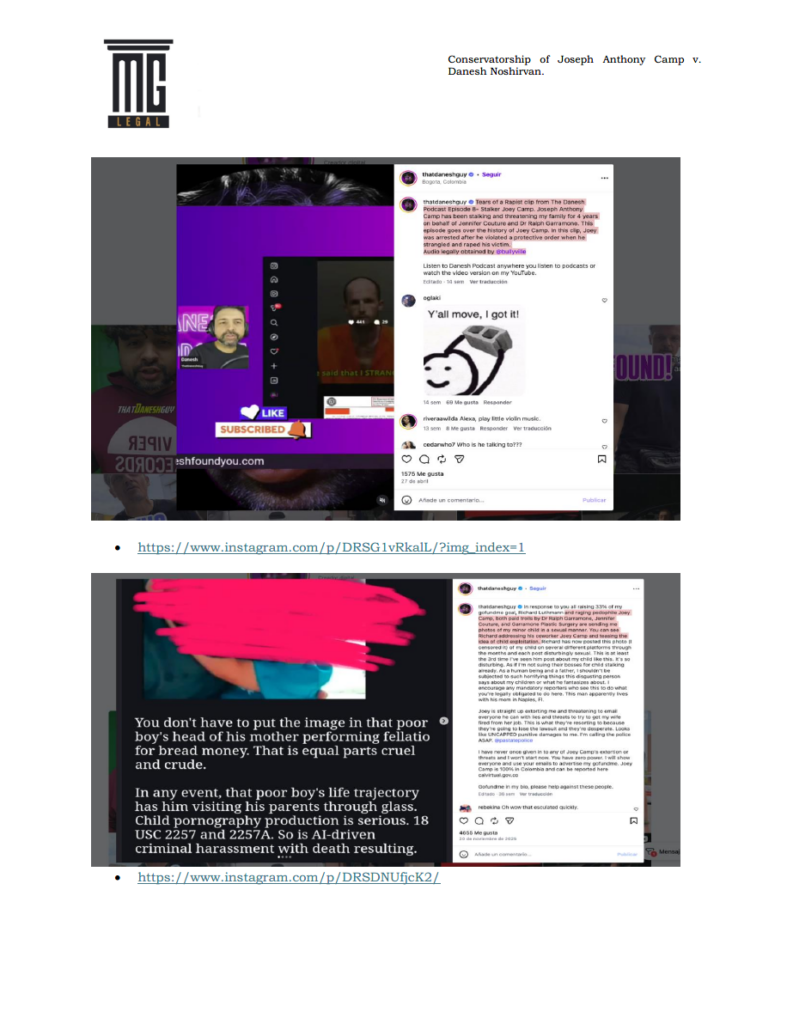
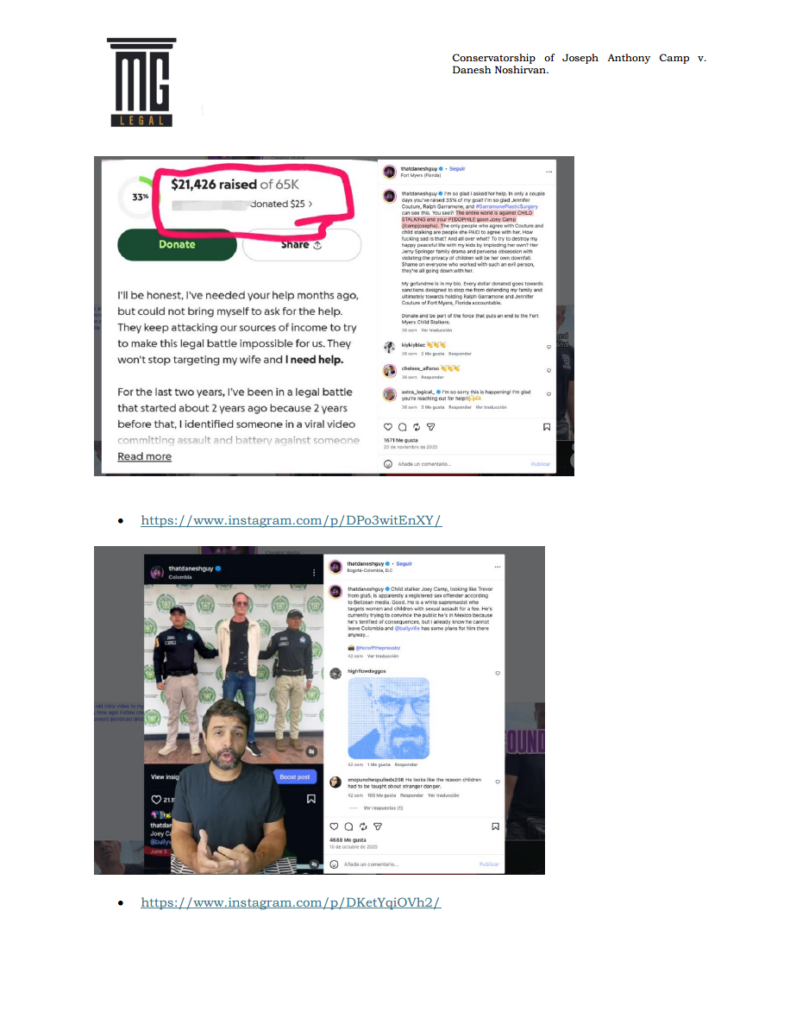
Camp says Danesh, the alleged contemnor, announced the refusal to the judicial authorities themselves. The July emails may independently prove notice, intent, and renewed dissemination, and Noshirvan is allowed to answer.
If Camp’s quoted refusal is genuine, Noshirvan did not leave Bogotá a subtle jurisdictional puzzle. He apparently left the Colombian court a written dare.
Google Receipts Join Bogotá’s Hammer: Chiappetta’s Firewall Springs a Leak
Then there is Nicholas Chiappetta, Noshirvan’s Florida lawyer and increasingly the man assigned to explain the unexplainable. During an August 7 meet-and-confer call, Chiappetta opposed Luthmann’s proposed use of the Colombian judgment.
“Nick told me he didn’t think that Danesh has participated in any proceedings outside of the United States,” Luthmann said. “That’s not true. We got a copy of Danesh’s email to the Colombian judges and filed it with the Fort Myers Federal Court. Can you say BUSTED?”
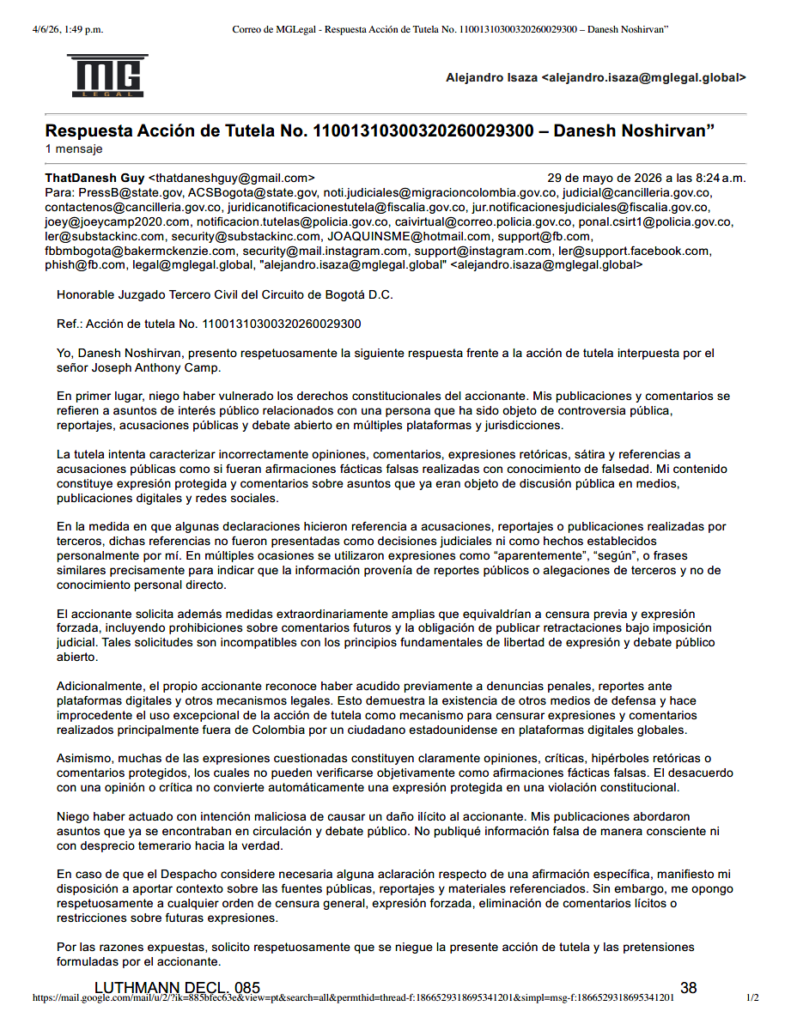
Subject: Response to Tutela Action No. 11001310300320260029300 – Danesh Noshirvan
From: ThatDanesh Guy th***********@***il.com
Date: May 29, 2026, at 8:24 a.m.
To: Pr****@***te.gov, AC*******@***te.gov, no*************@*******************ov.co, ju******@*************ov.co, co*********@*************ov.co, ju**************************@**********ov.co, ju**************************@**********ov.co, jo**@**********20.com, no******************@*********ov.co, ca********@****************ov.co, po**********@*********ov.co, le*@*********nc.com, se******@*********nc.com, JO********@*****il.com, su*****@**.com, fb********@***********ie.com, se******@************am.com, su*****@*******am.com, le*@**************ok.com, ph***@**.com, le***@*****al.global, al*************@*****al.global
Honorable Third Civil Circuit Court of Bogotá, D.C.
Re: Tutela Action No. 11001310300320260029300
I, Danesh Noshirvan, respectfully submit the following response to the tutela action filed by Mr. Joseph Anthony Camp.
First, I deny having violated the petitioner’s constitutional rights. My publications and comments concern matters of public interest involving a person who has been the subject of public controversy, news reports, public accusations, and open debate across multiple platforms and jurisdictions.
The tutela action incorrectly attempts to characterize opinions, commentary, rhetorical expressions, satire, and references to public accusations as though they were false factual statements made with knowledge of their falsity. My content constitutes protected expression and commentary concerning matters that were already the subject of public discussion in the media, digital publications, and social networks.
To the extent that certain statements referred to accusations, reports, or publications made by third parties, those references were not presented as judicial decisions or as facts personally established by me. On multiple occasions, expressions such as “apparently,” “according to,” or similar phrases were used precisely to indicate that the information came from public reports or third-party allegations and not from my direct personal knowledge.
The petitioner also seeks extraordinarily broad relief that would amount to prior restraint and compelled speech, including prohibitions against future commentary and an obligation to publish retractions under judicial compulsion. Such requests are incompatible with the fundamental principles of freedom of expression and open public debate.
Additionally, the petitioner himself acknowledges having previously pursued criminal complaints, reports to digital platforms, and other legal mechanisms. This demonstrates the existence of other available remedies and renders improper the exceptional use of a tutela action as a mechanism to censor expression and commentary made primarily outside Colombia by a United States citizen on global digital platforms.
Moreover, many of the challenged expressions clearly constitute opinions, criticism, rhetorical hyperbole, or protected commentary, none of which can be objectively verified as false factual assertions. Disagreement with an opinion or criticism does not automatically transform protected expression into a constitutional violation.
I deny having acted with malicious intent to cause unlawful harm to the petitioner. My publications addressed matters that were already circulating and being debated publicly. I did not knowingly publish false information or act with reckless disregard for the truth.
If the Court considers clarification concerning any particular statement necessary, I am willing to provide context regarding the public sources, reports, and materials referenced. Nevertheless, I respectfully oppose any order imposing general censorship, compelled speech, removal of lawful commentary, or restrictions upon future expression.
For the foregoing reasons, I respectfully request that the Court deny the tutela action and the relief requested by the petitioner.
Respectfully submitted,
Danesh Noshirvan
“ThatDaneshGuy”
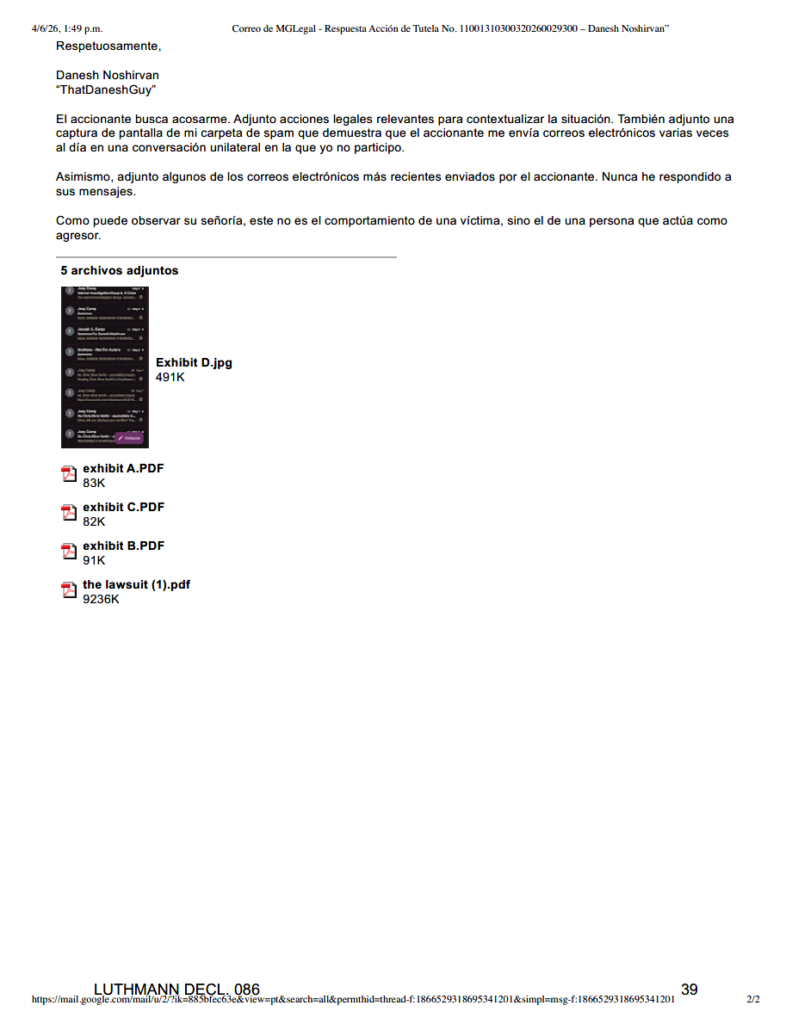
The petitioner seeks to harass me. I am attaching relevant legal actions to provide context for the situation. I am also attaching a screenshot of my spam folder demonstrating that the petitioner sends me emails several times each day in a unilateral conversation in which I do not participate.
I am likewise attaching some of the most recent emails sent by the petitioner. I have never responded to his messages.
As Your Honor can observe, this is not the behavior of a victim, but rather that of a person acting as an aggressor.
Noshirvan’s own May 29 email directly addressed the Third Civil Circuit Court, denied Camp’s allegations, defended his publications as opinion, satire, rhetoric, and third-party reporting, offered additional source material, attached five exhibits, and affirmatively requested that the court deny the tutela.
That was not silence, an email confined to contesting service, or styled as a special appearance. It was a merits submission asking a Colombian judge for victory.
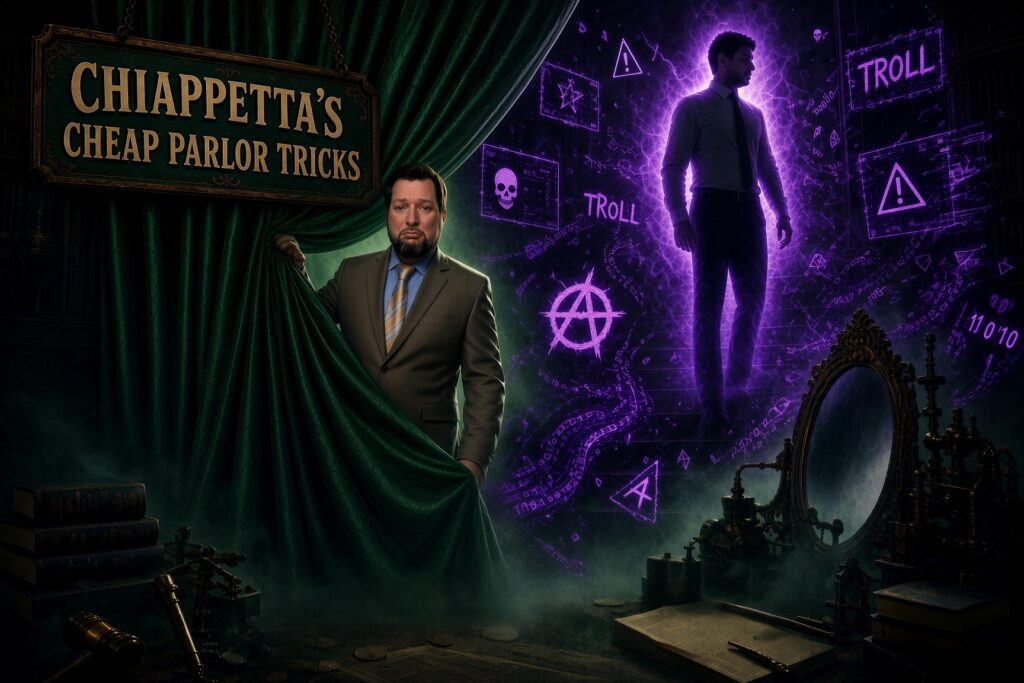
“I have a motion to disqualify Nick Chiappetta already pending with Judge Dudek. But I’m really concerned that he’s a retard. Danesh won at the trial court in Colombia, and celebrated online. He then lost on appeal. Chia Pet must carry around his own green curtain and call it the practice of law,” Luthmann said. “I’m half expecting the Wizard of Nickless to make a settlement offer in Monopoly money.”
Whatever jurisdictional arguments Colombian law may preserve, Chiappetta’s factual assertion that his client had not participated abroad collides head-on with his client’s written appearance. Either Noshirvan failed to tell his lawyer, Chiappetta failed to examine the record, or counsel spoke before securing the facts.

This is not Chiappetta’s first spell with a federal court’s patience and a fleeting relationship with the truth. In a related Noshirvan litigation, the late Judge John E. Steele publicly reprimanded him in August 2025, finding that he acted in bad faith and failed to meet the professional standards expected of an officer of the court in connection with a deposition and its aftermath.
Judge Steele also warned Noshirvan that similar litigation disruption or incitement of harassment could trigger more severe sanctions, including dismissal.
The court later awarded Garramone Plastic Surgery $62,320 in attorney’s fees arising from that sanctions dispute, the same sanction award that Noshirvan used to fundraise on GoFundMe.
Chiappetta is entitled to advocate. He is not entitled to make the documentary record disappear by saying he does not believe it exists.
Google Receipts Join Bogotá’s Hammer: Colombian Contempt Law Has Teeth—and Due Process
Colombian tutela enforcement is not an exotic theatrical device. Articles 27 and 52 of Decree 2591 of 1991 create two related but distinct mechanisms. Compliance proceedings focus objectively on whether the constitutional order has been obeyed and empower the first-instance judge to adopt measures necessary to restore the protected right.
A contempt incident is punitive and coercive: it can result in an arrest of up to six months and a fine of up to 20 times the monthly minimum wage, but only after the court determines subjective responsibility—intentional or negligent disobedience—and affords the accused notice and an opportunity to respond.
If the Danesh’s July statements are authenticated, they supply evidence of knowledge and intent beyond mere nonperformance. Against Meta and Substack, continued accessibility of the identified posts supports objective enforcement, but corporate silence alone does not automatically prove culpable contempt. The court must identify the responsible representative, communicate the incident, consider explanations, and determine whether compliance was possible.
Camp’s motion appropriately asks the court to take those preliminary steps before imposing sanctions.
The first-instance court ordinarily retains enforcement jurisdiction even when the operative order came from an appellate tribunal. That is why the contempt request was returned to Bogotá’s Third Civil Circuit Court. The Colombian Constitutional Court has repeatedly explained that enforcement is mandatory, contempt is incidental, and the two may proceed simultaneously without collapsing into one another.
Noshirvan therefore retains defenses. What he does not possess is a First Amendment force field that automatically nullifies a Colombian judgment within Colombia. American constitutional law may matter enormously if enforcement is sought here later. It does not erase a foreign proceeding he voluntarily entered, litigated on the merits, and asked to win.
Fort Myers Can No Longer Pretend This Is Background Noise
The latest motion in Luthmann v. Noshirvan, No. 2:25-cv-00337-KCD-NPM, asks District Judge Kyle C. Dudek to take limited judicial notice of the Colombian judgment’s existence, parties, procedural history, Noshirvan’s participation, and operative terms; consider its reasoning as persuasive foreign material; and lift a stay that began as a temporary settlement device but has left the case frozen for eleven months. It does not ask Judge Dudek to enforce the Colombian injunction, automatically accept disputed findings as true, or give the judgment collateral-estoppel effect.
Federal Rule of Evidence 201 permits notice that another judicial proceeding occurred, not wholesale adoption of every disputed foreign finding. Rule 44.1 allows a federal judge to consider relevant foreign-law materials, even when those materials would not independently satisfy evidentiary rules. Comity allows consideration without surrendering the federal court’s duty to apply Florida law, the First Amendment, and federal procedure.
The motion also detonates Chiappetta’s preferred fog. Noshirvan’s May 29 submission proves actual notice, voluntary participation, a merits defense, exhibits, and an affirmative demand for relief. Meanwhile, the Google returns connect the branded and personal accounts, and the contempt motion alleges post-judgment defiance.
Together, they make indefinite suspension look less like judicial economy and more like a gift of time to a defendant whose case turns on perishable platform evidence.
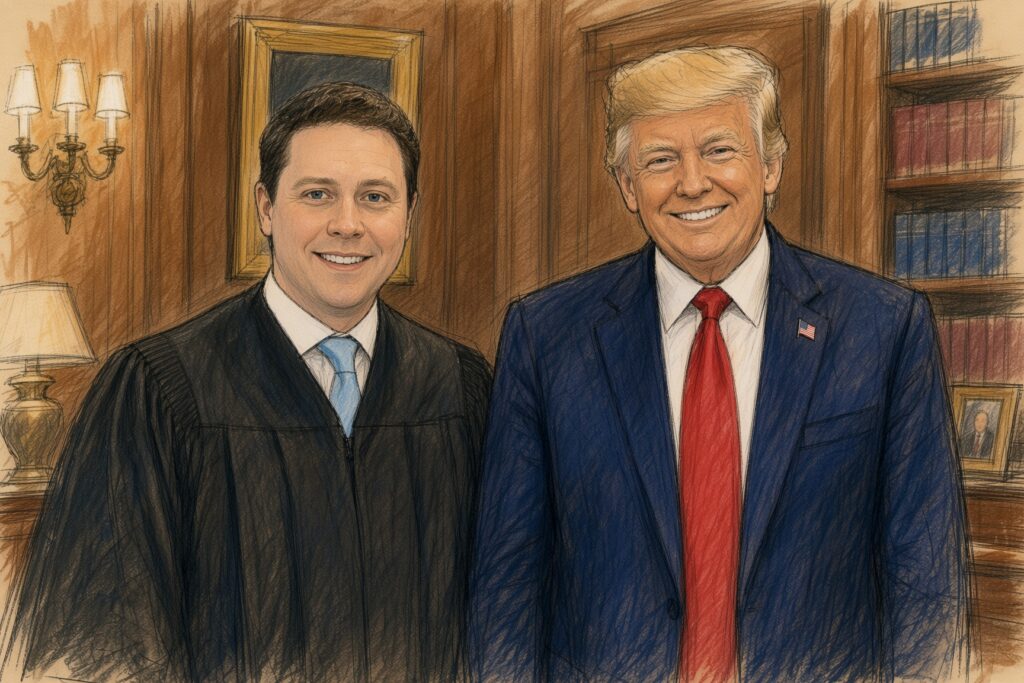
Judge Dudek, nominated by President Donald Trump and commissioned in September 2025, advertises an active case-management philosophy. He inherited matters after Judge Steele’s July 14 death.
Bogotá has ruled, Google has produced receipts, Camp is seeking contempt, and Luthmann is demanding discovery.
The Danesh machine wanted attention. It now has two court systems looking under the hood.
Leave a Reply